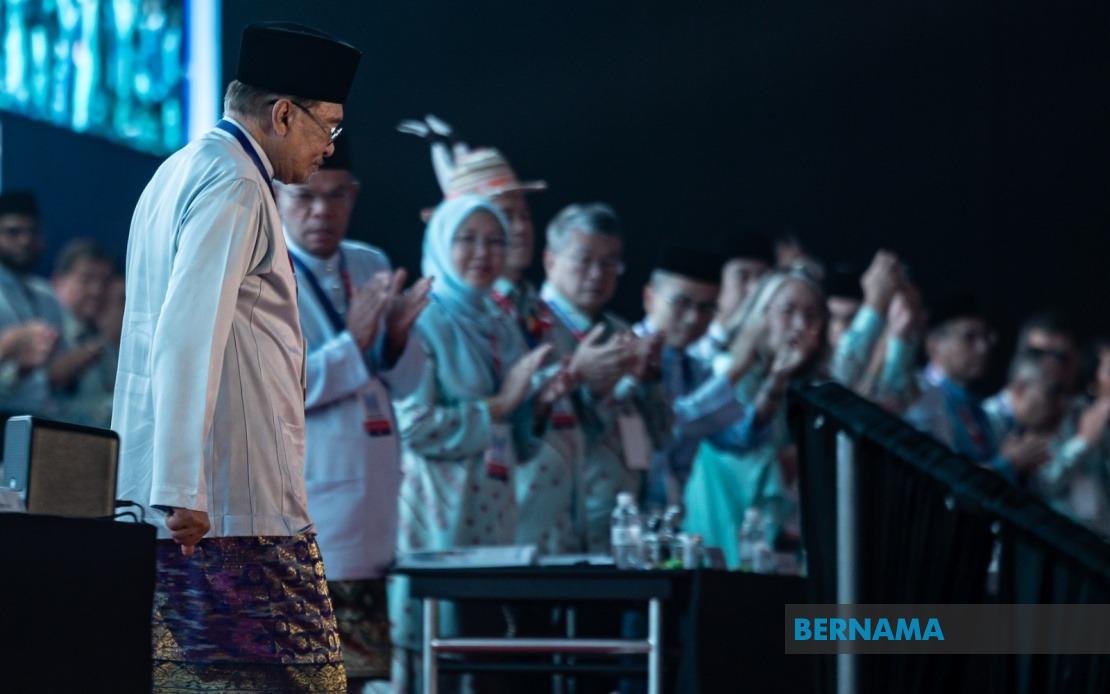
Prime Minister Datuk Seri Anwar Ibrahim has firmly rejected allegations that the MADANI Government treats some states as second-tier entities, countering a narrative that has gained traction in certain political quarters. Speaking at the 2026 PKR National Congress held at the Melaka International Trade Centre in Ayer Keroh on August 15, Anwar presented detailed budget figures as evidence that his administration has substantially boosted federal transfers to regions across the country. The timing of these remarks underscores growing sensitivity within the government to perceptions of regional imbalance, particularly as the nation navigates complex intergovernmental fiscal relationships and state-level political dynamics.
The Prime Minister's defence hinges on a comprehensive reframing of how federal allocations should be measured and interpreted. Rather than treating all states identically, Anwar argued that funding levels appropriately reflect differing development priorities and infrastructure requirements across Malaysia's diverse geography. This distinction matters significantly for understanding the government's budgetary philosophy and how it justifies resource distribution across the federation. By emphasising differentiation based on need rather than political considerations, the administration attempts to position itself as rational allocators rather than partisan distributors of national wealth.
Sabah exemplifies the centerpiece of Anwar's argument. The state's federal expenditure has surged by 35 per cent during the three years of MADANI governance, climbing from RM13 billion in 2022 to RM17.6 billion in 2026. This trajectory represents a substantial infusion of resources into Malaysia's largest state by geographical area, which faces distinct development challenges including infrastructure gaps and relative economic disadvantage compared to more industrialised regions. Anwar pointedly noted that Sabah's previous state government never raised allocation concerns during earlier administrations, implying that criticism now carries partisan motivations rather than genuine grievance grounded in fiscal neglect.
Sarawak, the federation's other East Malaysian anchor, has experienced even more dramatic growth. The allocation jumped from RM10.2 billion in 2022 to RM15.1 billion in 2026, representing a 48 per cent increase. This exceeds Sabah's proportional growth and signals the government's commitment to resource parity across the two historically marginalised eastern states. For Sarawak, where federal funding directly influences state government capacity and political stability, such increases carry strategic weight beyond mere numerical representation. They reflect acknowledgement of East Malaysia's pivotal position within federal architecture and the political necessity of demonstrating tangible benefit to constituencies that might otherwise feel alienated from peninsular-dominated governance.
The peninsula's states have not been neglected in this allocation expansion, though Anwar's framing emphasises that growth reflects changing circumstances rather than consistent generosity. Johor presents a particularly telling case, with allocations climbing from RM10.2 billion in 2022 to RM14.6 billion in 2026. This expansion appears especially significant given Johor's relatively developed economic status and larger tax base compared to less industrialised states, suggesting that even prosperous regions have received enhanced federal support. The inclusion of Johor in Anwar's catalogue of increased allocations signals an attempt to demonstrate broad-based growth rather than targeted regional preferences.
Terengganu and Perlis, historically among Malaysia's less wealthy states, have also witnessed meaningful increases. Terengganu's allocation expanded from RM6 billion in 2022 to RM8.1 billion in 2026, providing additional capacity for state development initiatives and administrative functions. Perlis similarly benefited from this overall expansion, though Anwar provided no specific figures for the smaller northern state. The inclusion of these states in the Prime Minister's enumeration reflects their symbolic importance in demonstrating comprehensive coverage rather than selective treatment, addressing potential grievances that might otherwise fester in smaller constituencies with fewer political voices.
Kedah and Kelantan round out Anwar's catalogue of increasing allocations, though again without specific numerical detail. Both states carry significant political implications: Kedah as a traditionally competitive battleground, and Kelantan as a PAS-controlled enclave within the federal framework. The mention of allocation increases to these states without quantitative specificity may reflect either genuine increases or rhetorical efforts to project impression of fairness despite possible complexity in actual distribution patterns. The lack of granular figures invites scrutiny from those inclined to investigate deeper, yet serves the immediate political purpose of casting a broad net of beneficiaries.
The broader context underlying this allocation discussion involves fundamental questions about federal-state fiscal relationships in Malaysia. The federation's constitutional structure allocates revenue sources asymmetrically, with the federal government controlling most tax instruments while states depend substantially on federal transfers. This creates inherent political tensions, as state governments continuously lobby for larger shares of national resources. When certain state leaders or opposition figures claim their states are sidelined, they invoke both legitimate development concerns and political strategy designed to pressure the federal government into higher transfers or to mobilise voter sentiment around grievance narratives.
Anwar's statistical approach attempts to depoliticise resource allocation by anchoring discussion in concrete figures demonstrating aggregate growth. However, this strategy contains potential vulnerabilities. Without context regarding population growth, inflation, or comparative per-capita allocations, raw numbers alone tell incomplete stories. A state that receives increased nominal allocations but lags in per-capita terms, or that faces rising development costs exceeding allocation increases, might legitimately argue that enhanced funding merely maintains existing relative disadvantage. The Prime Minister's framing necessarily simplifies complex fiscal realities to serve political communication objectives.
The 2026 PKR National Congress setting itself carries significance as the venue for these remarks. PKR, as the dominant coalition partner in the current federal government and Anwar's power base, requires internal solidarity and morale maintenance. Using a major party gathering to articulate and defend government fiscal policy serves multiple audiences simultaneously: the PKR faithful receive reassurance that their party's leadership champions equitable distribution, potential critics receive direct engagement with contrary evidence, and the broader public observes a government confident enough to publicly defend its spending choices through detailed specification rather than vague reassurances.
Moving forward, the sustainability of these allocation increases depends on Malaysia's broader fiscal trajectory. Federal revenues face pressures from global economic conditions, demographic shifts, and structural changes in the economy. Should Malaysia encounter fiscal constraints requiring budget discipline, the question of allocation priorities between states will resurface with renewed intensity. States accustomed to growing resources may resist plateaus or reductions, creating political friction regardless of the governing coalition's stated commitment to equitable development. The figures Anwar cited for 2026 represent projections rather than executed budgets, introducing uncertainty about actual delivery of promised allocations.
The allegations of state sidelining that prompted Anwar's response reflect broader patterns of regional anxiety within Malaysian federalism. East Malaysian states continue to harbour historical grievances about marginalisation and resource scarcity, while peninsular states compete for federal attention and funding. Opposition-controlled states, regardless of geography, maintain institutional incentives to criticise federal allocations and demand higher transfers. The MADANI Government's challenge involves satisfying these diverse and sometimes contradictory demands while maintaining fiscal discipline and equitable treatment across the federation. Statistical ripostes like those delivered at the PKR Congress offer one tool for managing these perceptions, but ultimately depend on demonstrable development outcomes and genuine improvement in state-level service provision to validate claims of fairness and commitment.

