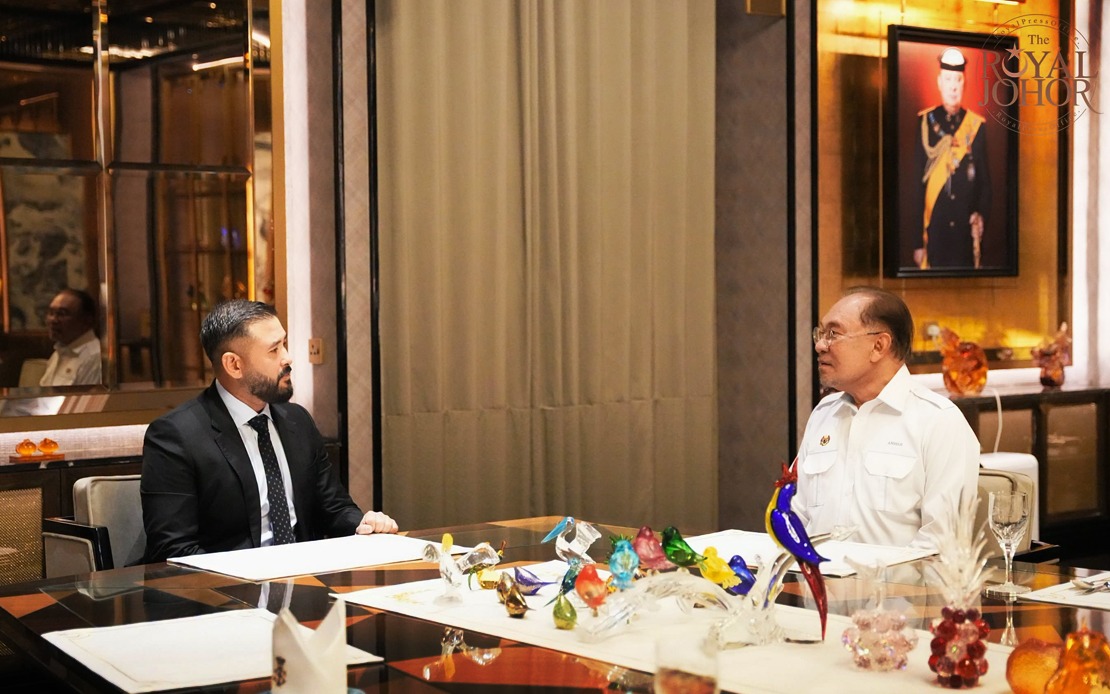
Prime Minister Datuk Seri Anwar Ibrahim on Saturday expressed his appreciation for the Johor Regent Tunku Mahkota Ismail's willingness to grant him an audience, characterising the meeting as a demonstration that political discourse need not depend on invoking royal connections. Speaking at the Padang Bukit Gambir Extreme Park in Tangkak during the announcement of Pakatan Harapan candidates for the 16th Johor state election, Anwar framed the private meeting as a rebuke to what he termed petty campaign tactics, arguing that those who resort to weaponising the monarchy's name lack the substance to engage in genuine political competition.
The Prime Minister's remarks carried a pointed message to his rivals, suggesting that opposition voices attempting to invoke the Sultan's authority while shrinking from substantive political debate expose the weakness of their position. By accepting the Regent's invitation, Anwar demonstrated that high-level engagement with the royal institution remains possible without publicly parading such interactions for electoral advantage. His tone suggested frustration with a particular style of political messaging that relies on claims of royal backing without transparent acknowledgment or authorisation.
During his conversation with Tunku Mahkota Ismail, Anwar seized the opportunity to brief the Regent on federal development projects his government has initiated in Johor. This approach reflects a broader strategy of the Pakatan Harapan administration to strengthen direct channels with state-level institutions, bypassing intermediaries and demonstrating concrete progress in implementing infrastructure and social programmes. The decision to highlight this work during the state election campaign sends a signal that the federal government's relationship with Johor remains constructive, regardless of electoral contests.
Anwar took the occasion to articulate what he characterised as Pakatan Harapan's governing philosophy regarding relations with Malaysia's constitutional monarchy. He emphasised that his coalition respects the prerogatives of the Malay Rulers, actively seeks their counsel, and welcomes their input even when disagreements emerge. This framing positions the government as fundamentally deferential to royal authority while simultaneously asserting its own policy independence—a delicate balance that requires constant engagement and communication rather than public gestures or ceremonial distance.
The Prime Minister detailed his personal approach to interactions with various sultans, noting that exchanges of views are normal and that divergences of opinion do not signal breakdown in relationships. He referenced his engagement with His Majesty Sultan Ibrahim, the King of Malaysia, emphasising that even when the government offers counter-perspectives to royal suggestions, the process remains rooted in mutual respect and a willingness to hear concerns. This framework allows Anwar to defend government policies without appearing dismissive of the monarchy's voice in national affairs.
Packatan Harapan's leadership delegation, which included DAP secretary-general Anthony Loke Siew Fook and Amanah president Datuk Seri Mohamad Sabu, listened as Anwar outlined the coalition's commitment to consulting with sultans, accepting their reprimands when warranted, and maintaining the institutional relationships that undergird Malaysia's constitutional framework. This messaging is critical for Pakatan Harapan in Johor, where the state monarchy commands deep respect and where perceptions of disrespect towards the institution could damage the coalition's standing among Malay-Muslim voters.
The timing of Anwar's comments reflects the heightened sensitivity surrounding the relationship between the federal government and Johor's palace. Recent political dynamics have seen various factions attempt to position themselves as closer to or more protective of royal interests, making Anwar's explicit statements about consulting with Tunku Mahkota Ismail and the Sultan particularly significant. By anchoring his remarks in concrete examples of engagement and dialogue, the Prime Minister undercuts claims that his administration is distant from or dismissive of royal perspectives.
For Malaysian voters, particularly in Johor, Anwar's emphasis on proper institutional protocols carries practical weight. The Prime Minister is essentially promising that Pakatan Harapan, if elected to lead the state, will govern in consultation with the Regent and Sultan rather than in opposition to them. This reassurance matters in a state where the monarchy's symbolic and constitutional importance is deeply embedded in political culture and where the Sultan remains an active participant in governance decisions.
Anwar's criticism of opponents who invoke royal authority without transparency or authorisation points to a pattern of campaign tactics that he views as corrosive to proper governance standards. By drawing attention to the contrast between his open meeting with the Regent and implicit claims of royal backing made by others, the Prime Minister attempts to establish himself as the candidate of institutional legitimacy. This argument presumes that voters will appreciate straightforward engagement with established protocols rather than shadowy appeals to undisclosed royal sympathies.
The broader context for these remarks includes ongoing questions about the federal government's autonomy in policymaking and the extent to which it consults state-level authorities on matters affecting their jurisdictions. Anwar's articulation of a consultative model that respects royal prerogatives while protecting government discretion addresses concerns that have periodically surfaced in Malaysian political discourse. His approach suggests that respect for the monarchy need not translate into paralysis in governance or abdication of federal responsibility.
For Southeast Asian observers, Anwar's framing of the relationship between democratic government and constitutional monarchy offers a model of how these institutions can coexist and interact. Rather than viewing royal engagement as threatening parliamentary sovereignty, Anwar presents it as a normal feature of mature democratic governance. This perspective resonates with how other Commonwealth nations have navigated similar dynamics, though the Malaysian context carries distinct historical and cultural dimensions that shape expectations and protocols.
Looking ahead to the Johor state election, Anwar's cultivation of visible engagement with the Regent positions Pakatan Harapan to counter narratives suggesting that the coalition is indifferent to or disrespectful of royal authority. By framing his meeting with Tunku Mahkota Ismail as responsive to a gesture of friendship, Anwar transforms what could have been a private courtesy into a public statement about institutional relationships and political legitimacy. This approach reflects his understanding that securing a mandate in Johor requires not only policy achievements but also credible commitment to respecting the state's constitutional traditions.