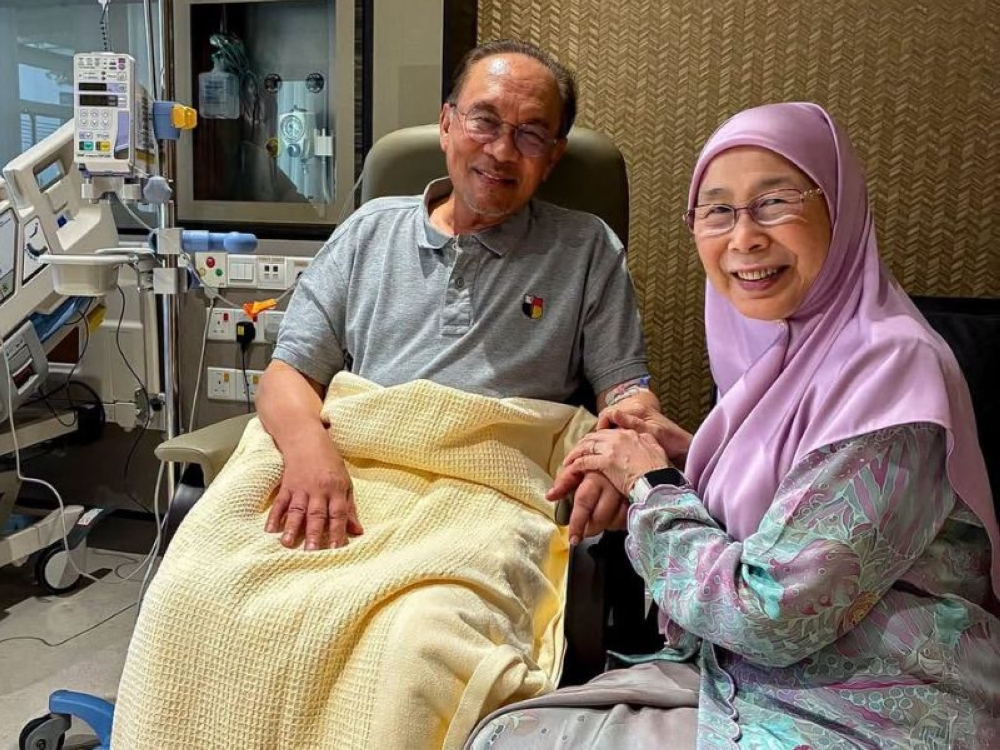
Prime Minister Datuk Seri Anwar Ibrahim is set to be released from hospital today following a planned surgical procedure to address a hernia condition, his wife Datin Seri Dr. Wan Azizah Wan Ismail confirmed on Tuesday. The medical intervention, performed at a private healthcare facility in Kuala Lumpur, proceeded without complications, and the Premier's recovery trajectory has met clinical expectations, paving the way for his imminent discharge.
The Prime Minister underwent the elective procedure on Monday as part of routine health management. Such surgical interventions are relatively commonplace among individuals of advancing age and typically involve straightforward repair techniques when undertaken under controlled hospital conditions. The decision to proceed with the operation was made following consultation with his medical team, reflecting a proactive approach to maintaining optimal health whilst managing governmental responsibilities.
For the Malaysian political landscape, the timing of the Prime Minister's recuperation arrives at a particularly significant juncture. The administration continues navigating complex policy challenges spanning economic restructuring, reform initiatives, and regional diplomatic engagements. The brief interruption to the Premier's schedule underscores the importance of institutional continuity and the delegation protocols established within the executive branch to ensure governance remains uninterrupted during periods when the principal executive requires medical attention.
The public disclosure of the procedure itself represents a considered approach to governmental transparency. Malaysian precedent has generally favoured candid communication regarding the health of senior public figures, recognising that citizen awareness of leadership fitness contributes to public confidence in state institutions. This transparency stands in contrast to some regional and international practices where health matters of top officials remain deliberately opaque, potentially fostering speculation and undermining institutional credibility.
Datin Seri Dr. Wan Azizah's confirmation of her husband's anticipated discharge demonstrates the integration of personal and public spheres characteristic of Malaysian political culture. As both a spouse and a significant political figure in her own right—having served as Member of Parliament and in various governmental capacities—her communication to media outlets carries particular weight in conveying official information whilst maintaining the human dimension of political leadership.
The constitutional framework governing Malaysia provides for the temporary assumption of executive functions by designated officials during periods of incapacity affecting the Prime Minister. Though the duration of anticipated recovery from hernia surgery typically spans days to a few weeks depending on procedural complexity and individual health factors, the existence of such constitutional safeguards reflects institutional design considerations built into the system of governance. These mechanisms ensure that administrative continuity is maintained whilst allowing senior leadership to receive necessary medical care without compromising governmental function.
For international observers and regional partners, the routine nature of the Prime Minister's hospitalisation and projected swift recovery offer reassurance regarding leadership stability in Malaysia. The Southeast Asian region maintains considerable geopolitical importance, with Malaysia occupying a significant position in regional economic networks and diplomatic arrangements. Clarity regarding the health status and continued active engagement of national leadership thus carries implications extending beyond domestic boundaries.
The hernia procedure itself reflects broader patterns in contemporary healthcare provision in Malaysia, where access to advanced surgical interventions across both private and public systems enables timely treatment of conditions that might previously have required overseas medical care. The capacity of domestic medical institutions to address such conditions represents a maturing healthcare infrastructure comparable to advanced economies, and has implications for medical tourism and regional health sector development.
Looking forward, the Prime Minister's expected return to active governmental duties later this week will permit resumption of scheduled meetings, parliamentary obligations, and policy deliberations that require his direct participation. The administrative machinery has presumably continued functioning during his absence under established delegation protocols, yet the restoration of full executive engagement typically accelerates decision-making processes and reaffirms continuity in policy direction and strategic initiatives.
The incident also illustrates the reality that even senior political figures remain subject to biological imperatives and health challenges inherent to human existence. This acknowledgment serves an important function within democratic societies, humanising leadership whilst simultaneously demonstrating that institutional frameworks possess sufficient robustness to accommodate temporary individual limitations without institutional collapse or governance dysfunction.

