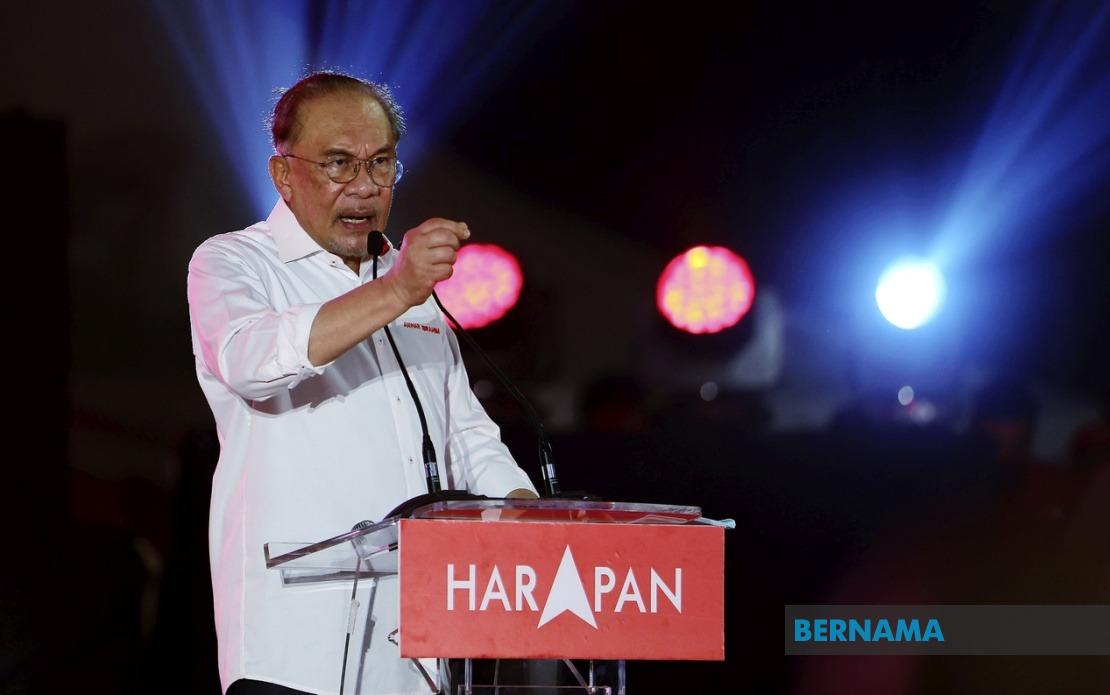
Prime Minister Datuk Seri Anwar Ibrahim has issued a pointed reminder to all participants in the forthcoming 16th Negeri Sembilan State Election to exercise restraint when discussing matters touching on royal institutions and the Federal Constitution. Speaking at the Pakatan Harapan candidate announcement ceremony in Kuala Pilah on July 14, the PH chairman stressed that while political competition represents a legitimate feature of democratic governance, it must be conducted with integrity and without resorting to inflammatory rhetoric or tactics that fragment community cohesion.
The emphasis on institutional respect reflects broader concerns about campaign conduct in Malaysian electoral politics. Anwar's intervention suggests that party strategists have identified potential vulnerabilities in the state contest where sensitive constitutional questions might be weaponised for electoral advantage. His carefully calibrated language—distinguishing between legitimate political disagreement and irresponsible incitement—draws a line that competing campaigns will need to navigate carefully during the election period. The warning carries particular weight given Anwar's position as both national leader and PH chairman, signalling that breaches of this informal code could face consequences at the federal level.
The Prime Minister articulated a vision of democratic practice that accommodates vigorous political debate whilst preserving institutional stability. He acknowledged that competing viewpoints and contestation form natural elements of electoral democracy, but insisted that parties must refrain from slander and actions designed to exploit communal divisions. This formulation attempts to separate substantive policy disagreements—which he implicitly encourages—from attacks on foundational institutions that transcend party politics. For Malaysian voters accustomed to seeing sensitive institutional matters invoked in campaigns, Anwar's statement represents an attempt to establish higher standards of political discourse.
Central to Anwar's message was the characterisation of clean leadership and institutional integrity as prerequisites for Negeri Sembilan's development trajectory. He framed the election as a choice between candidates committed to transparent governance and those willing to exploit divisive issues for narrow advantage. This positioning allows PH to claim the moral high ground whilst simultaneously restricting opposition parties' rhetorical options. By establishing institutional respect as a non-negotiable campaign principle before the formal campaign intensifies, Anwar has created a framework through which subsequent campaign statements can be evaluated and potentially criticised.
The announcement of PH's 36-candidate slate at the event showcased a deliberate blend of experienced figures and newcomers drawn from the coalition's three component parties: PKR, DAP, and Amanah. The inclusion of sitting Menteri Besar Datuk Seri Aminuddin Harun for the Linggi seat signals PH's confidence in his record and continuity, whilst DAP secretary-general Anthony Loke's candidacy for Chennah demonstrates the coalition's determination to expand into competitive areas. This balanced approach to candidate selection reflects the electoral mathematics of Malaysian state politics, where maintaining coalition unity whilst projecting forward momentum requires careful calibration of who represents the partnership.
Anwar's public endorsement of Aminuddin's leadership as cooperative and effective represents a significant statement about PH's governance model in states where it holds power. By explicitly praising the Menteri Besar's collaborative approach with the federal government, Anwar reinforces the narrative that PH-controlled administrations function as integrated parts of a cohesive national project rather than competing power centres. This messaging matters for Negeri Sembilan voters evaluating whether a PH state government can deliver benefits flowing from its federal counterpart's resources and policy levers. The framing also subtly suggests that divided government—where the state opposition wins—would interrupt this virtuous cycle of federal-state cooperation.
The presence at the ceremony of senior coalition figures including DAP secretary-general Anthony Loke, Amanah president Datuk Seri Mohamad Sabu, and PH Communications Director Datuk Seri Fahmi Fadzil underscored the coalition's unified positioning on the election's importance. These individuals collectively represent PH's communications machinery and strategic direction, and their attendance signalled that party leadership regards the Negeri Sembilan contest as sufficiently significant to warrant high-level engagement. For observers tracking coalition stability and internal dynamics, the visible unity of these figures provided reassurance that constituent parties remain aligned on campaign priorities despite occasional tensions that have marked recent PH history.
Anwar's exhortation for the PH machinery to work intensively towards delivering development and meaningful change reflected the coalition's strategy of emphasising material benefits and governance competence rather than identity or institutional politics. This emphasis on tangible outcomes—development projects, service improvements, economic opportunities—positions PH as a performance-oriented coalition capable of translating votes into concrete advantages for ordinary Negeri Sembilan residents. The message implicitly contrasts this results-focused approach with opposition strategies that might rely on stoking institutional anxieties or constitutional grievances.
The warning against exploiting constitutional and royal institution issues also carries implications for how Malaysian politics manages federalism and centre-state relations. By establishing that these matters should remain largely off-limits in state electoral contests, Anwar attempts to prevent escalation of tensions that could complicate governance if state governments lack legitimacy derived from clean campaign practices. For Southeast Asia's larger democracies watching Malaysian electoral conduct, this intervention suggests ongoing efforts to maintain institutional boundaries even as competitive pressures in democratic politics intensify. The success or failure of this normative claim will shape how future campaigns address sensitive constitutional questions.
Looking forward, the Negeri Sembilan election will test whether Anwar's appeal for responsible political conduct influences actual campaign behaviour. Opposition parties now face the implicit choice of either respecting this framework—limiting their rhetorical options—or explicitly rejecting Anwar's constraints and potentially facing accusations of institutional irresponsibility. This dynamic itself represents a form of soft power in Malaysian politics, where setting campaign norms can shape competitive advantage. The state contest will reveal whether PH's governing majority position translates into sufficient cultural authority to establish standards that opposition parties feel compelled to acknowledge, even if they ultimately disregard them in pursuit of electoral victory.

