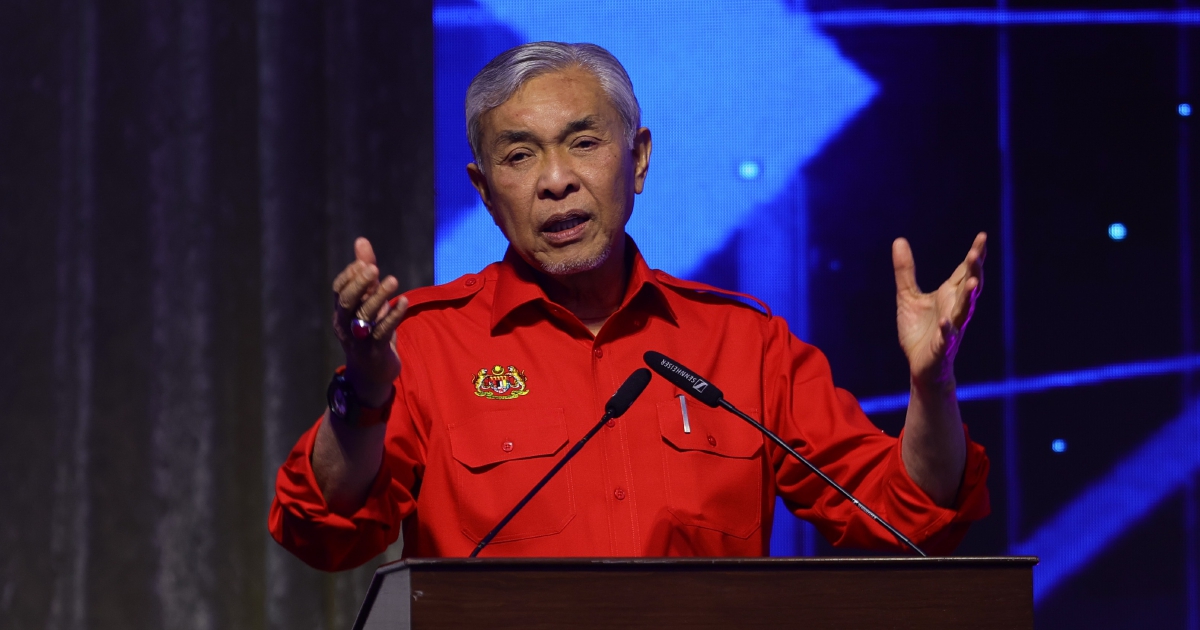
Barisan Nasional chairman Datuk Seri Dr Ahmad Zahid Hamidi has made clear that Prime Minister Datuk Seri Anwar Ibrahim holds the prerogative to dismiss ministers from the coalition if dissatisfied with their track record, signalling a pragmatic stance on ministerial accountability within the ruling government structure.
The statement, delivered in Seremban, underscores the established constitutional framework governing cabinet appointments in Malaysia, where the Prime Minister exercises executive authority over ministerial personnel. By publicly acknowledging this reality, Zahid appears to be reinforcing that coalition partners do not have immunity from performance-based removals, despite their participation in the government.
This pronouncement carries particular significance in the context of Malaysia's complex political landscape, where coalition stability often hinges on delicate power-sharing arrangements. Zahid's candid remarks suggest that while Barisan Nasional retains ministerial positions within the federal cabinet, these appointments remain contingent upon satisfactory performance standards set by the Prime Minister's office. The implicit message is one of meritocratic governance rather than entitlement-based representation.
For Anwar's administration, such assurances from the BN chairman represent important political cover should ministerial changes become necessary. In Malaysian politics, reshuffles can trigger sensitivities within coalition partners who may view them as slights against their party. By having senior coalition figures pre-emptively validate the PM's authority, potential future controversies may be mitigated before they escalate into full-blown political crises.
The statement also reflects the evolving nature of the current government, which operates as a broad coalition spanning multiple political ideologies and party interests. Since Anwar assumed office, maintaining cohesion across diverse coalition partners has required careful balancing of competing demands. Zahid's comments suggest a willingness from the BN leadership to subordinate narrow party interests to broader governmental functioning, at least publicly.
Historically, Malaysian coalitions have experienced fractures when smaller partners perceived that they were being sidelined or subjected to unfair treatment. By explicitly endorsing the PM's right to evaluate and potentially replace underperforming ministers, Zahid is attempting to establish performance as the legitimate criterion for retention, rather than allowing grievances to accumulate unchecked. This potentially deflates future accusations that removals were politically motivated rather than merit-based.
The comments also underscore growing expectations for ministerial excellence across Malaysia's political establishment. Public accountability for government ministers has become increasingly prominent, with citizens and media scrutinising competence and delivery more rigorously than in previous administrations. Zahid's stance aligns with this broader trend toward performance-based governance, though implementation remains inconsistent across different ministries and sectors.
Within the BN coalition, such statements may carry internal significance as well. Zahid's remarks effectively communicate to coalition members that continuous engagement with ministerial duties is non-negotiable, and that complacency or underperformance will not be tolerated indefinitely. This is particularly relevant for Umno members holding cabinet positions, as it establishes clear expectations for their tenure regardless of their party standing.
The broader implication extends to government stability in Malaysia. By reinforcing that the PM retains ultimate authority over cabinet composition, Zahid helps establish predictability in the system. Rather than uncertainty about whether coalition partnerships shield ministers from accountability, the BN chairman's statement clarifies that such protection does not exist. This transparency potentially reduces future tensions by establishing unambiguous ground rules.
For Southeast Asian observers, Malaysia's approach to coalition governance offers insights into how diverse political forces navigate shared power. Unlike systems where coalition partners have contractual guarantees over ministerial appointments, Malaysia's model preserves the PM's authority while relying on political consensus-building to prevent heavy-handed removals. Zahid's comments reinforce this balance—acknowledging the PM's prerogative while implicitly appealing to responsible exercise of that power.
Looking forward, Zahid's remarks may influence how future ministerial performance disputes are handled. Ministers aware that poor performance provides legitimate grounds for dismissal may recalibrate their priorities and work patterns accordingly. Similarly, the PM gains clearer political cover for making difficult personnel decisions, secure in the knowledge that senior coalition partners have publicly validated such actions.
The statement ultimately reflects pragmatic political realism. Zahid recognises that in a coalition government, pretending that the PM lacks authority over ministers would be both constitutionally inaccurate and politically counterproductive. By candidly acknowledging this reality, he simultaneously demonstrates BN's confidence in its ministerial representatives' abilities and its willingness to accept accountability standards applied to all cabinet members regardless of party affiliation.

