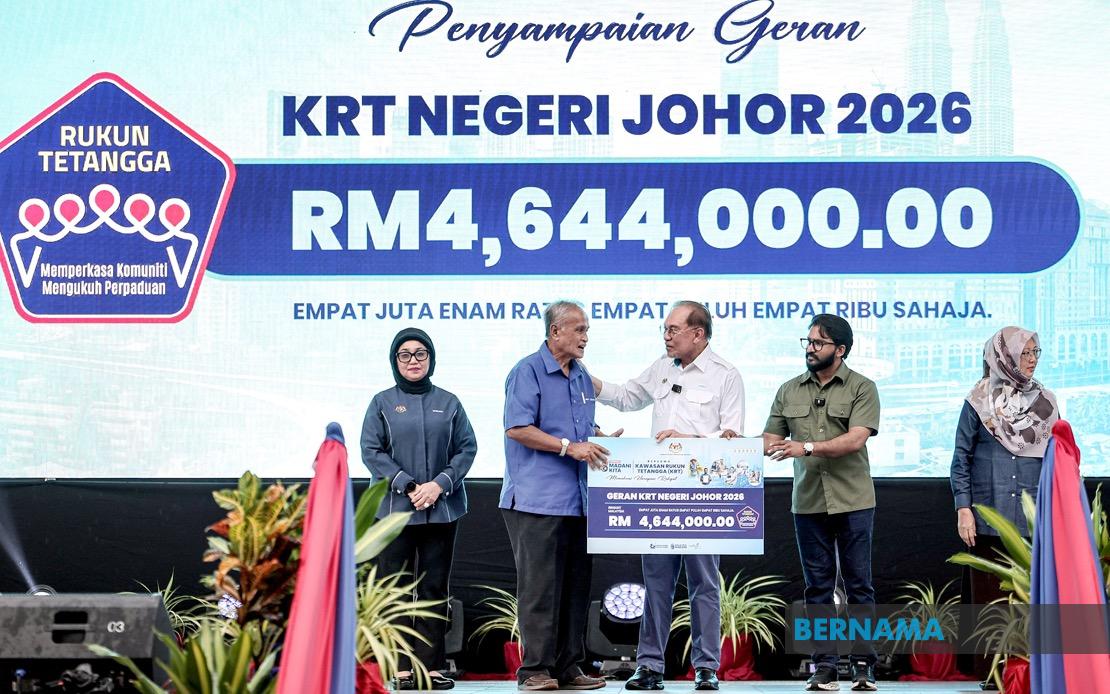
The Malaysian government has endorsed a significant increase in funding for Neighbourhood Watch Areas across the country, lifting the annual grant to RM10,000 from its current RM6,000 level. Prime Minister Datuk Seri Anwar Ibrahim made the announcement during the MADANI KITA Programme with KRTs at Dataran Segamat, declaring that the new payment structure will commence on January 1, 2027. The decision follows a decade-long freeze on grant amounts, prompting the government to reassess the financial support given to these community-based organisations that operate at the frontline of national governance.
Anwar emphasised that the grant adjustment reflects recognition of the critical contributions KRTs make to resolving challenges at the grassroots level. Over the past ten years, while inflation and cost pressures mounted, the RM6,000 allocation remained static, creating a widening gap between funding and operational requirements. The Prime Minister framed the increase as validation of the sector's importance to national stability and development, particularly given how KRTs facilitate coordination between security agencies, government departments, and local communities on matters ranging from public safety to welfare initiatives.
The timing of this announcement carries particular significance for Malaysia's broader governance agenda. By substantially boosting funding for KRTs, the government signals commitment to decentralising problem-solving and empowering community-level institutions that embody the principles of transparency and participatory democracy. These voluntary associations have historically served as informal but effective channels through which residents bring concerns to authorities and collectively address neighbourhood issues. The additional RM4,000 per organisation annually represents a 67 percent increase that should meaningfully enhance their capacity to conduct activities, maintain facilities, and expand their outreach.
Anwar articulated a philosophical framework underpinning the decision, stressing that Malaysia's foundational strength derives from its success in maintaining social cohesion across racial and religious lines since independence. He cautioned against allowing cultural and religious differences to become instruments of division, instead positioning diversity as a competitive advantage that distinguishes the nation regionally and globally. This framing positions KRTs as institutions crucial to preserving that harmony, as they operate within diverse neighbourhoods where residents of different backgrounds interact daily and where potential friction points require active management and consensus-building.
The grant increase carries implications for how local governance functions across Malaysia's urban and suburban landscapes. KRTs typically operate with minimal resources, relying heavily on volunteer labour and goodwill. The enhanced allocation allows them to move beyond survival-mode operations toward more proactive programming, whether that involves organising community dialogues, conducting safety audits, coordinating with local authorities on infrastructure concerns, or sponsoring neighbourhood events that strengthen social bonds. For residents, particularly in areas where formal municipal services remain stretched, KRTs effectively serve as additional governance infrastructure.
Beyond the KRT funding announcement, Anwar also unveiled complementary investments in Johor that underscore the government's multi-pronged approach to grassroots strengthening. The immediate allocation of RM3.205 million targets infrastructure improvements at Islamic educational institutions including madrasahs, tahfiz centres, and religious study facilities across districts such as Batu Pahat, Muar, and Segamat. This investment reflects recognition that educational infrastructure directly influences learning quality and student welfare, particularly in faith-based settings where facilities often operate under resource constraints. By prioritising repairs and upgrades at these institutions, the government addresses a sector frequently overlooked in mainstream infrastructure planning.
A separate RM1.0 million allocation designated for urgent maintenance work at Royal Malaysian Police quarters in Johor addresses the welfare dimension of security personnel. The government framed this investment as essential to maintaining operational morale and effectiveness among officers responsible for safeguarding national peace. This parallel spending reveals a coordinated strategy where grassroots security institutions, educational foundations serving religious communities, and neighbourhood-level watch organisations all receive enhanced support. Together, these measures construct a more robust ecosystem of local institutions capable of addressing diverse community needs.
The announcement gained official prominence through the attendance of Deputy Minister of National Unity R. Yuneswaran and Deputy Minister of Domestic Trade and Cost of Living Datuk Dr Fuziah Salleh, signalling whole-of-government coordination on the initiative. This cross-ministerial participation emphasises that KRT funding increases fall within a broader portfolio touching on social cohesion, economic resilience, and cost-of-living concerns. The presence of commerce-focused ministry representation alongside unity portfolios suggests the government views KRTs as relevant to both social stability and economic wellbeing at community level.
For Malaysian readers and regional observers, the KRT funding adjustment offers several interpretative angles. Domestically, it demonstrates government responsiveness to local institution advocacy and acknowledgment that decade-old budget allocations no longer reflect operational reality. Regionally, it showcases how Malaysia attempts to strengthen grassroots democratic participation through financial rather than merely structural reforms. The increase also provides a case study in how governments can enhance soft governance capacity without introducing new legislation, simply by reallocating resources to existing community structures with proven track records.
The decision to disburse increased grants beginning January 2027 allows sufficient time for budgetary planning and communication to the roughly 200,000-plus KRT members nationwide. The implementation timeline suggests governmental confidence in the policy's importance enough to commit several fiscal cycles in advance. Furthermore, the sequential approach, starting the programme in early 2027 rather than immediately, signals that the funding increase represents firm policy rather than temporary political gesture, though it also provides a window for any necessary administrative adjustments before disbursement commences.
For neighbourhood residents and KRT volunteers, the RM4,000 additional annual funding translates into enhanced activity budgets, better-maintained community spaces, and potentially more structured programmes addressing contemporary challenges from cybersecurity awareness to elderly care coordination. Rural and semi-urban KRTs, typically operating with even more constrained resources than their urban counterparts, stand to benefit substantially from proportional increases in available funds. The announcement thus carries particular relevance for Malaysia's less densely populated regions where community institutions fill governance gaps that formal municipal structures cannot entirely cover.