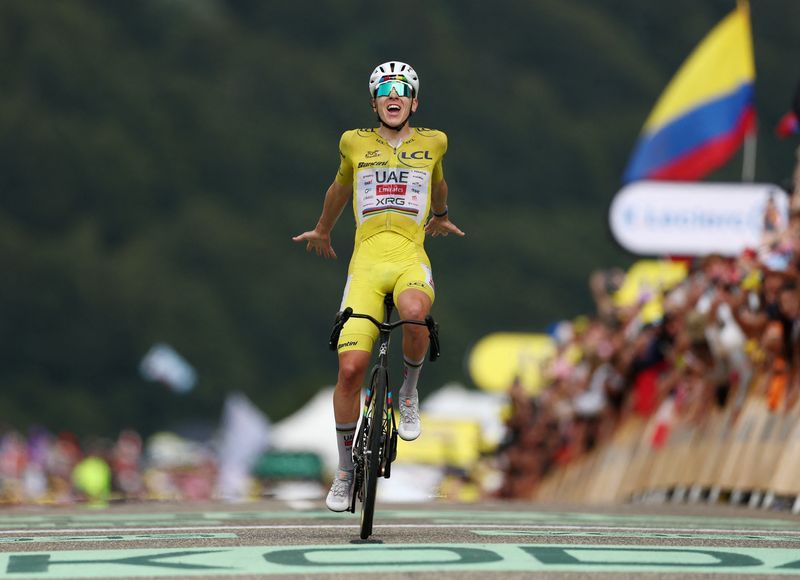
Tadej Pogacar cemented his dominance in this year's Tour de France on Saturday with a powerful solo victory on stage 14, further distancing himself from his closest rivals in pursuit of an unprecedented third consecutive title. The four-time champion launched a devastating attack on the steepest gradients of the Col du Haag climb, ultimately crossing the finish line at Le Markstein Fellering with a commanding margin that underscores his current superiority over the field.
The 155.3-kilometre stage from Mulhouse tested the peloton with a relentless mountain profile, featuring three category-one climbs and treacherous descent conditions as rain swept across the eastern French Alps. These challenging elements were intended to shake up the general classification standings, yet they served primarily to highlight Pogacar's exceptional climbing ability and tactical acumen. His UAE Team Emirates-XRG squad controlled the race with precision throughout the day, positioning their leader perfectly for the decisive moments.
Pogacar's winning margin of 38 seconds over his second-place teammate Isaac del Toro—himself a respected climber—speaks to the Slovak rider's current form. The gap between him and Jonas Vingegaard, his primary challenger, now stretches to four minutes and 30 seconds, a substantial advantage with several mountain stages still remaining. This buffer represents a significant psychological blow to Vingegaard, who finished fourth on the stage, trailing not only Pogacar but also del Toro and French rider Paul Seixas, a local favourite who garnered enthusiastic crowd support.
The stage unfolded with the familiar patterns of high-mountain Tours, where breakaway attempts punctuated the early kilometres. Frenchman Valentin Paret-Peintre of Soudal Quick-Step crested the Grand Ballon, the opening major climb, with nearly a two-minute advantage over the main peloton. Behind him, Richard Carapaz and four others established a determined breakaway group that nearly succeeded in staying clear through the intermediate climbs. However, poor road conditions during the descent from Col du Page—where rain created slippery surfaces—forced intense concentration and tactical adjustments that ultimately favoured the stronger GC contenders.
The drama intensified as the race approached its decisive phase. Carapaz and EF Education–EasyPost teammate Ben Healy briefly lost contact at the foot of Ballon d'Alsace, though they managed to rejoin the leaders through determined efforts. By the time riders began the final category-one climb to Col du Haag, Pogacar's domestiques had whittled the breakaway's advantage to just 80 seconds, setting the stage for the Slovenian's trademark aggressive move. The early attack from Carapaz and Tobias Johannessen briefly troubled the GC group, but the peloton, powered by Pogacar's teammates, absorbed these efforts with calculated precision.
Pogacar's decisive move came with approximately 2.5 kilometres remaining on the 11.2-kilometre ascent, precisely when the gradient ramped to 16 percent. Rather than respond defensively, the 27-year-old accelerated with a burst of power that immediately created separation. By the summit, he had accumulated a 30-second buffer, which he extended during the technically demanding final five kilometres to the finish. This pattern—controlled pressure followed by explosive acceleration at the critical moment—has become his signature this Tour, reflecting both physical superiority and tactical maturity.
Del Toro's second-place finish represented a strong performance for the young Colombian rider, who has impressed throughout this edition with his consistency at altitude. His victory on stage two demonstrated climbing credentials, while his ability to stay with Pogacar on the steepest gradients suggests he may become a genuine domestique turned contender in future Tours. Seixas's inclusion on the podium delighted spectators in his native France, providing a narrative thread beyond the dominant story of Pogacar's supremacy that would otherwise consume coverage.
The current standings reflect a two-tier separation among the general classification protagonists. Pogacar's four-minute 30-second margin over Vingegaard is significant enough to suggest the title race may already be effectively decided, barring a catastrophic mechanical failure or illness. Del Toro's rise to fourth overall underscores the depth of Pogacar's team advantage, a factor that proves increasingly decisive as the race enters its final mountain stages where coordinated team tactics can neutralize individual brilliance.
Looking forward, Pogacar acknowledged that Sunday's 15th stage, running from Champagnole to Plateau de Solaison, presents a different character of challenge, with its extended mountain profile potentially suiting sustained attacks rather than short, explosive climbs. His statement that he expects "a hard day for us, but we will be ready to fight" reflects appropriate respect for the remaining terrain while simultaneously demonstrating his confidence in current form. The coming days will reveal whether rival teams can manufacture opportunities through attrition or tactical coordination, though Pogacar's performance on stage 14 suggests such efforts face increasingly steep odds.
For Southeast Asian cycling enthusiasts following the Tour, Pogacar's dominant tour raises questions about team structure and resource allocation in professional cycling. His UAE Team Emirates-XRG squad's ability to position him perfectly through mountains mirrors the financial and organizational advantages that define contemporary professional sport globally. The performance also underscores the evolution of cycling tactics, where individual talent increasingly depends on coordinated team support, a dynamic familiar to observers of other major international sporting competitions.

