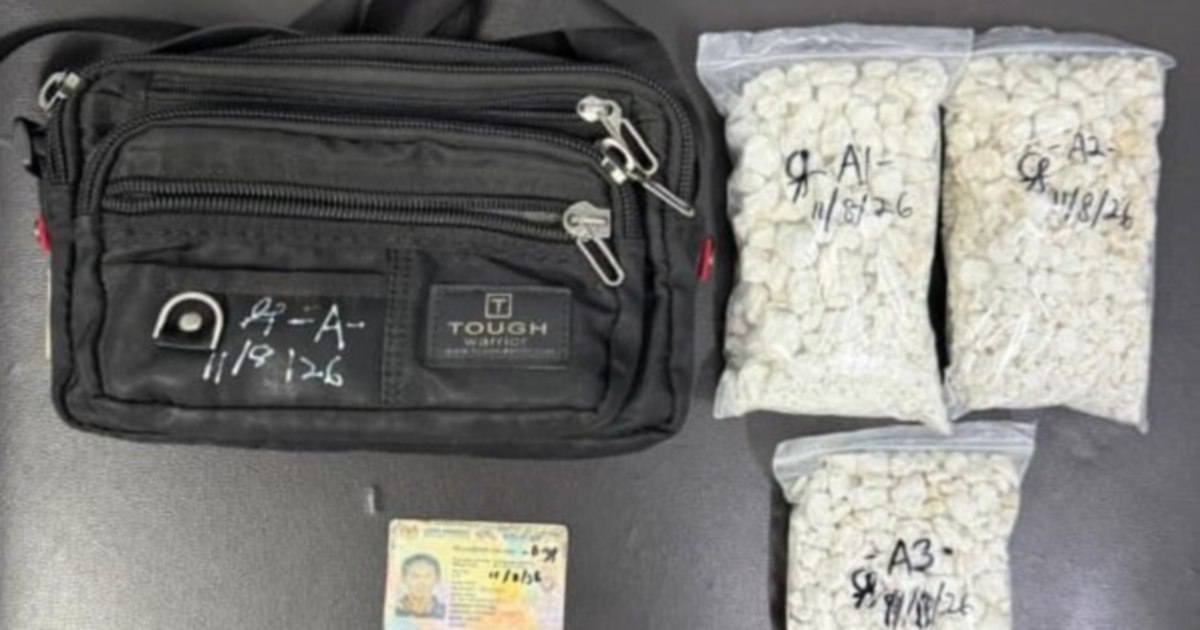
Police in Johor have made a significant drug seizure following an early morning narcotics enforcement operation in Simpang Renggam, with officers recovering 1.055kg of heroin and detaining a 42-year-old suspect. The contraband, estimated to have a street value of RM10,128, was uncovered during the targeted raid conducted in the district near Kluang. The operation underscores the ongoing efforts by local law enforcement to intercept the supply of hard narcotics in residential areas across the region.
Drug trafficking remains a persistent challenge in Johor, one of Malaysia's largest states by population and a crucial transit point along the country's southern corridor. The seizure adds to an increasing body of evidence suggesting that organised drug networks continue to operate with sophistication across urban and semi-urban centres. Simpang Renggam, located strategically between Kluang and Yong Peng, sits along major transportation routes that connect Johor's interior to distribution hubs, making the area a focal point for law enforcement surveillance.
The quantity recovered in this particular operation represents a substantial street-level haul rather than a manufacturing or major trafficking interception. At 1.055 kilograms, the heroin seized could support multiple retail transactions or supply a significant number of end-users over an extended period. The valuation of RM10,128 suggests the drugs were destined for street-level distribution, where such quantities typically command premium prices compared to wholesale rates paid by distributors acquiring larger volumes directly from production sources.
The 42-year-old detainee now faces investigation under the Dangerous Drugs Act, Malaysia's primary legislation governing narcotic offences. Depending on whether charges are pursued under Section 39A (trafficking) or Section 15 (possession for personal use), the suspect could face considerably different penalties. Trafficking convictions carry mandatory minimum sentences of five years imprisonment and six strokes of the cane, with maximum sentences extending to 20 years and 12 strokes. The distinction between personal use and trafficking hinges on the quantity involved and surrounding circumstances, though the volume recovered in this case typically suggests trafficking intent.
Police operations targeting heroin distribution networks have become increasingly coordinated across state lines, reflecting the transnational nature of the supply chain. Heroin flowing into Malaysia often originates from production regions in Southeast Asia, particularly the Golden Triangle area spanning Myanmar, Laos, and Thailand. Once processed and packaged, the drug transits through Cambodia and Thailand into Malaysia via established border crossing points, where it is then distributed through networks operating in major cities and secondary towns like Kluang and surrounding districts.
The early morning timing of the raid reflects operational best practices employed by narcotics units, as dawn operations typically catch suspects off-guard and prevent the destruction of evidence or the alerting of larger networks. Intelligence gathering and surveillance preceding such raids often extends over weeks or months, allowing authorities to establish patterns of movement and identify key nodes within distribution structures. The success of this particular operation suggests that tip-offs or community reporting may have contributed to the operational planning.
Simpang Renggam's vulnerability to drug trafficking activity connects to broader patterns of narcotics distribution across Johor. The state's position as Malaysia's second-largest by area and its extensive road network linking it to Singapore in the south and Selangor in the north creates inherent challenges for border enforcement and inter-district drug suppression efforts. Communities in smaller towns along transport corridors frequently experience collateral social impact from drug trafficking, including associated petty crime and addiction issues among vulnerable populations.
The confiscation of such quantities contributes incrementally to national drug suppression statistics, though policy analysts note that street-level seizures alone do not address upstream supply issues. Disrupting production and major trafficking organisations requires international cooperation with neighbouring countries and law enforcement agencies operating across Southeast Asia's porous borders. Malaysia has established bilateral agreements and multilateral frameworks through ASEAN to coordinate drug enforcement, though implementation challenges persist given resource constraints and varying enforcement priorities across partner nations.
Looking forward, this arrest presents investigators with opportunities to map wider distribution networks and identify supply chains feeding the local market. Interrogation of the detainee may reveal information about his suppliers, customers, and operational methods, potentially triggering further enforcement action against higher-level traffickers. Police have indicated that investigations remain ongoing, suggesting that officers believe the apprehension may yield intelligence extending beyond this single transaction.
For residents in Johor's secondary towns and the broader Southeast Asian region grappling with endemic drug problems, such enforcement successes offer modest reassurance of police commitment to combating narcotics. However, sustained reductions in availability and pricing at street level require sustained pressure across the entire supply chain, from border interdiction through major distribution hubs to retail street-level networks. The Simpang Renggam operation exemplifies the local enforcement component of this multifaceted approach.

