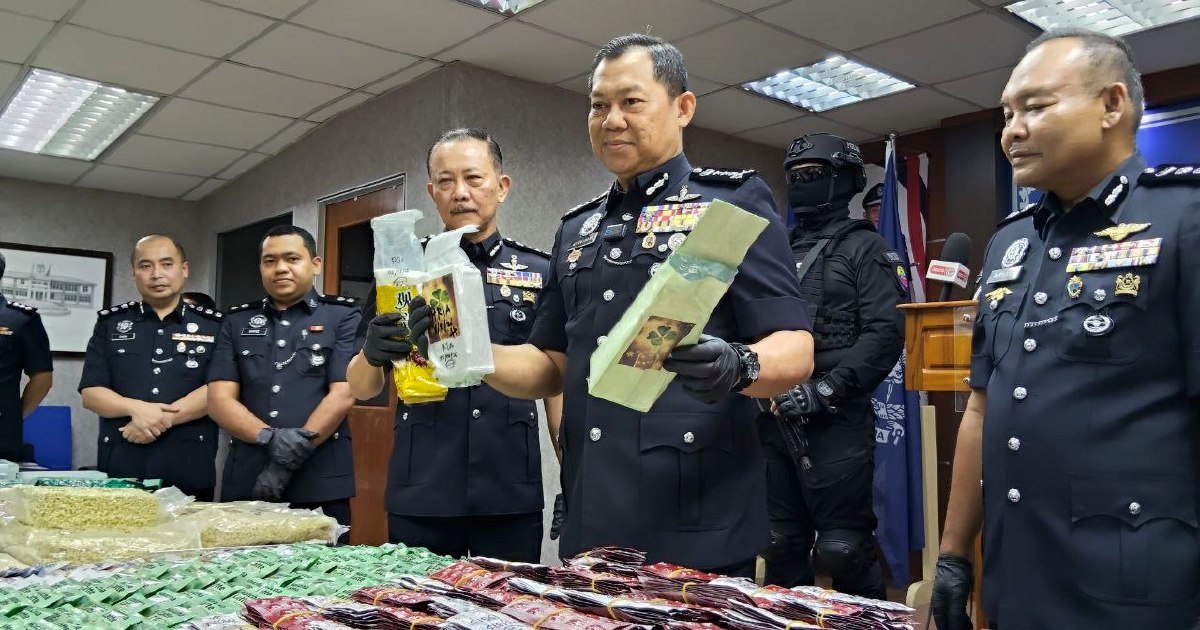
Authorities in Johor Baru have successfully dismantled a significant drug trafficking operation following a major raid on a residential unit in Persiaran Senibong, Masai. The enforcement action resulted in the seizure of 96.76 kilograms of assorted narcotic substances estimated to have a street value of RM8.49 million, making this one of the more substantial drug interdictions in the state's recent enforcement history. The apartment, located in what police described as a residential neighbourhood, had apparently been appropriated by the syndicate specifically to function as a distribution and storage centre for their illegal operations.
The investigation that led to this breakthrough appears to have been methodical and intelligence-driven, reflecting the increasing sophistication of law enforcement approaches to combating organised drug crime in Johor. Police conducted the operation with two individuals taken into custody at the scene. While details regarding the specific roles of these suspects within the syndicate's hierarchy remain to be fully disclosed, their apprehension marks a significant development in what investigators likely view as a broader network of distribution channels operating across the state and potentially into other parts of Peninsular Malaysia.
The scale of this seizure underscores the enduring challenge of drug trafficking in the Johor region, particularly given its strategic geography as a transit point for narcotics destined for markets throughout Southeast Asia and beyond. The apartment's location in Masai, situated within the broader Johor Baru metropolitan area, suggests that traffickers continue to exploit urban residential spaces to conduct their illegal activities. Such use of private apartments as clandestine storage facilities represents an adaptation by criminal organisations to law enforcement pressure, as these locations offer greater anonymity compared to traditional warehouse facilities that have historically attracted greater police attention.
The composition of the seized drug cache, though not entirely specified in preliminary reports, typically reflects the diversified inventory maintained by mid-level distribution syndicates operating in Malaysia. Such operations generally stock multiple drug categories to serve different customer segments and retail networks, each carrying different profit margins and demand profiles. The variety within this single seizure suggests the syndicate was serving a substantial downstream network of street-level dealers and user communities across Johor.
This enforcement outcome demonstrates the continued commitment of Johor police to dismantle organised drug trafficking networks operating within their jurisdiction. The successful identification and raid on this particular distribution hub represents the convergence of intelligence gathering, investigative groundwork, and tactical execution. Such operations typically involve surveillance of suspected locations, monitoring of financial transactions, and cooperation between various enforcement agencies at federal and state levels. The relatively swift transition from intelligence assessment to operational execution suggests the police had built sufficient confidence in their intelligence before initiating the raid.
For Malaysian drug enforcement authorities more broadly, such seizures serve multiple strategic purposes beyond the immediate disruption of criminal operations. They provide valuable forensic evidence, intelligence on syndicate organisational structures, and insights into trafficking methodologies and preferred storage locations. The arrested individuals will likely face interrogation designed to establish the full scope of the distribution network, identify upstream suppliers, and map downstream retail operations. This intelligence cascading effect frequently leads to subsequent enforcement actions against other nodes within the criminal ecosystem.
The valuation of the seized narcotics at RM8.49 million reflects current street-level pricing in Malaysia, though actual wholesale costs to the distribution syndicate would have been considerably lower. This margin represents the economic incentive that drives the drug trafficking industry despite the substantial legal risks involved. Understanding these profit dynamics is crucial for policymakers seeking to develop enforcement strategies that address the economic roots of drug trafficking rather than merely targeting individual operations.
From a regional perspective, Johor's role as a transit point and distribution hub for narcotics trafficking remains a concern for law enforcement agencies throughout Southeast Asia. The state's proximity to Singapore, another major drug market with high street prices that incentivise smuggling, creates additional pressure on enforcement resources. Cooperation between Malaysian and Singaporean authorities has become increasingly important in interdicting trafficking flows, and such intelligence-sharing arrangements likely contributed to this particular operation's success.
The arrest of two individuals in connection with this operation raises questions about the broader structure of the distribution syndicate. Trafficking organisations of this sophistication typically operate on a cell basis, with compartmentalised responsibilities designed to limit the damage if individual members are apprehended. The two suspects arrested may represent only the warehouse or distribution logistics component of a larger network, with senior traffickers and upstream suppliers potentially remaining unidentified at this stage. Police investigations will likely focus on extracting maximum intelligence from these suspects regarding their contacts, operational methods, and financial structures.
The continued emergence of such large-scale seizures reflects both the persistence of drug trafficking networks and the effectiveness of law enforcement intelligence and operational capabilities. However, the volume of narcotics flowing through Malaysian drug markets remains substantial, and enforcement actions, while important for public safety and crime suppression, represent interventions within an ongoing struggle between trafficking organisations and state authorities. The Masai apartment seizure thus constitutes an important tactical success, yet the broader challenge of reducing drug availability and preventing the emergence of successor syndicates remains an ongoing concern for policy and enforcement communities throughout Malaysia.

