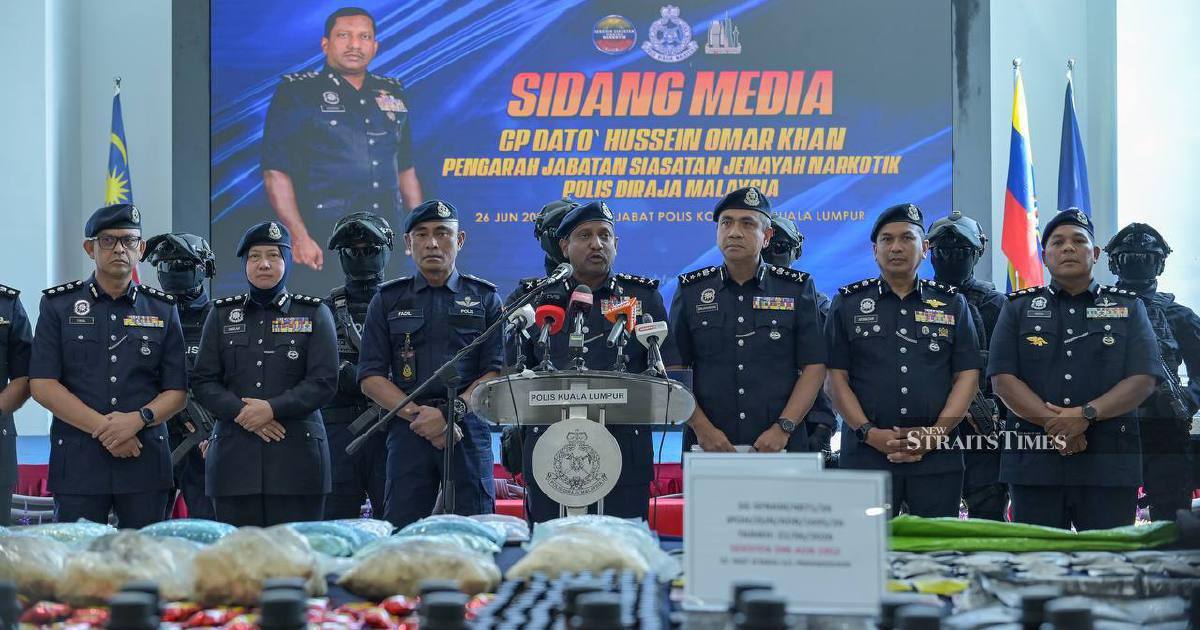
Police have successfully thwarted what authorities describe as a major attempt to flood the local market with illicit drugs, culminating in the largest haul in recent operations. The breakthrough came on June 20 when specialist narcotics units conducted three synchronized raids across Cheras, a densely populated district in Kuala Lumpur that has historically served as a focal point for drug-related criminal activity. The coordinated enforcement action resulted in the confiscation of controlled substances valued at approximately RM135.63 million and the detention of seven individuals suspected of being central players in the trafficking network.
This operation represents a significant milestone in Malaysia's ongoing battle against drug trafficking, which continues to pose one of the most persistent threats to public health and social stability across the nation. The scale of the seizure underscores the sophisticated nature of modern drug distribution networks operating within urban centers, where traffickers leverage established transportation routes and market infrastructure to move large quantities of narcotics. Cheras, with its strategic location and proximity to major highways and commercial zones, has attracted criminal enterprises seeking to position themselves at critical junctures of supply chains serving the broader Klang Valley region.
The timing and execution of the June 20 operations suggest that police intelligence units had been conducting sustained surveillance of the suspected trafficking group. The decision to initiate simultaneous raids at multiple locations indicates careful coordination aimed at preventing suspects from alerting associates or destroying evidence. Such tactical precision has become increasingly important as drug syndicates employ more advanced counter-surveillance methods and compartmentalize their operations to minimize exposure to law enforcement. The ability to strike multiple targets in quick succession represents a considerable operational achievement that disrupts not only the immediate supply chain but also the trust networks these criminal organizations depend upon.
The apprehension of seven individuals provides authorities with critical leads for further investigation into the broader architecture of the trafficking network. Drug enforcement agencies typically conduct extended interrogations following large seizures to identify upstream suppliers, downstream distribution points, and the financial mechanisms through which proceeds are laundered. Each arrest creates potential opportunities for plea bargains or cooperation agreements that can unwind larger criminal enterprises, making the human dimension of these operations as valuable as the physical seizure of contraband. The seven detainees will likely face serious charges under Malaysia's stringent drug trafficking legislation, which carries severe penalties including lengthy prison sentences and, in trafficking cases involving large quantities, the potential for capital punishment.
The RM135.63 million valuation reflects the street-level retail value of the confiscated drugs, a figure that demonstrates the enormous profit margins driving international and domestic trafficking operations. Drug syndicates can acquire bulk quantities at a fraction of this cost in source countries or through regional wholesale networks, then distribute through tiered dealers to maximize returns. The calculation of seizure values helps policymakers and law enforcement understand the scale of economic activity driven by illicit drug trade—money that typically flows back through money laundering networks into legitimate business sectors or funds further criminal enterprises. For Malaysian authorities, quantifying seizures in monetary terms also allows for meaningful comparison with regional operations and demonstrates measurable impact in combating transnational organized crime.
Cheras has emerged as a particular focus for narcotics enforcement in recent years due to the concentration of trafficking activity and the complexity of dismantling operations embedded within residential and commercial mixed-use areas. The district's diverse economic makeup, with numerous small businesses, wholesale centers, and rental properties, creates operational challenges for law enforcement seeking to identify and monitor suspicious activities. Traffickers exploit this environment by blending illicit operations with legitimate commercial activity, making detection more difficult for routine patrols. The June 20 operation demonstrates that sustained intelligence gathering and intelligence-led policing can overcome these environmental challenges.
The successful outcome also reflects strengthened inter-agency coordination within Malaysia's law enforcement structure. Drug enforcement operations of this magnitude typically require cooperation between the Royal Malaysia Police narcotics division, Customs authorities, and intelligence agencies sharing real-time information about suspected trafficking movements. Enhanced intelligence sharing protocols established over recent years have improved the ability of Malaysian agencies to identify and track large-scale operations before they can successfully distribute narcotics to end consumers. This collaborative framework extends to international partnerships with regional law enforcement bodies that exchange information about trafficking routes and known operatives moving across Southeast Asian borders.
From a public health perspective, prevention of successful market flooding is crucial for limiting new drug addiction and associated social harms. Each kilogram of narcotics prevented from reaching street-level distribution represents potential reductions in overdose incidents, drug-related crime, and the social costs of addiction treatment. Malaysia's drug treatment infrastructure, already strained by existing addiction caseloads, benefits from enforcement operations that reduce the total number of new users entering the system. The economic savings from prevented addiction extend across healthcare systems, criminal justice resources, and lost productivity in the workforce.
The June 20 operations also send an important message to trafficking organizations that Malaysia maintains serious enforcement capacity and will pursue sophisticated investigation and enforcement against large-scale operations. International drug syndicates constantly assess the risk-reward calculus of operating in specific jurisdictions based on enforcement intensity, corruption vulnerabilities, and market demand. A high-profile seizure followed by successful prosecution of major traffickers can meaningfully affect these calculations, potentially redirecting trafficking routes toward perceived safer markets or increasing distribution costs through elevated compensation required to offset increased legal risks.
Looking forward, the evidentiary material gathered from this operation will feed into broader law enforcement efforts targeting trafficking networks. Seized communications, financial records, and intelligence provided by cooperating witnesses can illuminate the structure of larger criminal organizations and identify additional targets for investigation. The success of the June 20 operation therefore extends well beyond the immediate confiscations and arrests, potentially catalyzing additional enforcement actions against the dismantled network's suppliers and distributors throughout Malaysia and neighboring countries.

