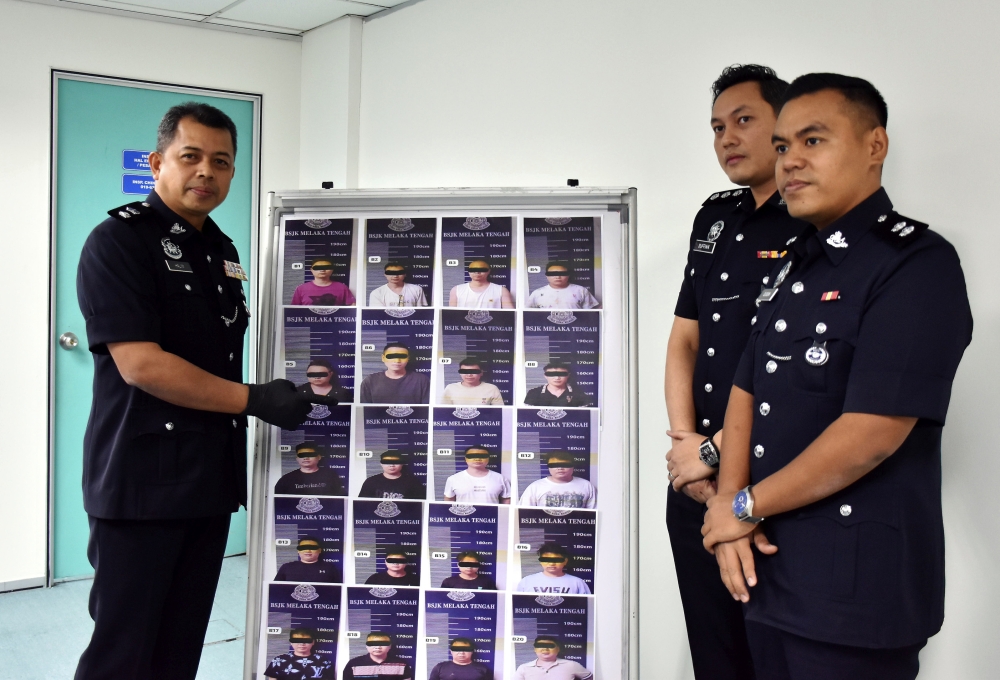
Law enforcement authorities in Melaka have dismantled what investigators describe as a coordinated criminal network operating an elaborate investment fraud operation, culminating in the arrest of 21 Chinese nationals during a series of raids conducted across the state. The busts underscore growing concerns about sophisticated financial scams targeting vulnerable members of the public and highlight the evolving tactics employed by international criminal syndicates operating within Malaysian borders.
The operation represents a substantial enforcement action against investment-related fraud, a category of crime that has proliferated across the region in recent years. Authorities discovered that the syndicate had been orchestrating a complex scheme whereby unsuspecting victims were lured with promises of returns from fictitious investment opportunities. The mechanics of such operations typically involve elaborate marketing materials, fabricated testimonials, and persuasive communications designed to establish credibility and overcome natural scepticism from potential targets.
Investment scams have emerged as a particularly insidious form of financial crime in Malaysia and throughout Southeast Asia, partly because they exploit legitimate aspirations for wealth accumulation and financial security. What distinguishes this case is the apparent scale of the operation and the international dimension, with the involvement of foreign nationals suggesting either transnational criminal networks or coordination between Malaysian-based facilitators and overseas accomplices. The arrest of 21 individuals simultaneously indicates comprehensive intelligence gathering and meticulous planning by enforcement agencies.
The choice of Melaka as a base for such operations warrants consideration, as the state has become increasingly attractive to various criminal enterprises seeking locations outside the intense scrutiny directed at Kuala Lumpur and Selangor. The port city's geographic position, existing commercial infrastructure, and transient population patterns may have created conditions facilitating the establishment and concealment of illegal financial operations. Additionally, the relative accessibility of banking and telecommunications networks in established commercial hubs makes it easier for syndicates to maintain connections with victims and accomplices.
For Malaysian investors and the general public, the implications of such schemes extend beyond the direct financial losses suffered by individual victims. These operations undermine confidence in legitimate investment avenues and financial institutions, potentially discouraging prudent saving and investment behaviour. They also strain enforcement resources and court systems, dividing attention from other pressing security concerns. The sophistication of modern investment scams means that even financially literate individuals may fall victim to carefully constructed deceptions.
The mechanics of contemporary investment fraud frequently involve multiple layers of deception. Victims are typically approached through social media, dating applications, or other digital platforms where initial trust is established through sustained personal interaction. Once rapport develops, perpetrators transition conversations toward investment opportunities, often beginning with modest amounts to establish credibility before requesting increasingly substantial transfers. The extraction of funds may involve cryptocurrency channels, hawala networks, or bank transfers routed through multiple accounts to obfuscate the money trail.
This particular operation's targeting of victims through non-existent investment schemes reflects a broader troubling trend whereby advancing technology is weaponised to facilitate crime. The same digital infrastructure that enables legitimate financial inclusion and economic participation becomes a vector for predatory activity. The anonymity afforded by online platforms and the difficulty of tracing digital communication across borders complicates enforcement efforts and provides operational advantages to criminal organisations.
The involvement of 21 suspects raises questions about the organisational structure and division of labour within the syndicate. Sophisticated scam operations typically employ specialised roles including recruiters who identify and cultivate victims, technical operators who manage digital infrastructure, money launderers who facilitate fund transfers, and higher-level coordinators directing overall strategy. Understanding these hierarchies is crucial for law enforcement seeking to disrupt supply chains and prevent reconstitution of networks following arrests.
Malaysian authorities have progressively enhanced capabilities in combating financial fraud through technological investment, international cooperation, and specialised training. Collaboration with international partners, particularly from China where many cybercriminals operate, has yielded intelligence critical to disrupting transnational schemes. However, the persistent occurrence of large-scale operations suggests that detection and prevention remain challenged by the rapid evolution of criminal tactics and the resource disparities between enforcement agencies and sophisticated criminal enterprises.
Victims of investment fraud face prolonged emotional and financial trauma extending far beyond immediate monetary loss. Many experience profound shame and embarrassment that inhibits reporting, meaning actual victim numbers likely exceed official statistics. The cumulative social impact includes diminished trust in financial systems, eroded community confidence, and psychological consequences rivalling those of conventional theft or robbery. Support mechanisms for fraud victims remain underdeveloped across the region.
The successful dismantling of this particular network provides temporary respite but cannot be mistaken for systematic resolution of investment fraud problems. New syndicates invariably emerge to fill operational voids, adapting their methods to evade enhanced enforcement measures. Sustainable progress requires multipronged approaches encompassing public education about fraud recognition, institutional improvements in platform governance and transaction monitoring, international regulatory harmonisation, and community-based prevention initiatives.
Moving forward, both public and private sectors must intensify efforts to educate Malaysians about investment fraud indicators including unrealistic return promises, pressure to act quickly, requests for upfront fees, and difficulty accessing verifiable company information. Legitimate financial institutions and regulators share responsibility for maintaining transparent communication about genuine investment risks and authenticating advisory relationships. Only through sustained, coordinated action across law enforcement, regulatory bodies, financial institutions, and civil society can Malaysia effectively counter the expanding challenge posed by sophisticated investment scams.

