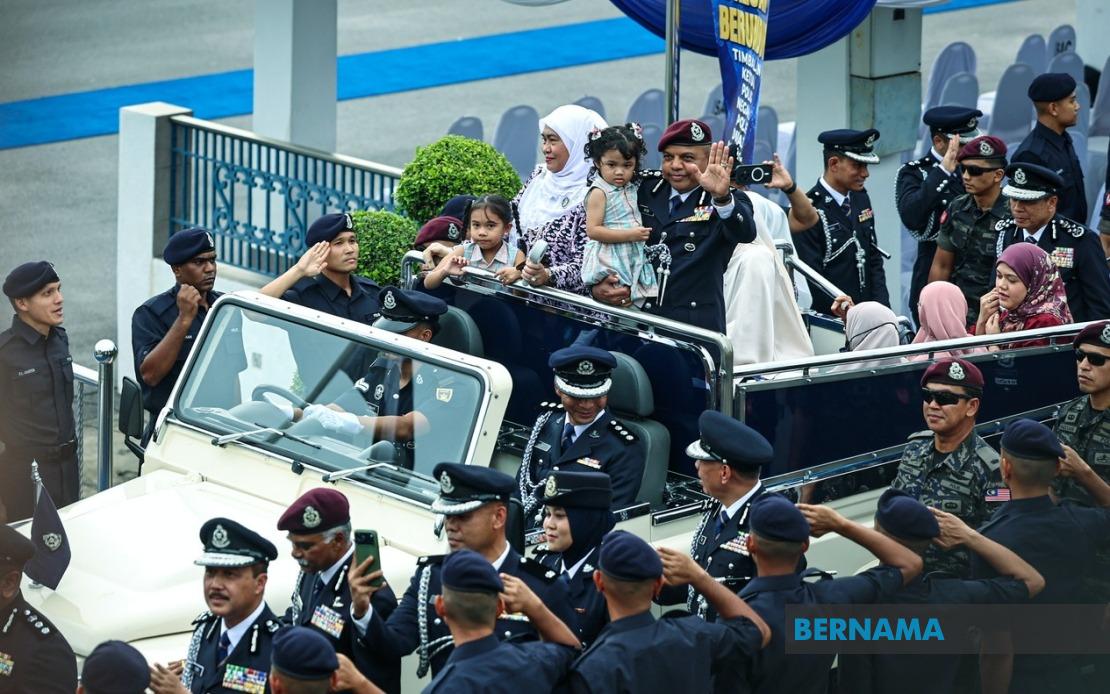
Malaysia's police force can only aspire to world-class standing by rigorously applying the law without fear or favour, according to outgoing Deputy Inspector-General of Police Tan Sri Ayob Khan Mydin Pitchay. Speaking at the handover ceremony for his successor at the Kuala Lumpur Police Training Centre on July 26, Ayob Khan stressed that consistent enforcement regardless of a person's political position or background forms the bedrock of public confidence in law enforcement institutions.
The retiring officer's remarks come as Datuk Seri Ibrahim Darus, the Bukit Aman Special Branch director, takes over as Acting Deputy Inspector-General of Police. Ayob Khan's emphasis on political neutrality reflects growing concerns within Malaysia's law enforcement community about maintaining institutional independence in an environment where accusations of partisan policing have periodically surfaced. The challenge of remaining apolitical while serving a government that holds legal and budgetary authority over the police force presents a fundamental tension that Malaysian law enforcement must navigate.
Ayob Khan articulated his position bluntly at the press conference, stating that the police must arrest and prosecute violations of law irrespective of whether the offender belongs to the ruling coalition or opposition parties. This principle, he argued, forms the essential foundation for earned respect from the Malaysian community. Without consistent application of the law, he implied, public trust erodes and the institution loses its legitimacy regardless of its operational capacity or resources.
The incoming Deputy IGP's appointment marks a significant transition within Malaysia's police hierarchy as the service seeks to maintain institutional continuity while addressing public expectations around impartiality. The timing of these leadership changes coincides with ongoing debates about police reform and independence that have featured prominently in discussions about Malaysian democratic institutions. How the new leadership navigates these pressures will significantly influence whether the Royal Malaysian Police can successfully position itself as a professional, non-partisan institution.
Ayob Khan's career trajectory underscores the complexity of maintaining political neutrality within the police force. His thirty-five years of service included commanding the Counter-Terrorism Division, where his team arrested fourteen to fifteen individuals suspected of involvement with the Liberation Tigers of Tamil Eelam in 2019. Notably, among those arrested were two state assemblymen from the then-ruling government party. The inclusion of government members in arrests, despite their party's position in power, demonstrates the type of impartial enforcement Ayob Khan advocates as essential to institutional credibility.
This example carries particular weight given Malaysia's political history and the legitimate concerns some citizens hold about selective prosecution. Opposition figures and civil society observers have occasionally raised questions about whether law enforcement applies consistent standards across the political spectrum. By highlighting his willingness to arrest members of his own government during his tenure in counter-terrorism, Ayob Khan provides concrete evidence of the principle he now promotes as his successor assumes office.
Ayob Khan's previous postings included serving as Johor police chief and directing both the Narcotics Criminal Investigation Department and the Bukit Aman Criminal Investigation Department before his appointment as Deputy Inspector-General in June 2023. These varied roles provided experience across different operational spheres, from counter-terrorism to narcotics enforcement to criminal investigation, each presenting distinct challenges regarding potential political pressure or interference.
Regarding his future trajectory, Ayob Khan firmly rejected speculation about entering politics after his retirement tomorrow. He distinguished between politicians, whom he described as focused on electoral cycles spanning five years, and statesmen, who think in terms of twenty-year horizons and institutional legacies. The distinction reflects a perspective common among professional police leaders who view their role as distinct from and potentially threatened by political considerations. His statement implicitly underscores the importance of maintaining professional distance from electoral politics to preserve police independence.
The emphasis on impartial law enforcement resonates throughout Southeast Asia, where several nations grapple with questions about police autonomy amid strong executive authority. Thailand, Indonesia, and the Philippines have all confronted similar challenges, with varying degrees of success in maintaining institutional independence. Malaysia's approach to this perennial tension offers lessons for the broader region about how professional police services can maintain legitimacy while serving democratically elected governments.
For Malaysian citizens and businesses, a police force perceived as impartial and professional provides crucial institutional stability. Foreign investors, civil society organizations, and ordinary residents all benefit when law enforcement commands respect across political divides. The economic and social costs of perceived partisan policing extend beyond immediate legal cases to affect broader confidence in government institutions and the rule of law itself.
Ayob Khan's emphasis on institutional independence arrives during a period when Malaysian society continues debating the balance between police authority and civil liberties, between operational effectiveness and human rights protections. The incoming leadership, under Ibrahim Darus, will inherit both the professional legacy Ayob Khan has articulated and the practical challenges of implementing consistent, impartial enforcement across a complex, politically diverse nation.
The transition at the highest levels of Malaysian police leadership provides an opportunity to reinforce the principle that law enforcement institutions derive their legitimacy and effectiveness from fair, predictable application of legal standards rather than from the political positions held by those they investigate or arrest. Whether this principle can be sustained through implementation across the entire police force, from federal leadership to neighborhood constables, will largely determine whether Malaysia's law enforcement can achieve and maintain world-class standing.

