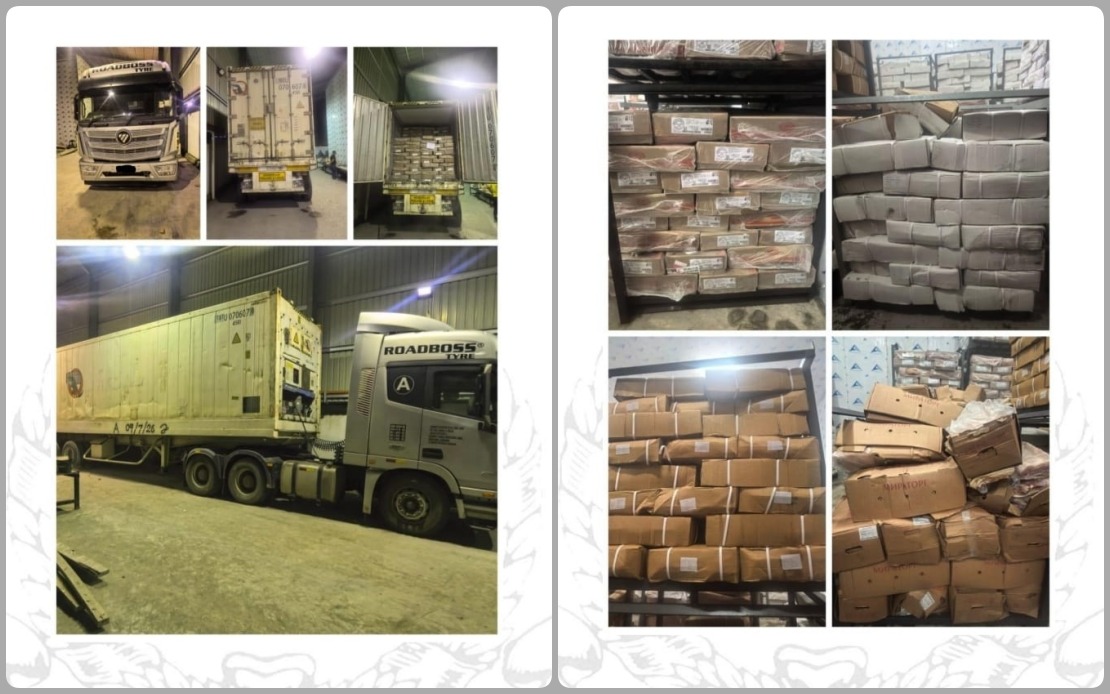
Malaysian authorities have cracked down on a significant smuggling operation after discovering RM6.19 million worth of frozen pork products stored without proper import documentation in a Miri warehouse. The enforcement action, codenamed Op Taring Chiller, resulted in the arrest of a 26-year-old local resident and represents the latest success in police efforts to combat food-related contraband across the country.
The operation unfolded on the night of July 9, when officers moved on intelligence to inspect the warehouse facility. According to Datuk Seri Mohd Yusri Hassan Basri, director of the Internal Security and Public Order Department, the raid seized an extraordinary volume of pork products in various forms. The haul included 30,000 kilogrammes of cooked frozen pork large intestines, 18,000 kilogrammes of pork loin distributed across 15 pallets, 750 kilogrammes of additional pork meat, multiple pallets of bone-in pork bellies with rind, and frozen pork shoulder cuts. The scale of the seizure underscores the sophisticated nature of organised food smuggling networks operating in Malaysia's border regions.
The enforcement operation coordinated multiple agencies in a demonstration of integrated policing strategy. The Wildlife Crime Bureau and Special Investigation Intelligence division of the Internal Security and Public Order Department spearheaded the raid, supported by officers from the Miri district police headquarters and veterinary inspectors from the Sarawak Veterinary Services Department. This multi-agency approach reflects growing recognition among Malaysian law enforcement that combating food smuggling requires coordinated intelligence and specialised expertise across different enforcement bodies.
Authorities have initiated criminal proceedings against the detained suspect under the Veterinary Public Health Ordinance 1999, invoking Sections 9(1) and 9(3) which govern the importation and storage of food products subject to veterinary controls. Additionally, officers issued a compound notice totalling RM25,000 under the same ordinance, providing a financial penalty mechanism to deter similar violations. The legal framework demonstrates Malaysia's commitment to maintaining strict oversight of food imports, particularly concerning products that may raise halal compliance and food safety questions.
This seizure reflects broader enforcement priorities within Malaysia's regulatory architecture. The police statement emphasised that the operation constitutes part of sustained efforts to eliminate the storage and distribution of frozen food products with uncertain halal status. For Malaysia's Muslim-majority population, halal certification represents not merely a religious obligation but a fundamental consumer protection principle. Undocumented pork imports bypass the regulatory oversight that would ordinarily verify handling standards, cold chain integrity, and food safety compliance, creating potential public health risks alongside cultural and religious concerns.
The performance metrics released by authorities reveal the magnitude of smuggling challenges confronting Malaysia. Between January 1 and July 10, the Wildlife Crime Bureau conducted 201 raids nationwide, resulting in 375 arrests. These operations targeted diverse smuggling categories including goods evading duty obligations, diverted subsidised products, frozen food contraband, illegal wildlife trafficking, and electronic waste. The cumulative value of goods seized across all categories reached RM264.86 million, demonstrating that food smuggling operates within a broader ecosystem of organised criminal commerce.
The concentration of activity in border states like Sarawak reflects Malaysia's geography and trade dynamics. Sarawak's position on Borneo island, with land borders and maritime proximity to Indonesia and Brunei, creates persistent smuggling vulnerabilities. The ability to move large volumes of perishable products across these boundaries requires sophisticated logistics and coordination with corrupt officials or criminal syndicates. Previous years have witnessed similar operations uncovering thousands of tonnes of undocumented pork in Sarawak and Sabah, suggesting sustained international demand for products unsuitable for Malaysia's regulated markets.
The implications of such smuggling extend beyond immediate food safety considerations. When illegal products circumvent customs and veterinary inspections, they also undercut legitimate importers and processors operating under compliance frameworks. Malaysian food businesses maintaining proper documentation, securing halal certification, and adhering to veterinary standards face unfair competition from contraband sources bearing no regulatory costs. This distortion incentivises legitimate operators to either lower their compliance standards or exit the market, ultimately degrading the overall quality and reliability of food supply chains.
Police leadership emphasised that sustained enforcement constitutes a strategic priority. The statement noted that the Royal Malaysia Police will intensify intelligence gathering, monitoring, and coordinated enforcement operations to dismantle smuggling networks and address organised crime more comprehensively. This commitment suggests that Miri's success represents not an isolated action but part of a coordinated campaign targeting specific criminal organisations and trafficking routes. Enhanced border surveillance, inter-agency intelligence sharing, and targeted operations in high-risk zones appear central to the evolving enforcement strategy.
The broader context for Malaysia includes competing demands on enforcement resources. Border security, ports, and warehouse monitoring require substantial investment and personnel. Smuggling networks constantly adapt their methods, employing smaller shipments, concealment techniques, and corrupted officials to evade detection. The RM264.86 million in seizures across all categories suggests that enforcement operations capture only a fraction of contraband attempting entry—estimates suggest detected smuggling represents perhaps 10 to 20 percent of total illicit flow, implying substantially larger volumes reaching markets undetected.
For Malaysian consumers and businesses, the operation underscores the significance of purchasing from licensed retailers and verified suppliers. Products obtained through informal channels, cross-border smuggling, or undocumented sources carry substantial risks regarding halal authenticity, hygiene standards, and traceability. The regulatory framework governing food imports exists to protect public health and cultural values; compliance costs borne by legitimate operators ultimately reflect investment in consumer safety.
The enforcement action also carries relevance for regional food security discussions. Southeast Asia collectively faces challenges coordinating food standards, tracing transnational supply chains, and preventing contaminated products from circulating across borders. Malaysia's approach—combining border enforcement, veterinary oversight, and criminal prosecution—offers lessons for regional partners addressing similar smuggling pressures. Cooperation mechanisms allowing intelligence sharing and coordinated operations across ASEAN could enhance detection capabilities and disrupt criminal networks operating across multiple jurisdictions.

