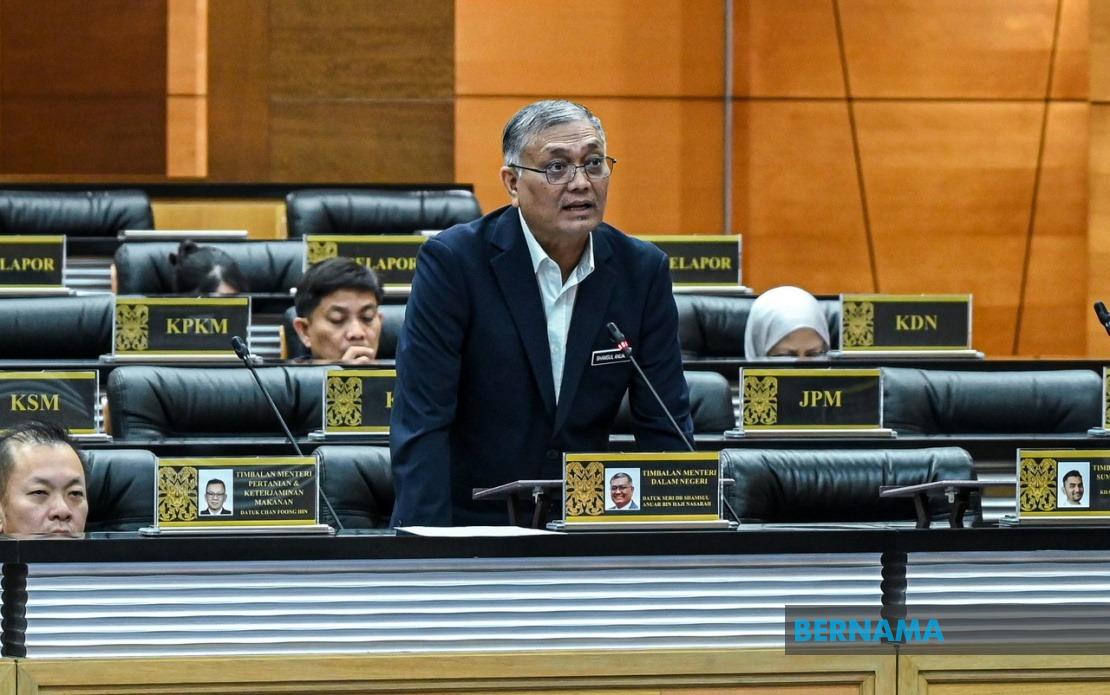
Deputy Home Minister Datuk Seri Dr Shamsul Anuar Nasarah has moved to reassure Parliament that the police force maintains strict neutrality when investigating cases involving high-ranking or politically connected individuals, declaring that no one receives preferential treatment in sensitive inquiries regardless of their status or party affiliation.
Speaking during a Dewan Rakyat session on July 15, Shamsul Anuar responded directly to concerns about the handling of several prominent cases by emphasizing that the Royal Malaysia Police conducts its work according to professional standards while maintaining transparency and fairness in all proceedings. His statement appeared designed to counter public perception that political connections or ministerial rank might influence the pace or direction of investigations into sensitive matters involving figures close to power.
Among the cases under examination is the investigation into a viral intimate video recording that emerged in 2019 and subsequently became linked to a former Cabinet minister. Police continue to pursue leads to locate the original recording and identify all technological devices and equipment involved in its creation, distribution, and proliferation across digital platforms. The inquiry operates under multiple legal frameworks, including Section 292, Section 377B, and Section 504 of the Penal Code, alongside Section 233 of the Communications and Multimedia Act 1998, indicating the complexity and seriousness with which authorities are treating the matter.
The 2019 incident represented a watershed moment in Malaysian digital crime, raising acute questions about digital privacy, consent, and the responsibilities of technology platforms in preventing the spread of intimate content without permission. The extended timeline for investigation reflects both the technical difficulties in tracing digital material once distributed online and the broader challenge law enforcement faces in adapting to crimes conducted through interconnected global systems where evidence may be distributed across multiple jurisdictions and servers.
Separately, Shamsul Anuar addressed a distinct investigation concerning the son-in-law of former Prime Minister Tan Sri Muhyiddin Yassin, noting that this matter falls under the jurisdiction of the Malaysian Anti-Corruption Commission rather than police authority. The MACC has already taken the significant step of issuing an arrest warrant against the individual, indicating that the anti-corruption body has gathered sufficient evidence to advance the case beyond the initial investigative phase. However, Shamsul Anuar declined to elaborate further, citing the ongoing sensitivity and the sub judice nature of proceedings.
The bifurcation of responsibilities between PDRM and MACC in investigating cases involving prominent figures reflects Malaysia's institutional architecture for managing corruption and serious crime. This separation of powers, while designed to prevent political interference, also creates complexity in public understanding of how different agencies coordinate and whether investigations maintain consistent standards. The mention of a warrant against a family member of a former prime minister signals that no person remains immune from investigation simply by virtue of proximity to high office, though the Deputy Home Minister's circumspection on details suggests administrative sensitivity around the case.
On the broader question of international cooperation, Shamsul Anuar outlined Malaysia's framework for extradition matters, which operates under the Extradition Act 1992 and bilateral treaties with foreign governments. Malaysia maintains formal extradition agreements with eleven countries and has acceded to the ASEAN Extradition Treaty, positioning the nation within regional and global frameworks for pursuing suspects who flee across borders. He indicated that the government remains engaged in diplomatic negotiations with additional nations to expand these agreements, reflecting recognition that transnational crime increasingly demands seamless cooperation between law enforcement agencies across borders.
The extradition framework carries particular significance for Southeast Asia, where organized crime, financial fraud, and corruption frequently involve movement of suspects and assets across multiple jurisdictions. Malaysia's position as a financial center and transportation hub means the country both initiates and receives extradition requests, requiring robust processes that balance the rights of individuals with the interests of justice. The willingness to negotiate new treaties suggests Malaysia is responding to contemporary criminal threats that do not respect national boundaries.
Shamsul Anuar's parliamentary statement should be understood within the context of ongoing public skepticism about whether politically connected individuals receive favorable treatment from enforcement agencies. In the decade preceding his remarks, Malaysia had witnessed multiple instances where high-profile investigations appeared stalled or where prosecutions of prominent figures faced complications, fueling concern that institutional capture or political pressure might undermine the impartiality of investigations. The Deputy Home Minister's explicit reaffirmation of police neutrality appears calculated to counter such perceptions and rebuild confidence in state institutions.
The reference to conducting investigations "professionally, transparently and fairly" invokes standards that require demonstrable action beyond rhetoric. For investigations to meet these criteria in the public eye, evidence of equal treatment must be visible in charging decisions, resource allocation, and prosecution outcomes across cases regardless of the political status of those involved. The challenge for Malaysian law enforcement lies in not merely stating commitment to impartiality but ensuring that investigative outcomes are perceived as legitimate by all segments of society, including opposition supporters who may harbor suspicions that the system remains compromised.
For Malaysia and the broader Southeast Asian region, the handling of cases involving former and current political figures carries implications extending beyond individual accountability. These investigations test whether democratic institutions can maintain functional independence and whether rule of law can function effectively even when cases implicate the powerful. Success in impartial investigation reinforces institutional credibility; perceived failures reinforce cynicism about governance and accelerate the erosion of public trust essential to effective law enforcement.
The Deputy Home Minister's parliamentary intervention, while offering reassurance on principle, leaves open the question of measurable outcomes. The public will ultimately assess the sincerity of these commitments through the trajectory of the 2019 video investigation, the progress of the MACC inquiry involving the former prime minister's family member, and patterns in how other high-profile cases are handled going forward. Transparency in investigative progress, timely charging decisions, and rigorous prosecution will provide the evidence by which the police force's stated commitment to impartiality can be evaluated.

