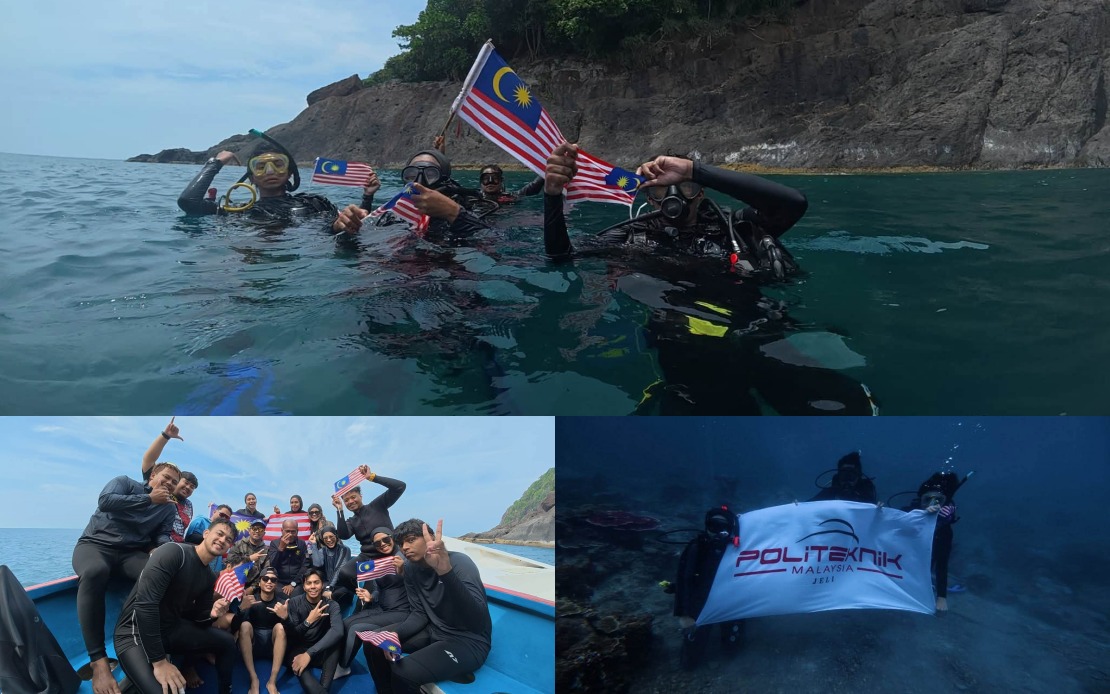
Politeknik Jeli Kelantan found an unconventional way to celebrate Malaysia's 69th National Day this month, placing the Jalur Gemilang on the seabed off Pulau Tenggol in Terengganu waters as part of a structured scuba diving training initiative. The underwater flag display, conducted between August 27 and 30, represented far more than a symbolic gesture of national pride—it served as a practical demonstration of the technical competencies that the institution seeks to develop in its aquaculture students, blending patriotism with vocational excellence.
The programme emerged from a water safety course that formed part of the Diploma in Aquaculture Technology curriculum. According to Mohd Adam Nashriq Bani Yamin, an aquaculture lecturer at the institution, the initiative was designed to equip students with essential skills for their future maritime careers whilst simultaneously instilling safety awareness relevant to potential workplace emergencies. The timing coincided with the National Day period, providing an opportunity to weave patriotic sentiment into what might otherwise have been routine technical instruction.
The expedition to plant the flag involved a carefully selected group comprising two lecturers and two fifth-semester students from the Diploma in Aquaculture Technology programme. This smaller cohort underwent formal PADI (Professional Association of Diving Instructors) certification training at Dive Buddy Dungan, with guidance from instructor Dr Nabila Talib representing Dive Buddy Malaysia. The structured certification process meant that participants achieved recognised international qualifications—the PADI Open Water Diver certificate—rather than simply completing in-house training exercises.
Mohd Adam Nashriq emphasised that the flag planting served a dual pedagogical purpose within the aquaculture discipline. Beyond the immediate spectacle of a Malaysian flag 18 metres below the surface, the exercise exposed students to the realities of underwater work environments where many marine aquaculture and marine biotechnology professionals conduct their daily operations. Upon graduation, these students are likely to encounter roles requiring them to work in marine farming settings, seabed inspections, or underwater ecosystem monitoring—contexts where swimming and diving proficiency is not merely advantageous but potentially essential.
The polytech also flew its own institutional flag at the same underwater depth, a gesture that Mohd Adam Nashriq characterised as an expression of organisational patriotism. This dual-flag approach transformed the initiative from a purely national commemoration into a statement about institutional identity and pride, reflecting broader efforts within Malaysian technical education to cultivate both national consciousness and professional pride among graduates.
The scuba training formed part of a broader water safety curriculum component. Interested students received structured instruction in diving techniques, safety protocols, and emergency response procedures—knowledge directly applicable to their future roles in marine industries. The PADI certification pathway offered by Dive Buddy Malaysia provided internationally recognised credentials that extend students' employment prospects beyond purely domestic contexts, potentially enabling career mobility within Southeast Asia's expanding maritime and aquaculture sectors.
Mohd Adam Nashriq articulated a strategic vision for how such experiential learning enhances graduate preparation. Institutions increasingly recognise that academic knowledge alone—whether in aquaculture science, marine biotechnology, or related fields—proves insufficient without corresponding practical competencies. By integrating water safety certification and diving skills into the curriculum, Politeknik Jeli positions its graduates as more versatile professionals capable of handling both theoretical challenges and operational realities within marine industries.
The underwater flag exercise also carries implications for marine conservation and research applications. Diving skills acquired through such structured programmes extend beyond commercial aquaculture into marine ecosystem monitoring, coral reef research, and underwater conservation work. These competencies position graduates to contribute meaningfully to Malaysia's broader marine stewardship objectives, whether through private sector employment in aquaculture or participation in government-supported marine research initiatives.
For Malaysian technical education institutions more broadly, the Politeknik Jeli initiative exemplifies creative approaches to integrating patriotic observances with vocational skill development. Rather than treating National Day as merely an administrative occasion marked by flag hoisting and speeches, the institution leveraged the commemorative period to deliver authentic, industry-relevant training. This approach resonates with current discussions within Malaysian education about ensuring technical institutions produce graduates with both national consciousness and competitive professional capabilities.
The programme's success may inspire similar initiatives at other technical and vocational institutions across Malaysia. Politeknik Jeli demonstrated that patriotic expression need not conflict with rigorous professional preparation—indeed, the two can be meaningfully integrated when educators approach curriculum design creatively. As Malaysia's maritime economy expands and aquaculture increasingly features among the nation's strategic industries, institutions producing technically skilled graduates with both international certifications and deep national commitment become increasingly valuable.
The underwater flag display also carried subtle messaging about Malaysia's confident engagement with its marine environment and resources. Rather than viewing the seabed merely as a physical location, the Politeknik Jeli initiative positioned it as a legitimate space for national expression and professional activity—a subtle assertion of Malaysian presence and competence within maritime domains that will assume growing economic importance across the coming decades.

