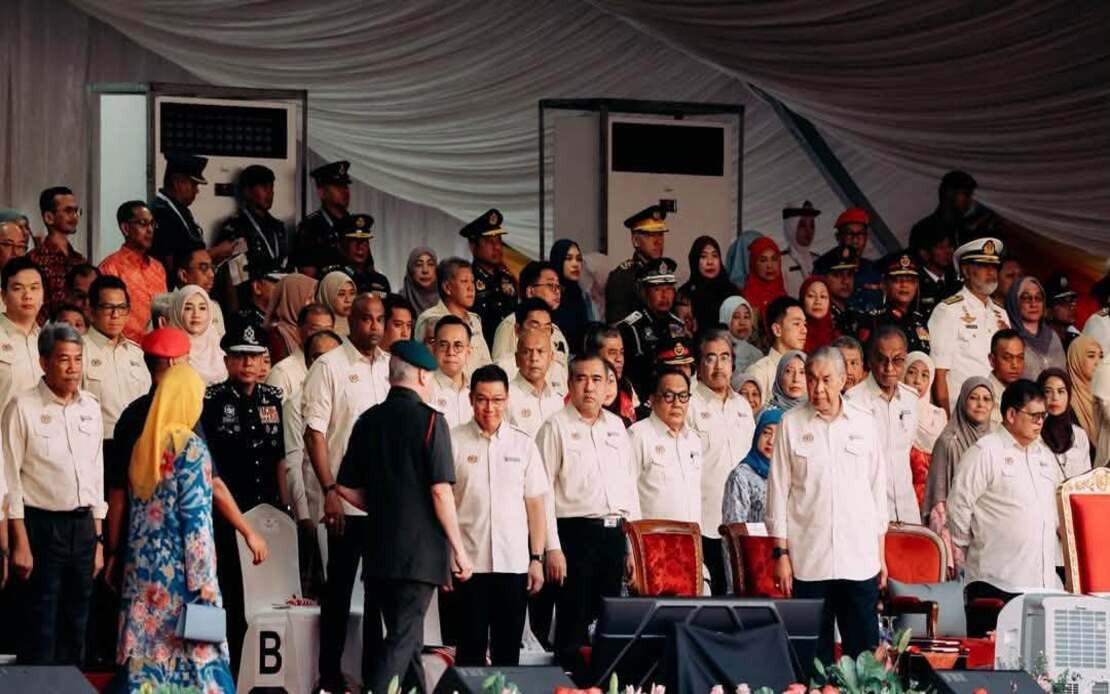
Malaysia's coalition government requires a conscious commitment to political maturity and a fundamental understanding that governing is fundamentally about balancing partisan interests with broader national objectives, according to Domestic Trade and Cost of Living Minister Datuk Armizan Mohd Ali. Speaking on National Day, the minister underscored that the new political configuration following the 15th General Election represents a watershed moment demanding acceptance and understanding rather than resistance, particularly as the country transitions from decades of single-party dominance to a multi-party coalition framework.
The minister's remarks point to an emerging tension within Malaysian politics. While party activists continue their traditional contestation through public statements and media commentary, the cabinet leadership has maintained what Armizan characterizes as harmonious and professional working relationships. This apparent dichotomy between party-level adversarialism and ministerial-level cooperation reveals a deliberate institutional discipline that distinguishes governing from campaigning. The ability to compartmentalize these roles without allowing electoral competition to corrode cabinet functionality represents a notable development in Malaysia's democratic evolution, particularly for a coalition still establishing its operational rhythms.
Armizan's framing gains urgency when contextualized against the preceding four years. The 2018-2022 period witnessed extraordinary political turbulence, during which Malaysia cycled through three Prime Ministers and corresponding Cabinet reshuffles within a single parliamentary term. This instability created cascading governance challenges, disrupted policy implementation, and generated investor uncertainty about government longevity. Each leadership transition required extensive cabinet recalibration and realignment, consuming political capital that might otherwise have addressed substantive policy challenges. The economic costs of this repeated upheaval—including delayed infrastructure projects, delayed reforms, and international reputation damage—remain difficult to quantify but undoubtedly substantial.
The minister positions the current coalition government as a corrective response to that fractious period. Unlike the previous administration, which arose from shifting electoral coalitions and parliamentary arithmetic that frequently shifted beneath the government's feet, the Unity Government represents a more deliberately constructed consensus spanning ideological spectrum. Umno, MCA, MIC, PKR, Amanah, and other constituent parties entered this arrangement with explicit acknowledgment of shared governance responsibilities. This foundational comprehension that coalition survival depends on mutual forbearance rather than confrontation represents the political maturity Armizan emphasizes.
However, the minister's invocation of political maturity raises questions about sustainability and institutional depth. Coalition governments are inherently vulnerable to defection, particularly when parties perceive electoral advantage in withdrawal. Malaysia's recent political history demonstrates this repeatedly—parties have frequently abandoned coalitions when exit calculations shifted favorably. The question becomes whether professional cabinet dynamics can withstand the electoral pressures and factional tensions that inevitably emerge within multi-party arrangements. Armizan's optimism about leadership capability must contend with the reality that political maturity among Cabinet members does not automatically extend throughout party structures or grassroots activists who may perceive their organizational interests as threatened by coalition constraints.
The minister's emphasis on balancing political rights with nation-building responsibilities articulates a philosophical position that subordinates immediate party advancement to collective governance objectives. This framing appeals to national interest logic—proposing that individual parties benefit from overall government stability and performance more than from extractive defection or sabotage. Yet this calculation remains contested terrain. Some party factions might calculate that exiting the coalition at opportune moments better serves their long-term organizational interests than remaining constrained within a broader arrangement that requires compromise on policy and personnel matters.
Armizan's reference to National Day observances emphasizes unity and collective national commitment as counterweight to partisan division. This rhetorical strategy attempts to invoke higher-order national identity above party affiliation, arguing implicitly that Malaysian citizenship and shared governance obligations transcend election cycles and factional interests. The minister positions political maturity as the prerequisite for translating this national unity sentiment into functioning institutions capable of delivering welfare improvements and development outcomes that legitimate governance itself.
The stability imperative becomes particularly acute when considering policy implementation timelines and economic performance metrics. Governments require sufficient continuity to initiate, develop, and complete policy cycles before electoral transitions occur. Repeated cabinet reorganizations truncate these cycles, leaving initiatives incomplete and preventing elected officials from demonstrating tangible accomplishments to constituents. Development trajectory requires years of sustained effort across multiple fiscal cycles. The previous government's internal instability demonstrably impaired capacity for such sustained implementation, creating opportunity costs that manifested in delayed infrastructure, incomplete reforms, and reduced international competitiveness.
From a Southeast Asian perspective, Malaysia's coalition governance experience carries regional implications. Throughout the region, several nations grapple with managing multi-party coalitions and preventing political instability from undermining economic performance and institutional credibility. Thailand, Cambodia, and Indonesia all operate coalition arrangements that face similar tensions between party autonomy and governance necessity. Malaysia's relative success in maintaining coalition stability—despite electoral disruptions and party cycling—offers potentially instructive lessons about institutional design, cabinet discipline, and political leadership choices that prioritize governance continuity.
The minister's framework also addresses investor psychology and international confidence. Multinational corporations and financial institutions condition capital deployment on governance stability and policy predictability. Repeated government transitions generate uncertainty that suppresses investment and raises financing costs. Conversely, coalitions demonstrating maturity and continuity signal reduced political risk, potentially attracting capital flows and supporting currency stability. The economic consequences of political instability thus extend beyond domestic budgeting to international economic relationships that shape employment, fiscal revenue, and growth trajectory.
Looking forward, Armizan's emphasis on political maturity suggests a ministerial perspective that governance performance will ultimately determine coalition durability better than formal agreements or structural arrangements. If the Unity Government delivers tangible improvements in cost of living, employment, infrastructure development, and public services quality, constituent parties benefit electorally through capacity to demonstrate accomplishment. Conversely, if governance outputs disappoint, political maturity may corrode as parties face electoral pressure to distinguish themselves through exit or aggressive differentiation from coalition partners.
The sustainability question ultimately hinges on whether Malaysian political actors internalize the lesson that four years of coalition stability produces superior electoral outcomes compared to four years of internal upheaval and leadership cycling. If this collective learning persists beyond the current electoral cycle, Malaysia's multi-party governance could establish itself as a durable institutional feature rather than temporary expedient. Such consolidation would represent meaningful democratic maturation, transforming coalition management from an anomalous challenge into a normalized feature of Malaysia's political landscape.

