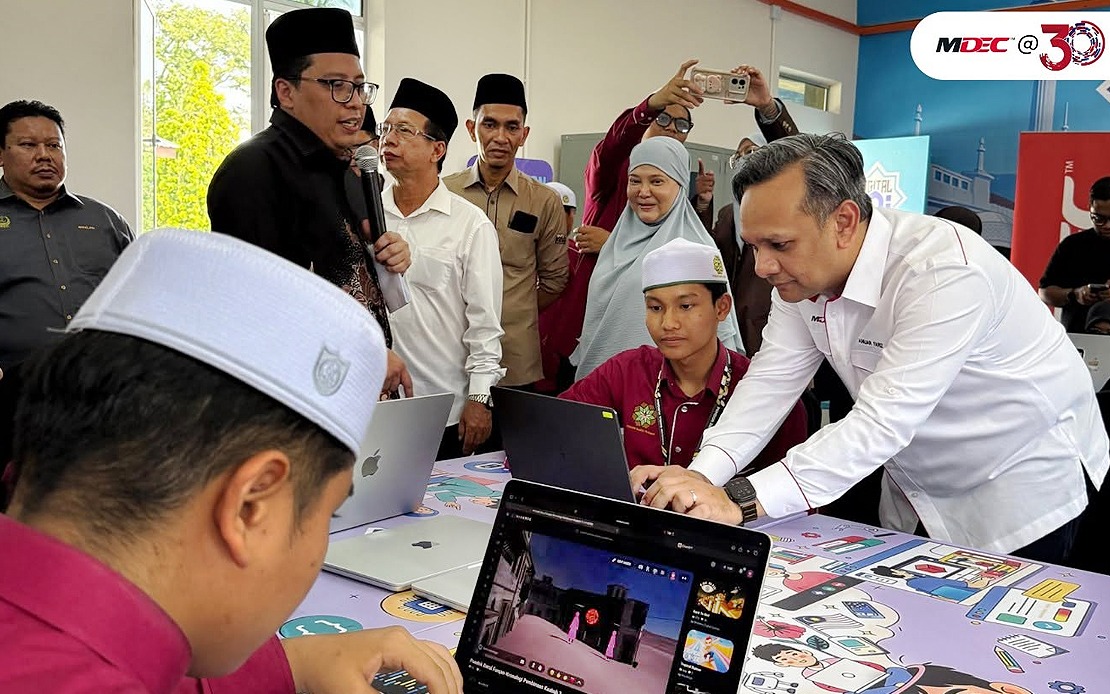
The Malaysia Digital Economy Corporation (MDEC) has delivered a Digital Maker Hub to Pondok Darul Furqan in Tambun, marking a significant stride in extending technological competency across Malaysia's Islamic education network. This facility, officially handed over in Ipoh on July 13, represents a strategic commitment to democratising access to digital tools and twenty-first-century skills among both educators and students in religious institutions that have traditionally operated outside the mainstream technology ecosystem.
The newly established hub functions as an interactive learning environment furnished with contemporary digital infrastructure. Laptops, high-speed internet connectivity, smartboards, robotics kits, microcontroller systems and complementary equipment form the foundation of this space, enabling learners to engage in hands-on technological experimentation rather than purely theoretical instruction. This practical orientation matters significantly in a region where digital literacy gaps persist across various educational sectors, and particularly in institutions where technology adoption has lagged behind urban counterparts.
MDEC chief executive officer Anuar Fariz Fadzil emphasised that the initiative responds to Malaysia's strategic imperative to cultivate artificial intelligence expertise across the entire population. The corporation frames digital skill development not as a luxury confined to privileged institutions but as a prerequisite for national competitiveness as the country pursues its ambition to establish itself as an AI Nation by 2030. This framing reflects broader recognition that technological transformation cannot succeed if substantial educational institutions remain disconnected from the digital mainstream.
The Digital Maker Hub operates under the umbrella of the Islamic Education Institution Digital Transformation Programme, commonly referred to as Digital IPI, a collaborative undertaking between MDEC and the Department of Islamic Development Malaysia (JAKIM). This partnership structure acknowledges that integrating technology into Islamic education requires sensitivity to institutional values and pedagogical traditions whilst simultaneously modernising teaching methodologies. The programme explicitly seeks to ensure that religious education and technological training reinforce rather than contradict one another, embedding principles of trustworthiness and ethical conduct within digital literacy curricula.
Pilot activities at Pondok Darul Furqan already demonstrate the programme's interactive potential. During a two-day MetaSkool Metaverse Programme, thirty students and five teachers participated in immersive learning experiences centred on metaverse technology. Rather than passive instruction, these sessions emphasised experiential engagement and creative exploration, encouraging participants to conceptualise practical applications of emerging technologies rather than memorising technical specifications. This approach recognises that younger learners particularly benefit from environment-based, discovery-oriented pedagogies when encountering novel technological domains.
The rollout strategy incorporates measured expansion through a pilot phase encompassing five additional Islamic education institutions strategically distributed across Kedah, Kelantan, Negeri Sembilan, Pahang and Penang. This geographic distribution across multiple states suggests careful attention to regional representation and equitable access, moving beyond a concentrated concentration in prosperous urban centres. Each selected institution will receive its own Digital Maker Hub, creating multiple nodes within an emerging network of digitally-equipped Islamic schools across the peninsula.
Prime Minister Datuk Seri Anwar Ibrahim launched Digital IPI in March, signalling high-level political endorsement for an initiative that might otherwise risk marginalisation within broader economic development priorities. The programme targets meaningful scale, projecting benefits for more than three thousand students and fifty teachers through structured training modules spanning multiple technological domains. Curricula encompass digital literacy fundamentals, artificial intelligence applications, digital creative production, immersive technology platforms and content development methodologies—a comprehensive suite addressing both foundational competencies and advanced specialisations.
For Malaysian policymakers and educational administrators, this initiative carries significant implications regarding educational equity and labour market preparedness. Islamic education institutions serve hundreds of thousands of students across the country, many from rural and economically disadvantaged communities where alternative educational pathways remain limited. By systematically extending digital infrastructure and training to these settings, Malaysia reduces the risk of creating a two-tiered skills ecosystem where only privately-educated or urban-based cohorts develop technological proficiency. This democratisation of access addresses both equity concerns and practical workforce development imperatives.
The integration of metaverse technology and robotics within Islamic educational contexts also signals broader sectoral recognition that religious values and digital advancement need not conflict. Rather than positioning technology adoption as secularising or diluting traditional institutional missions, the programme demonstrates how pedagogical innovation can enhance religious education whilst preparing students for digital economies. This framing carries particular resonance in Southeast Asia, where similar tensions between tradition and modernisation occupy educational and cultural discourse across multiple countries.
From a regional Southeast Asian perspective, Malaysia's approach offers a replicable model for other nations managing digital transformation within diverse educational ecosystems. Indonesia, Thailand, and the Philippines grapple with comparable challenges of extending technology access beyond privileged urban institutions whilst respecting institutional identities rooted in religious and cultural traditions. Malaysia's institutional partnership between JAKIM and MDEC demonstrates how government agencies can collaborate effectively when technological innovation aligns with cultural and religious sensitivities rather than challenging them.
Longer-term success will depend on sustained resourcing, educator training, and curriculum development beyond initial infrastructure installation. Digital equipment depreciates and requires maintenance; metaverse platforms continue evolving; and teachers need continuous professional development to maximise pedagogical applications rather than treating technology as supplementary novelty. Whether the programme maintains momentum and expands beyond its pilot phase will determine whether this represents genuine systemic transformation or a well-intentioned but ultimately limited intervention.

