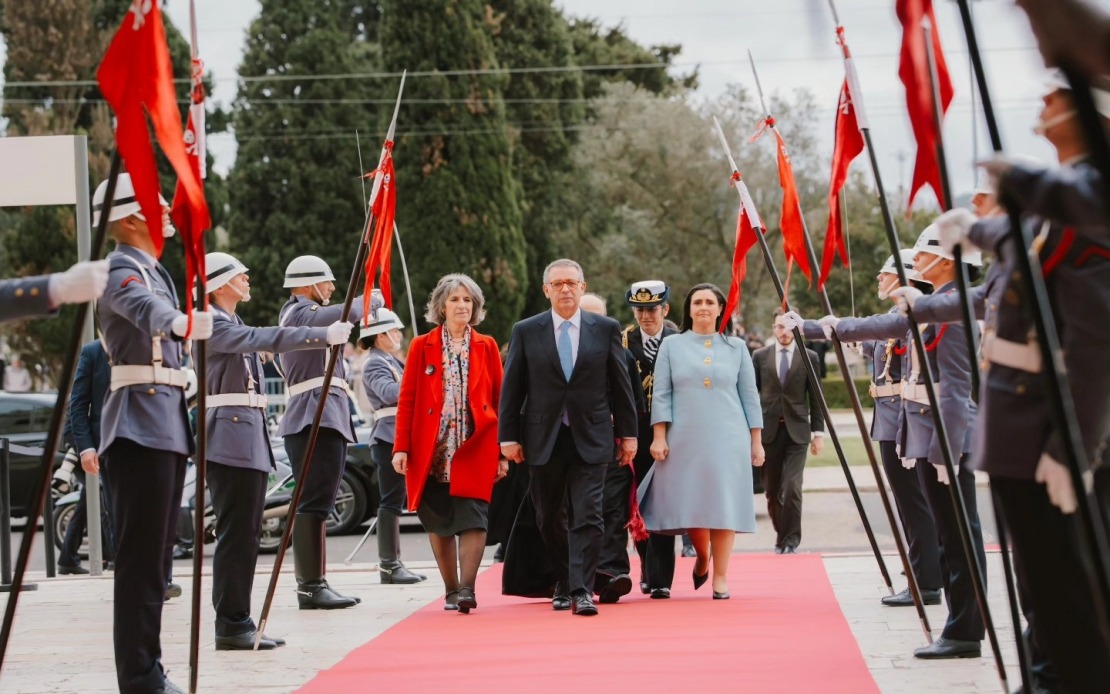
Portugal has moved to prohibit face coverings in public environments after President Antonio Jose Seguro gave his formal approval to the controversial legislation this week. The law, which originated from proposals put forward by the right-wing Chega party, represents a significant policy shift in the traditionally diverse European nation and aligns it with a growing movement across the continent to restrict facial concealment in shared spaces.
In explaining his decision to sign the measure, Seguro emphasised that the government had responded to concerns relating to social cohesion, cultural continuity, and the maintenance of civic confidence. The Portuguese presidency's official statement highlighted that the legislation had been substantially refined during parliamentary deliberations, with amendments that ultimately satisfied the President's constitutional concerns about the measure's scope and application.
The administration framed facial visibility as fundamental to Portuguese society's character, arguing that uncovered faces enable the mutual recognition essential to functional community life. Officials contended that the ability for citizens to engage in direct, unmediated interpersonal connection represents a cornerstone of Portuguese democratic values and social trust—a philosophical position that reflects broader European debates about integration and shared civic identity.
Moreover, the government invoked gender equality principles in justifying the restriction. The statement explicitly rejected what it characterised as gender asymmetry, pointing out that if the law were applied selectively to certain groups—particularly women observing certain religious practices—it would contradict the principle that men and women must enjoy equal dignity and rights under law. This framing attempted to position the ban as protective of women's autonomy rather than restrictive of religious expression.
Seguro's justification also drew on precedent established by the European Court of Human Rights, suggesting that the court's previous rulings concerning face coverings had influenced the Portuguese government's interpretation of constitutional permissibility. The President argued that democratic societies must balance individual liberty with collective security and social cohesion, citing what officials described as an accepted framework for managing personal beliefs within communal frameworks.
However, Amnesty International's Portuguese branch has mounted vigorous opposition to the new law, characterising it as fundamentally discriminatory in effect even if not discriminatory in language. The human rights organisation contends that the restriction disproportionately impacts Muslim women who voluntarily adopt face coverings as an expression of religious conviction and personal identity. From this perspective, the law restricts religious freedom and bodily autonomy under the guise of secular governance principles.
Portugal now joins a substantial cluster of European nations with similar or overlapping restrictions. France, Belgium, Austria, Denmark, and the Netherlands have all implemented full or partial prohibitions on public face coverings, establishing a European norm that continues to expand. This coordinated movement raises questions about whether such policies reflect genuine security concerns, cultural preservation anxieties, or heightened anxieties about religious minorities in post-migration Europe.
For Malaysian observers and policymakers, the Portuguese development offers instructive perspective on how Western democracies navigate tensions between pluralism and social cohesion. Malaysia's own experience with managing religious expression in plural communities—through mechanisms such as federal and state constitutional frameworks protecting religious freedom alongside provisions for public order—provides a contrasting model. The Portuguese approach prioritises facial recognition as integral to civic participation, whereas Malaysian law typically accommodates diverse religious practices while establishing context-specific boundaries.
The philosophical clash evident in the Portuguese debate reflects deeper questions about what constitutes legitimate governance in religiously diverse societies. While Western European nations increasingly invoke security, gender equality, and social integration to justify restrictions on religious expression, other democracies have sought accommodation frameworks that protect both minority rights and majority concerns. The Portuguese case suggests that European policymakers increasingly view integration as requiring visible conformity rather than internal commitment to shared civic values.
As this ban takes effect, its implementation and any resulting legal challenges will likely reach European courts, potentially generating jurisprudence that influences policy across the continent. For Southeast Asia's diverse, Muslim-majority nations like Malaysia and Indonesia, the Portuguese precedent underscores the importance of constitutional protections for religious freedom and minority rights—frameworks that prevent majoritarian pressure from converting cultural preferences into restrictive law. The contrast between European restrictions and Southeast Asian accommodation models highlights different philosophies about how plural democracies can function sustainably.

