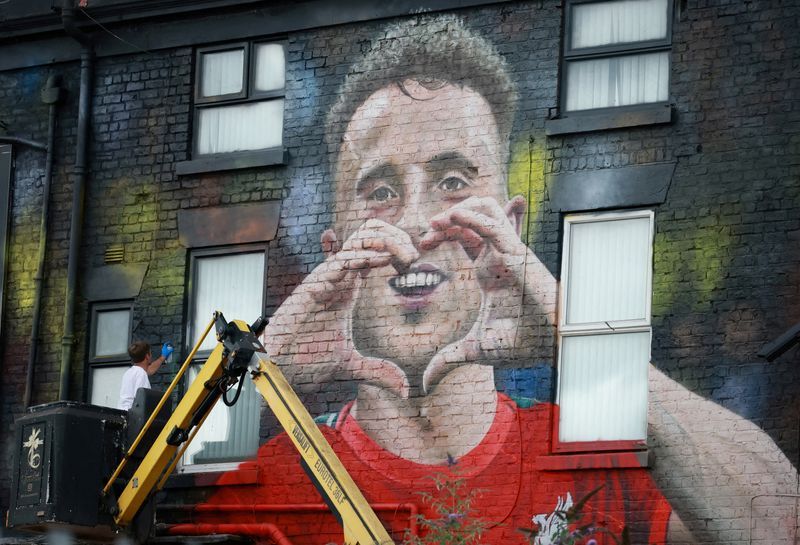
Portugal's World Cup journey has been shaped by an absence as profound as any presence on the pitch. When the squad takes the field against Croatia in the tournament's round-of-32 fixture in Toronto on Thursday, the moment will carry a significance that extends far beyond the ninety minutes of play. Though the match unfolds on July 2 in Canada, the clock will have already crossed midnight in Portugal, marking July 3—the date that, one year earlier, robbed the nation of one of its most talented and cherished footballers.
Diogo Jota's death in a motor vehicle accident in northwestern Spain remains a wound that has not yet fully healed for Portuguese football. The Liverpool forward, aged 28, and his brother Andre Silva were killed when their Lamborghini left the roadway and subsequently caught fire. The tragedy sent shockwaves through the sport, claiming a player whose combination of technical skill, clinical finishing, and unwavering commitment to Portugal had elevated him to legendary status within the national consciousness. Unlike many athletes whose national team contributions are measured in decades, Jota managed to leave an indelible imprint during his relatively brief international career.
Portugal's footballing establishment has deliberately ensured that Jota remains woven into the fabric of this World Cup campaign rather than consigned to memory alone. Roberto Martinez, the team's manager, took the extraordinary step of naming Jota as an honorary member of the squad—a gesture that acknowledges both the void his absence creates and the spiritual presence his legacy continues to exert. This symbolic inclusion reflects how deeply Jota penetrated the collective identity of Portuguese football, transcending the typical player-coach relationship to become what Martinez has described as the team's light.
The gestures of remembrance have accumulated throughout Portugal's tournament journey. Ruben Neves, a midfielder and close personal friend of Jota, has assumed the number 21 shirt as a tangible connection to his departed teammate. Prime Minister Luís Montenegro distributed wristbands bearing Jota's name to the playing contingent, transforming a piece of jewellery into an instrument of national mourning and solidarity. During Portugal's opening fixture against DR Congo in Houston, Jota's parents Isabel and Joaquim Silva watched from the stands as an emotional tribute unfolded, their presence a physical embodiment of a family's enduring grief.
For the players themselves, the coinciding of this knockout match with the death anniversary creates a complex emotional landscape. Vitinha, Portugal's defender, articulated the intensity of this convergence during pre-match comments, describing how the upcoming fixture represents not merely a sporting contest but a moment laden with multiple layers of motivation—for family, for country, and crucially, for Jota himself. The player's words reveal how Portuguese footballers have consciously transformed personal tragedy into collective purpose, channelling their grief into competitive drive.
Jota's influence extends even beyond Portuguese borders, resonating particularly within the Liverpool squad. Andy Robertson, the Scotland captain and Jota's close friend and teammate at club level, experienced an immediate emotional reckoning when Scotland secured World Cup qualification in November. That moment of triumph became inseparable from Jota's absence. Remarkably, Jota's widow Rute Cardoso reached out to Robertson with a message that transcends the conventional boundaries of sporting consolation. Her words—thanking him for carrying Jota's memory into the tournament and transforming the pain of loss into strength—reveal how grief within football's fraternity can bridge national divides and create bonds of mutual remembrance.
From a statistical perspective, Jota's contribution to Portugal's competitive trajectory cannot be overstated. His record of 14 goals across 49 international appearances represented an exceptional conversion rate for a player operating within a squad blessed with considerable attacking talent. Had circumstances permitted, he would almost certainly have featured prominently in this North American campaign. Instead, the absence of his familiar presence in training sessions and team hotels serves as a constant, aching reminder of football's fragility and football's capacity to expose the randomness of tragedy.
The timing of Thursday's match creates a poignant symmetry in the tournament calendar. As the contest unfolds in Toronto, Portuguese fans monitoring proceedings from home will simultaneously experience the moment when July 3 arrives—the exact anniversary of the crash that claimed Jota's life. This temporal overlap ensures that the match cannot be experienced as a mere sporting spectacle but rather as a collective moment of national reflection, with football serving as the medium through which a nation processes ongoing grief.
Among the Portuguese-Canadian community in Toronto, Jota's legacy carries particular resonance. Miguel De Silva, owner of a local establishment frequented by Portuguese supporters, articulated how the coinciding circumstances might serve as additional motivation for the Portuguese contingent. Beyond the conventional incentives of tournament advancement, the players carry the emotional weight of honouring a fallen colleague, a responsibility that can either paralyse or galvanise depending on how it is channelled. For Portugal's squad, the evidence suggests that this grief has been transformed into purpose rather than hindrance.
The broader implication of Portugal's approach to Jota's memory reveals something significant about how modern football grapples with mortality and legacy. Rather than compartmentalising grief or relegating remembrance to formal pre-match ceremonies, the Portuguese footballing apparatus has integrated Jota into the ongoing narrative of the tournament itself. He remains, in a very real sense, part of the squad—present in the choices of shirt numbers, in the words spoken in team meetings, in the wristbands worn beneath training kits, and in the hearts of players who shared dressing rooms with him.
As Portugal prepares for a crucial knockout stage match during a tournament that will be forever connected to Jota's anniversary, the players will carry more than tactical instructions and competitive ambitions onto the pitch. They will carry the hopes of a nation attempting to transform personal and collective tragedy into sporting achievement, honouring a teammate whose death robbed Portuguese football of one of its brightest talents at what should have been the prime of his international career.

