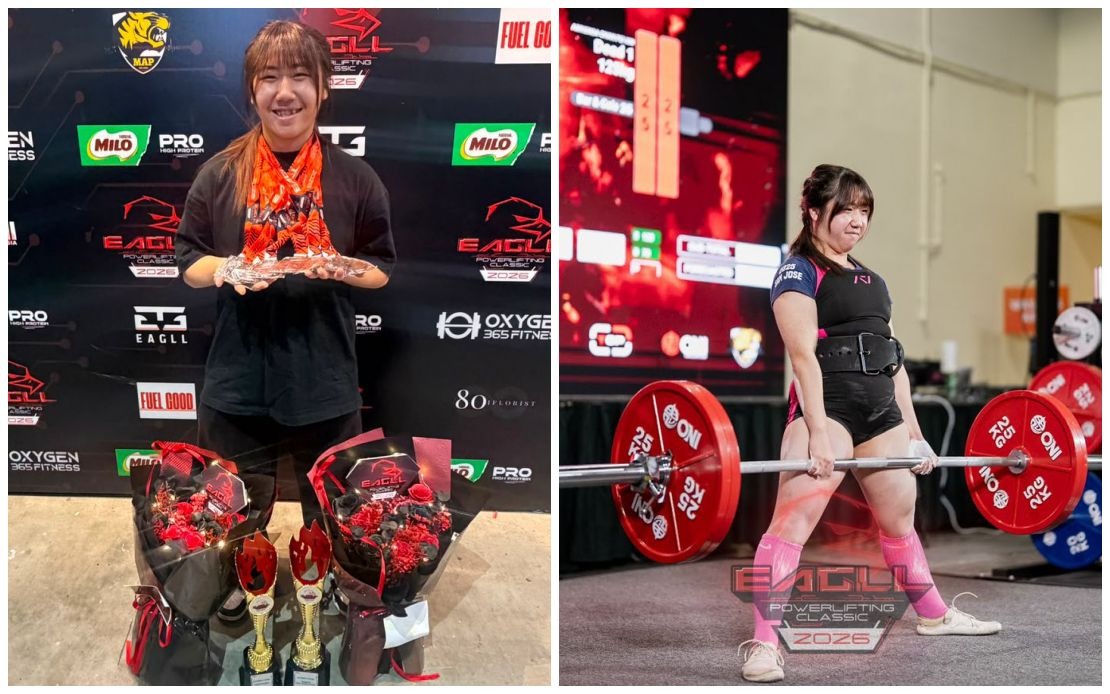
Malaysian powerlifter Abrienda Chan has transformed her competitive aspirations into tangible results, establishing five national records across the Under-57 kilogramme category at the Eagll Powerlifting Classic (EPC) 2026, held recently in Kuala Lumpur. The achievement represents a decisive breakthrough for the 20-year-old Sarawakian athlete, who emerged from the competition with seven gold medals and one silver across both junior and open age divisions. Her performance underscores the depth of talent emerging from Malaysia's powerlifting ecosystem and signals a new generation ready to compete on the international stage.
The five records Abrienda established demonstrate the breadth of her strength across all major lifts. In the U57 category, she posted an open squat record of 128 kg, junior and open bench press records of 70 kg, and junior and open total records of 343 kg. These figures, while perhaps modest compared to heavier weight categories, are remarkable given her slight frame. Standing at just 151 centimetres, Abrienda represents an exception to the conventional wisdom that powerlifting favours larger athletes, a reality that makes her progress particularly noteworthy for younger competitors who may feel the sport is inaccessible to them.
When discussing her competition strategy, Abrienda revealed tactical considerations that speak to her maturity as an athlete. She candidly acknowledged that she had targeted additional records but encountered technical difficulties during her final squat attempt, preventing her from securing the junior squat record. Furthermore, her coaching team adopted a conservative approach during the deadlift, prioritising medal security and overall titles rather than pursuing marginal gains. This decision-making reflects sophisticated understanding of competition management—a quality that often separates rising prospects from those who plateau at elite amateur levels.
The most striking aspect of Abrienda's performance came through her unexpected success in the open overall standings. Finishing second in the open category proved shocking to the athlete herself, particularly given that she competed against significantly more experienced lifters. Recognising her youth relative to the field, Abrienda had not anticipated placing in the overall standings, making the result a genuine surprise. Her emergence as Junior/Sub-Junior Overall Champion alongside this open category podium finish indicates that she is approaching the threshold where age-group dominance is transitioning into competitive relevance against the entire athlete population.
Abrienda's record-breaking performance arrives within months of her earlier declaration to media that she intended to rewrite Malaysia's powerlifting records as part of systematic preparation for two major world championships scheduled for 2027. This transparent goal-setting and subsequent delivery demonstrates planning discipline uncommon in young athletes. Her track record includes a previous gold medal from the 2024 Asian Classic Powerlifting Championships, while she continues to hold all three lift records and the total record in the Under-52 kg sub-junior category, her weight class before transitioning upwards.
The athlete's progression trajectory is particularly significant for Southeast Asian powerlifting development. Malaysia has traditionally produced strong weightlifters competing in Olympic lifting, but the sport of powerlifting remains less established in the region compared to East Asia or Australia. Abrienda's emergence provides a template for developing female powerlifters in nations where the sport lacks deep institutional infrastructure. Her ability to identify records and systematically break them, combined with her acceptance of technical challenges and willingness to learn, suggests capacity for sustained improvement rather than a single breakthrough performance.
Beyond the numerical achievements, Abrienda's comments about preparation and self-knowledge reveal psychological maturation. She attributed her improved confidence and readiness for international competition to the deep experience of preparing for the EPC 2026 and gaining clearer understanding of her body's capabilities and limitations. This introspective approach to athletic development, often overlooked in favour of focusing purely on competition results, frequently determines who sustains progress through increasingly demanding competitive levels. Her ability to extract learning from both successes and technical setbacks indicates resilience essential for world championship competition.
Support systems surrounding Abrienda's development merit attention as well. She specifically acknowledged her family, coaching staff, and Turbo Fitness, which provided training facilities and financial assistance for competition travel expenses. This multi-layered support network is particularly important in Malaysia, where elite athletic development often depends on private or corporate sponsorship supplementing limited government sports funding. The availability of dedicated facilities and financial backing allowed Abrienda to concentrate entirely on performance improvement rather than navigating logistical obstacles. For Malaysian sports administrators, her example illustrates how targeted private sector support can accelerate athlete development in emerging disciplines.
Looking forward, Abrienda has articulated explicit targets for 2027 world championships. She will compete at the World Classic & Equipped Bench Press Championships in Istanbul, Turkey, and the World Classic Sub-Junior & Junior Powerlifting Championships in Haining, China. Her specific aspiration—breaking into the world's top three in the U57 junior category—provides measurable, realistic objectives that should guide her training programme for the coming months. International competition at this level exposes athletes to vastly superior technical execution and competitive intensity, factors that typically reveal weaknesses invisible at domestic competition levels.
The implications of Abrienda's achievements extend beyond individual athletic accomplishment. Her success validates investment in Malaysian powerlifting and demonstrates that competitive potential exists within the domestic athlete population. International federations and national sports councils increasingly recognise powerlifting as a discipline with genuine mass participation and spectator appeal, particularly among younger demographics. Abrienda's visibility as a young, successful female powerlifter could catalyse increased participation from other female athletes who might otherwise view the sport as male-dominated.
Abrienda's journey also illustrates a broader pattern in Malaysian sport where individual athletes, often with limited institutional support, achieve breakthroughs that prompt retrospective recognition from sporting authorities. Her progression from dominating sub-junior categories to competitive relevance in open divisions, combined with systematic record-breaking, positions her among Malaysia's emerging sporting talents. Whether she achieves her world championship ambitions or not, her trajectory has already influenced perceptions of what Malaysian powerlifters can accomplish on international stages.

