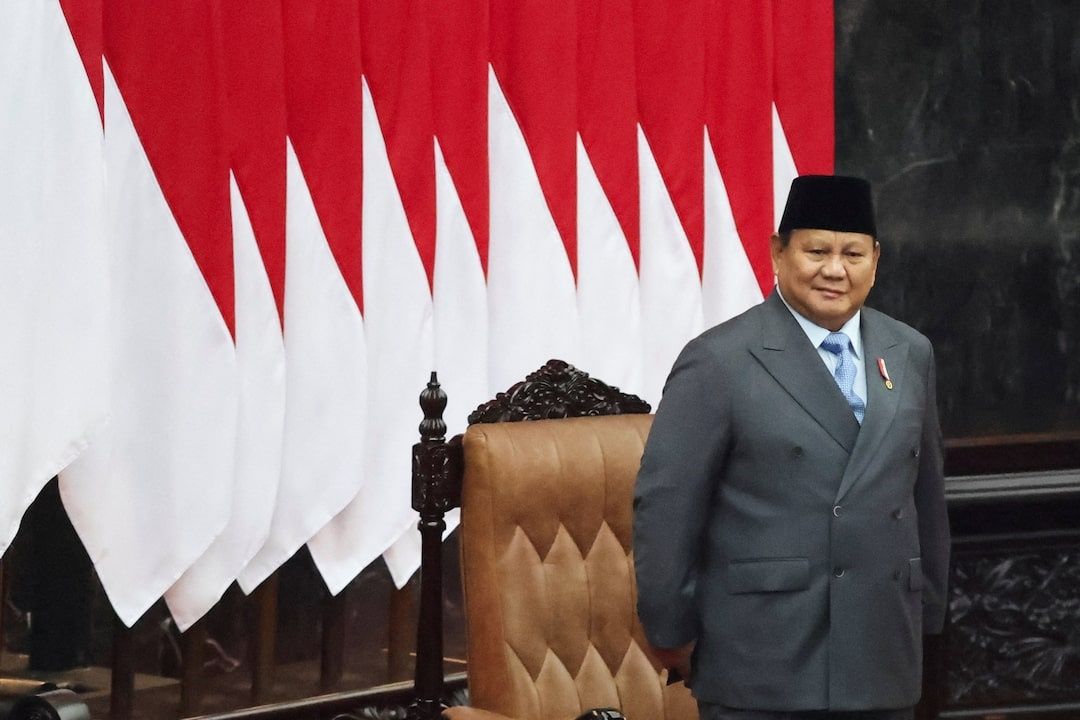
Indonesian President Prabowo Subianto confronts a critical credibility test this week as he presents his 2027 budget proposals to a financial community increasingly wary of his government's policy direction and fiscal discipline. Taking the stage on Friday with approval ratings that have collapsed by nearly 30 percentage points since his October 2024 inauguration, the former special forces commander must convince domestic and international stakeholders that his administration can deliver on its sweeping economic promises while reining in ballooning fiscal deficits.
When Prabowo swept to electoral victory, he carried with him an ambitious mandate built on three pillars: rooting out endemic corruption, propelling economic growth from its current 5% trajectory to a robust 8%, and implementing a generous free meals initiative benefiting millions of schoolchildren nationwide. These commitments resonated with voters fatigued by economic stagnation and institutional dysfunction. Yet the gap between campaign rhetoric and governing reality has widened considerably in the months since he assumed office, undermining both public confidence and investor sentiment.
The economic fundamentals have deteriorated markedly throughout 2024 and into 2025. Indonesia's currency has experienced persistent depreciation pressure, eroding household purchasing power and complicating debt servicing for companies with foreign-currency liabilities. Simultaneously, the country's equity markets have underperformed, reflecting broader unease about policy direction and macroeconomic stability. These tangible headwinds have coincided with mounting criticism about government expenditure levels and questions regarding the operational independence of Bank Indonesia, the central bank tasked with maintaining monetary discipline.
Prabowo's signature free meals programme, designed to address child malnutrition and support lower-income families, has become emblematic of the administration's governance challenges. The initiative has encountered successive budget constraints that have limited its rollout, while concurrent allegations of administrative mismanagement have tarnished what was positioned as a transformative social intervention. For a government staking considerable political capital on anti-corruption credentials, such implementation difficulties prove particularly damaging to public trust.
The fiscal arithmetic presents another looming constraint on Prabowo's policy ambitions. Indonesia's budget deficit, currently hovering near 2.8 per cent of gross domestic product, tracks ominously toward the constitutional ceiling of 3 per cent. This deteriorating fiscal position leaves minimal room for the expansionary spending programmes that might otherwise address slowing growth or fund Prabowo's stated development priorities. Economists and analysts are scrutinising the upcoming budget presentation for evidence that the administration understands these constraints and is prepared to make difficult trade-offs.
Investor apprehension crystallised sharply following Prabowo's May parliamentary address, when he unveiled plans to establish Danantara Sumberdaya Indonesia, a centralised state entity designed to monopolise exports of critical natural resources including coal, tin, nickel, and palm oil. The announcement sent tremors through global commodity markets and raised concerns among international investors already nervous about policy predictability. The proposal suggested a dramatically more interventionist posture than markets had anticipated, conjuring comparisons to state-directed economic models that have historically underperformed.
The role and operational scope of Danantara Sumberdaya Indonesia remains frustratingly opaque months after its announcement. Various members of Prabowo's cabinet have since walked back the initial proposal, suggesting the entity would function primarily as an overseer and coordinator rather than assuming direct operational control of commodity exports. Yet this clarification has failed to resolve investor uncertainty, as the institution's actual mandate, governance structure, and implementation timeline remain undefined. Markets harbour legitimate concerns that the entity could evolve into a de facto monopoly that stifles competition, suppresses transparency, and ultimately reduces export revenues through inefficiency and rent-seeking behaviour.
For commodity-dependent economies across Southeast Asia, Indonesia's resource export policies carry significant ramifications. Regional trading partners and competitors will calibrate their own strategic responses based on how these policies ultimately develop. An opaque or poorly managed export regime could destabilise regional commodity supply chains and prompt retaliatory measures from trading partners. Malaysia, Thailand, Vietnam, and other regional actors with competing commodity interests are monitoring developments closely.
The timing of the budget presentation coincides with Prabowo's broader Independence Day address, suggesting the government intends to frame its economic policies within a nationalist narrative of national renewal and self-reliance. This rhetorical framing may resonate with domestic constituencies, but international investors require concrete fiscal commitments and institutional safeguards rather than inspirational rhetoric. The challenge facing Prabowo involves reconciling nationalist economic aspirations with the practical requirements of macroeconomic stability and investor confidence.
Economists at major financial institutions have characterized the 2027 budget as perhaps the most consequential credibility test Prabowo's government has faced. As Irman Faiz of Bank Danamon observed, the market's patience for policy surprises has substantially diminished following consecutive years of unsettling announcements and course corrections. Global investors increasingly distinguish between emerging markets that maintain institutional predictability and those prone to sudden policy shifts. Indonesia's trajectory between these categories will become clearer once the budget framework and resource export policies receive fuller articulation.
The political economy of Prabowo's position merits careful attention. His approval rating decline to 51 per cent reflects not merely economic disappointment but broader concerns about governance competence and programme implementation. Prabowo inherited an administrative apparatus with institutional weaknesses and limited capacity for executing complex policies at scale. The free meals programme's stumbling launch suggested these capacity constraints remain acute. Voters and investors alike question whether the administration possesses the bureaucratic machinery necessary to deliver either economic growth acceleration or effective resource management.
For Malaysian observers and policymakers, Indonesia's economic trajectory carries direct implications. As the region's largest economy and a crucial trade partner, Indonesia's performance influences Malaysian export prospects, currency stability, and regional growth dynamics. Should Prabowo's administration successfully stabilise fiscal discipline while pursuing pragmatic resource management policies, regional economies benefit from a more predictable operating environment. Conversely, policy incoherence or nationalist economic measures could trigger competitive devaluations, supply chain disruptions, and broader regional turbulence.
The budget presentation represents Prabowo's opportunity to arrest the erosion of confidence that has characterised his early tenure. However, reversing nine months of accumulated disappointment through a single fiscal document proves extraordinarily difficult. True credibility restoration requires sustained demonstration of institutional capacity, fiscal prudence, and policy consistency over successive quarters. Friday's announcement will indicate whether the government understands the magnitude of the challenge before it.

