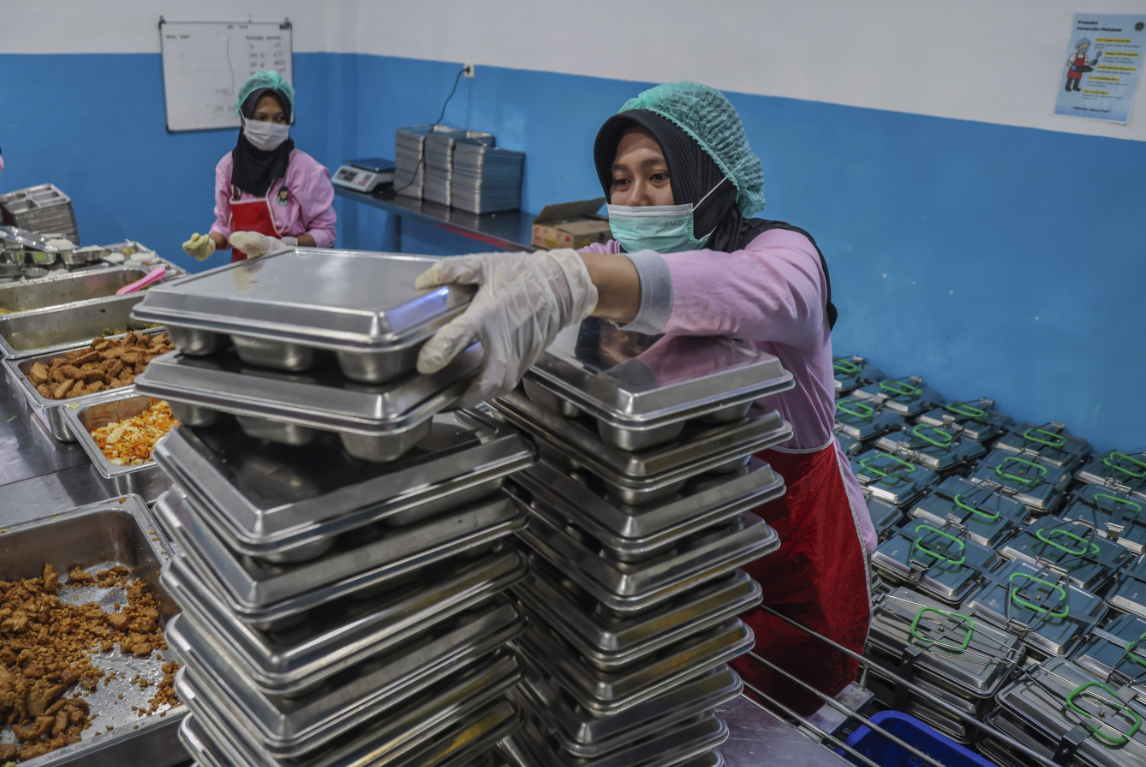
President Prabowo Subianto is undertaking a significant reassessment of two cornerstone social programmes that have become focal points of controversy since his administration took office. The free nutritious meal scheme and the Red and White cooperative initiative, both positioned as transformative efforts to address poverty and malnutrition across Indonesia, are now subject to thorough policy reviews that could reshape their delivery mechanisms and scope. This development emerged from a four-hour closed-door meeting at the Presidential Palace on Wednesday involving multiple cabinet ministers responsible for overseeing these initiatives, signalling that the government recognises the need for substantial course corrections.
The review of the free meals programme represents a particularly significant recalibration of one of Prabowo's most ambitious undertakings. With a staggering budget allocation of at least Rp 268 trillion (approximately US$19.5 billion) earmarked for 2026, the initiative aims to provide nutritious food to roughly 83 million beneficiaries, encompassing schoolchildren, pregnant women, and other vulnerable populations. The sheer scale of the operation underscores the administration's commitment to combating malnutrition and childhood stunting, challenges that have long plagued Indonesia's public health landscape. Yet the programme's enormous financial footprint has attracted intense scrutiny regarding value for money and implementation efficiency.
According to Agustina Arumsari, deputy chief of the National Nutrition Agency (BGN), President Prabowo has instructed the agency to complete a comprehensive evaluation within one month, focusing on how the meals are currently being distributed through schools. The President emphasised that improvements must be implemented thoughtfully rather than hastily, reflecting a desire to avoid creating unintended social consequences. This measured approach suggests recognition that such programmes operate within complex social environments where policy changes can generate unequal outcomes among student populations.
A critical focus of the review centres on recalibrating eligibility criteria to exclude higher-income households from the scheme, a move that would substantially narrow the programme's scope while potentially improving its targeting efficiency. However, the government faces genuine implementation challenges when schools contain mixed-income student bodies. Officials have expressed concern about the psychological and social implications of providing meals to some students while withholding them from others within the same classroom, recognising that such visible disparities could generate stigma and classroom dynamics that extend far beyond nutrition. This consideration reveals the government's awareness that social programmes operate within intricate human and institutional contexts that statistics alone cannot capture.
Beyond eligibility restructuring, the review is examining alternative delivery mechanisms that could reduce operational costs and complexity. Currently, the programme relies heavily on dedicated meal kitchens, but officials are now evaluating whether existing school canteen infrastructure could be leveraged instead. Such a shift would represent a meaningful departure from the current centralised model, potentially allowing for greater flexibility and efficiency while reducing the administrative burden on school systems. The exploration of such alternatives suggests that the government is genuinely reconsidering not merely the programme's scale but its fundamental architecture.
The mounting pressure on this signature initiative reflects a convergence of serious challenges that have accumulated over recent months. Street protests erupted last month demanding the programme's suspension, driven by public alarm over food poisoning incidents, concerns about fiscal sustainability, and revelations of corruption investigations involving senior officials from both the National Police and the Indonesian Military (TNI). These overlapping crises have transformed the free meals scheme from a policy triumph into a credibility test for Prabowo's administration, forcing leadership to demonstrate responsiveness to public concerns and institutional accountability.
Parallel to the meals programme review, the government is simultaneously restructuring the Red and White cooperative initiative, though in a direction that represents expansion rather than contraction. Coordinating Food Minister Zulhas Hasan announced that these cooperatives will assume a broader role as the government's primary distribution channel for various assistance programmes, including social aid and subsidised goods. This expanded mandate transforms the cooperatives from localised economic initiatives into critical infrastructure for welfare delivery across the archipelago. Additionally, the government has tasked these cooperatives with purchasing agricultural products such as rice and corn when market prices fall below government-set levels, effectively creating price support mechanisms that protect farming communities from volatile commodity markets.
However, the Red and White cooperatives have not escaped their own serious controversies. The programme has drawn significant criticism following the deaths of at least four cooperative managers during mandatory military-style training exercises, a tragedy that exposed serious gaps in programme design and operational safeguards. These deaths transformed what was intended as character-building and discipline-oriented training into a public relations catastrophe, raising fundamental questions about whether military-style protocols are appropriate for civilian economic initiatives. The fatalities have intensified pressure on the government to substantially revise the cooperative programme's implementation.
The near-simultaneous reviews of both programmes suggest a broader recalibration of Prabowo's approach to flagship social and economic initiatives. Rather than wholesale abandonment, the administration appears to be pursuing strategic refinement—maintaining these programmes' essential aims while substantially modifying their operational details and scope. This approach reflects the political reality that abandoning initiatives so prominently championed during the election campaign would signal weakness, yet persisting with them unchanged in the face of mounting criticism and documented problems would demonstrate tone-deafness to public concerns.
For Malaysian and Southeast Asian observers, the Indonesian experience offers instructive lessons about the challenges inherent in scaling ambitious social programmes across vast, heterogeneous populations. Indonesia's difficulties with programme implementation, public accountability, and institutional capacity illustrate why even well-intentioned initiatives can encounter resistance and criticism when deployed without adequate consultation, pilot testing, or risk management. The emphasis on psychological and social implications of mixed-income classroom disparities also reflects emerging recognition across the region that antipoverty interventions succeed or fail not merely on technical metrics but on whether they generate socially sustainable outcomes.
The outcomes of these reviews will carry significance extending beyond Indonesia's borders. As Southeast Asian governments increasingly pursue comparable social programmes to address malnutrition, rural poverty, and economic inequality, the ways in which Indonesia navigates these challenges—and learns from mistakes—will inform policy development across the region. The government's apparent willingness to conduct genuine reassessments rather than defend indefensible positions may ultimately strengthen these initiatives and provide other nations with practical guidance on programme design, implementation oversight, and adaptive management.

