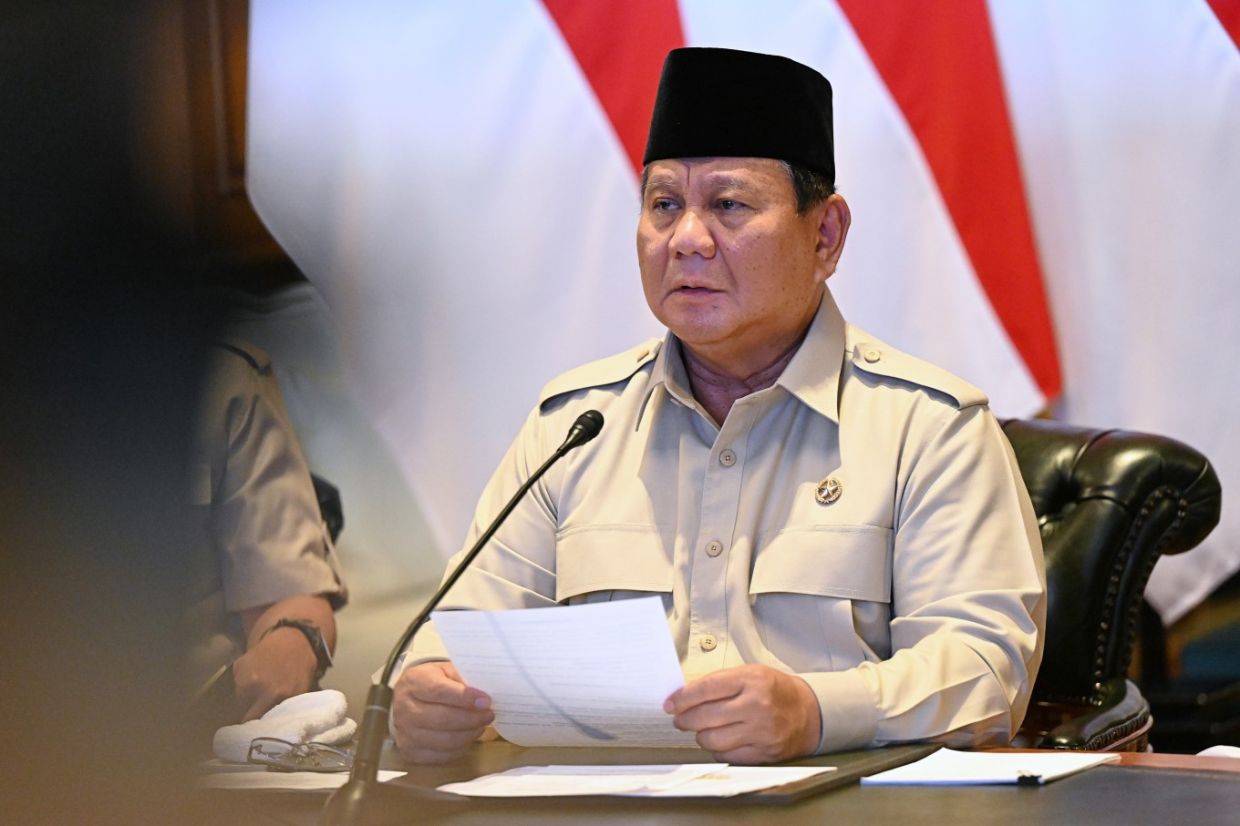
Indonesian President Prabowo Subianto's political fortunes have undergone a dramatic reversal. What was once described as an almost mythical period of sustained public goodwill has now come to an abrupt end, with fresh polling data revealing a precipitous nine-month collapse in his approval ratings. The shift from 81.2 percent satisfaction in November 2025 to just 51.1 percent in July 2026 represents not merely a dip in popularity but a fundamental recalibration of public sentiment, driven by mounting frustrations with economic performance and the gap between campaign rhetoric and on-the-ground reality.
The presidential honeymoon that Prabowo enjoyed was, by any comparative standard, remarkable in its duration and resilience. Throughout 2025, he maintained approval ratings consistently in the 70 to 80 percent range—a plateau that his predecessor Joko Widodo did not reach until well into his second term. Even by global standards, the figures were exceptional. American presidents entering their tenures in recent years have started with far lower baselines: Donald Trump's second term began at 47 percent approval in January 2025, while Barack Obama and Joe Biden both experienced steeper early declines from their initial highs. The Indonesian public appeared genuinely committed to giving Prabowo an extended runway to govern.
What sustained this unusual period of grace was not simply the residual momentum from his 2024 election victory. Instead, the government's flagship social spending initiatives, particularly the free nutritious meal programme introduced in January 2025, appeared to translate directly into measurable public satisfaction. The programme succeeded in converting campaign promises into visible, tangible benefits that reached millions of households. This approach proved effective in extending the goodwill that typically accompanies any new administration. Yet as economists and political analysts have long observed, no such period lasts indefinitely. The July 2026 data from Saiful Mujani Research and Consulting (SMRC) simply reflect the inevitable reassertion of democratic accountability, where aspirations confront constraints and rhetoric meets reality.
The mechanics of Prabowo's decline follow a well-established pattern in Indonesian politics and indeed globally. His central campaign pledges—to control corruption and accelerate gross domestic product growth from 5 to 8 percent—are now being measured against an increasingly difficult economic environment. A weakening rupiah, sluggish equity markets, rising food prices, and mounting public anxiety about household purchasing power have all converged to create a gap between what was promised and what citizens are actually experiencing. When presidents enjoy strong underlying economic momentum, rhetorical skills and media visibility can paper over minor implementation gaps. Yet as the economic narrative shifts, public tolerance for such gaps evaporates rapidly.
The scale of the approval collapse is striking in another dimension: the rise in active dissatisfaction. In November 2025, only 16 percent of respondents expressed disapproval of Prabowo's performance. By July 2026, that figure had surged to 46.9 percent. This is not merely a softening of support but the emergence of a substantial base of active critics. SMRC executive director Deni Irvani attributed the shift to three converging negative perceptions: economic management, political conditions, and law enforcement outcomes. Economic satisfaction plummeted to just 15.7 percent by July, while political satisfaction collapsed from 35.8 percent in November to 13.5 percent in July. Only law enforcement perceptions held relatively steady at 26.4 percent, suggesting that Prabowo's much-publicized anti-corruption and security initiatives have not yet moved public sentiment.
For Malaysian observers, the Indonesian situation offers instructive parallels. Both countries have experienced the phenomenon of extended presidential or prime ministerial honeymoons following electoral victories, yet both have also witnessed how quickly public sentiment can shift when economic conditions deteriorate or flagship programmes encounter implementation difficulties. The Malaysian experience with various administrations demonstrates that even popular leaders cannot indefinitely defy economic gravity. Currency weakness, inflation, and concerns about fiscal sustainability tend to eventually override political capital and media management strategies. Prabowo's experience suggests that Southeast Asian publics, whatever their initial enthusiasm, ultimately judge leaders by pocketbook issues rather than communicative prowess or political visibility.
It is worth noting that Prabowo himself has not been a passive figure during this downturn. He maintains a highly visible public profile, delivers frequent televised addresses, and operates a sophisticated communications apparatus designed to keep him prominently featured in national discourse. His willingness to respond directly and forcefully to critics in media and political circles has been characteristic of his leadership style. Yet the polling data suggest that this approach has reached its effective ceiling. Public relations intensity cannot overcome the weight of daily economic experience. Citizens ultimately make judgments based on observable changes in prices at markets, movements in exchange rates, employment prospects, and whether promised programmes arrive on schedule and function as advertised. Rhetorical engagement with critics, however potent it may be in political circles, operates at a different level from the lived experience that actually drives approval ratings.
A fair critique of the polling data must acknowledge that Saiful Mujani, founder of SMRC, has emerged as an outspoken government critic in recent months. Officials from Prabowo's Gerindra Party have raised questions about potential bias in SMRC's methodology and interpretation of data. Such concerns deserve serious consideration in any comprehensive analysis. However, methodological criticism is not equivalent to evidence of flawed polling. SMRC has maintained a credible track record across multiple administrations and political cycles, including periods when its surveys favoured the Jokowi government. More importantly, the SMRC findings are not isolated anomalies. Indikator Politik Indonesia conducted an independent survey of 4,250 respondents between July 14 and 24, 2026, which found satisfaction at 49.5 percent—a figure that closely tracks SMRC's results and demonstrates a consistent pattern of decline from December 2025 when Indikator recorded 81 percent approval. When two independently operated polling organisations converge on similar numbers separated by only small margins, the argument that the results reflect pollster bias becomes substantially harder to sustain.
The government has begun responding to these warning signals with renewed policy attention. Officials familiar with discussions at the Presidential Palace report that Prabowo has convened the National Economic Council to examine ways to strengthen economic management, the area where public satisfaction has collapsed most dramatically. Announced measures include expansion of social assistance programmes, though the timing of such announcements coming after the approval decline raises questions about whether they represent genuine policy recalibration or reactive damage control. Concerns about climate disruption from anticipated El Niño conditions have also entered government planning, with officials indicating that fuel prices will be held steady to protect household purchasing power—a decision that reflects awareness of inflation's political consequences.
Beyond immediate policy adjustments, Prabowo's inner circle has also engaged polling specialists who worked on his successful 2024 presidential campaign to analyse the current situation and identify pathways to recovery. These consultants reportedly have advised the President that public approval could be restored through improvements in government programme implementation and enhanced public communications strategy. Specific programmes flagged for attention include the free nutritious meal initiative and the Red and White Cooperatives programme, both of which have encountered execution difficulties in recent months. The fact that Prabowo feels compelled to seek external advice on his communication approach represents an implicit acknowledgment that current strategies are insufficient.
Historically, a 30-point approval decline over nine months is neither unprecedented nor automatically catastrophic for a leader. Indonesian and global political history provides examples of presidents and prime ministers who have recovered from even steeper drops. Jokowi himself experienced significant fluctuations in approval during his tenure, yet completed two full terms. However, the recovery process typically requires genuine improvement in the underlying conditions that drove the decline—inflation must moderate, employment must improve, currency stability must return, and flagship programmes must demonstrate actual results. Purely rhetorical or communicative adjustments, however skillfully executed, cannot substitute for such material improvements. For Prabowo, the critical period ahead will determine whether the economic conditions prove responsive to government intervention or whether external factors constrain policy options.
The broader lesson for Southeast Asia is that electoral mandates and initial popular goodwill, while valuable assets, do not create immunity from the fundamental constraints of governance. Public sentiment reflects rational calculations about living standards and government performance. The Indonesian case demonstrates that even historically extended periods of public support eventually give way to accountability mechanisms when citizens perceive that promises are not being fulfilled or that conditions are deteriorating. How Prabowo navigates this transition in coming months will provide important signals about both his individual political future and the durability of democratic institutions in Indonesia more broadly.

