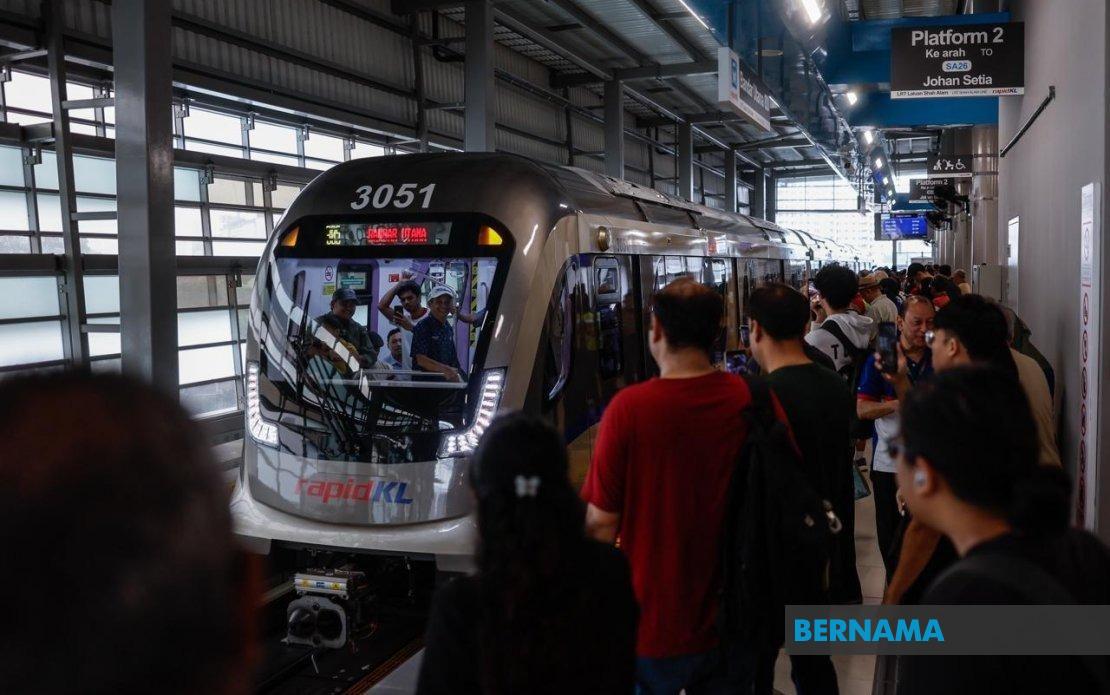
The Light Rail Transit 3 Shah Alam Line commenced operations on June 29, marking a fresh addition to the Klang Valley's public transportation network and opening a new commuting corridor for residents across the western suburbs of Kuala Lumpur. Prasarana Malaysia Berhad, the operator responsible for the new line, has tempered expectations for opening day traffic, projecting between 5,000 and 10,000 passengers to board services across the 23-kilometre route spanning 18 stations from Shah Alam to Bandar Utama. While such figures might appear modest compared to the maturity of established lines, they reflect the typical adoption curve for new transit infrastructure, where awareness and habit formation among commuters develop gradually over weeks and months rather than materializing instantly.
Amir Hamdan, Prasarana's president and chief executive officer, outlined the company's longer-term traffic forecasts during a site visit at Glenmarie 2 station, one of the line's key interchange hubs. The authority has set an ambitious target of 67,000 passengers per day by the end of the first operational year, contingent upon how swiftly residents transition from private vehicles to the new rail service and integrate it into their commuting patterns. This projection underscores Prasarana's confidence that the line will generate genuine demand among the middle-income workforce concentrated in Shah Alam's manufacturing and corporate sectors, many of whom currently depend upon private automobiles despite chronic traffic congestion in the region.
Early indications suggest the launch has generated enthusiasm among the commuting public. Amir reported widespread positive sentiment from passengers who boarded the inaugural services, with many expressing relief at the prospect of escaping daily gridlock and enjoying a more comfortable, predictable journey to their workplaces. Social media activity provided tangible evidence of user satisfaction, as early adopters shared their experiences online, amplifying word-of-mouth awareness of the new service. This organic enthusiasm is crucial for building ridership momentum in the weeks ahead, as satisfied early passengers become informal ambassadors encouraging friends and colleagues to trial the line themselves.
The federal government has strategically sweetened the value proposition for potential riders by implementing a one-month free-travel promotional period, announced by Prime Minister Datuk Seri Anwar Ibrahim on June 28. Beginning immediately and extending through July 31, all passengers boarding LRT3 Shah Alam Line trains or connecting Prasarana feeder bus services will incur no fare charges. This subsidy represents a calculated investment in ridership acquisition, removing a significant psychological and financial barrier during the critical early-adoption phase when commuters are forming habits and assessing whether the service justifies modifications to their established routines. The promotion effectively transforms the first month into an extended trial period, permitting risk-averse commuters to evaluate the service thoroughly before committing financially.
Operationally, the line commenced service at 6 am with train headways—the interval between successive vehicles—set at approximately eight minutes during peak morning hours. Prasarana reported smooth inaugural operations across all stations, with automatic gates, ticketing machines, and passenger flow management systems functioning without significant disruptions. This technical stability is foundational to building public confidence; any widespread malfunctions or service interruptions during the opening period could undermine the nascent ridership base that management hopes to cultivate. The relatively generous eight-minute frequency reflects a measured approach balancing passenger comfort with operational efficiency, ensuring neither excessively crowded trains during rush periods nor excessive waiting times that would discourage adoption.
Key interchange stations represent particular strategic importance for the line's overall network integration. Glenmarie 2 station, where Prasarana's senior management conducted their opening-day inspection, connects to the established Kelana Jaya Line, permitting through-passengers traveling from or to that corridor to access Shah Alam destinations without returning to the city center. Similarly, Bandar Utama station interfaces with the Kajang Line, creating a second major connection point that expands the network's coverage and utility. These interchange capabilities magnify the economic value of the new line by reducing journey times and transfers for trip-makers whose destinations lie beyond the immediate Shah Alam corridor, effectively incorporating the new infrastructure into a more cohesive metropolitan transit ecosystem.
Prasarana's management has deliberately positioned the initial operational phase around iterative service refinement rather than aggressive capacity expansion. The operator intends to monitor ridership patterns meticulously, incorporating user feedback to inform future decisions regarding train frequency increases or the deployment of additional rolling stock during congested periods. Amir Hamdan indicated a willingness to station reserve trains at designated locations along the route, enabling rapid deployment during unanticipated demand spikes, though no such measures are currently anticipated as necessary. This adaptive posture reflects lessons learned from previous transport infrastructure projects across Asia, where premature over-provisioning generates wasteful costs while under-sizing creates bottlenecks that undermine network reputation.
One operational consideration Prasarana has explicitly deferred is the introduction of women-only coaches, a feature increasingly common on crowded transit systems across Southeast Asia and beyond. While the operator has not ruled out this enhancement, current ridership levels do not justify dedicating scarce carriage capacity to gender-segregated seating; instead, Prasarana intends to collect usage data and solicit passenger feedback before advancing such proposals. This evidence-based approach acknowledges that Malaysian commuter preferences and security priorities may diverge from patterns observed elsewhere, necessitating local validation before implementing specialized facilities. The decision illustrates a broader principle guiding Prasarana's inaugural phase: gathering empirical data about actual ridership behavior rather than relying upon assumptions or international precedents.
The Shah Alam Line's emergence carries particular significance for Malaysia's economic geography and urbanization trajectory. Shah Alam, designated as Selangor's state capital and home to substantial manufacturing, automotive, and technology sectors, generates substantial daily commuter traffic primarily from Kuala Lumpur and surrounding municipalities. The previous absence of direct rail connectivity forced reliance upon privately operated buses and personal vehicles, constraining workforce flexibility and productivity while contributing to regional air quality degradation. The new line therefore addresses a genuine infrastructure gap, potentially unlocking latent demand for employment and residential locations in Shah Alam by reducing commute friction and cost for workers based elsewhere in the Klang Valley.
From a regional perspective, the LRT3 Shah Alam Line represents incremental progress in Southeast Asia's broader urban transit modernization. While Malaysia has achieved significant metro expansion in recent decades, comparable cities across Thailand, Indonesia, and the Philippines continue grappling with severe congestion, indicating the competitive advantage reliable rail transit confers upon metropolitan economies. The smooth opening of this new line, coupled with forthcoming phases of other projects including the mass rapid transit corridors currently under construction, positions the Klang Valley favorably relative to comparable urban regions facing acute capacity constraints. Success in building ridership and extending service frequency will validate continued public investment in rail infrastructure, potentially unlocking political support for subsequent phases of planned expansion.
The coming weeks and months will test whether the modest opening-day projections translate into sustained adoption establishing the 67,000-passenger daily target. Prasarana's commitment to continuous monitoring and adaptive service adjustments positions the operator to respond constructively to operational challenges or unexpected usage patterns. The free-ride promotional period provides a natural extended trial window, after which fare revenue will begin accruing and the service's financial viability becomes more transparent. For Malaysian transportation planners and policymakers, the LRT3 Shah Alam Line's trajectory offers valuable evidence regarding commuter responsiveness to new rail infrastructure quality, accessibility, and frequency—data that should inform decisions about future network expansion and investment prioritization across the country's metropolitan corridors.

