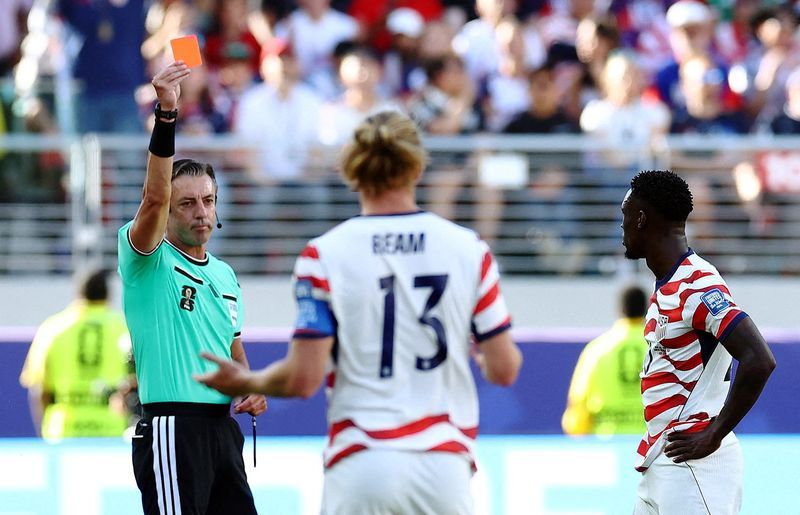
The Premier League's top referee and chief executive have raised serious concerns that the fallout from FIFA's controversial handling of United States forward Folarin Balogun's World Cup red card could profoundly damage confidence in football's officiating structures. The incident, in which political intervention led to the reversal of Balogun's suspension through a process critics viewed as opaque, threatens to create lasting doubts extending well beyond the tournament and into the domestic season beginning Friday.
Balogun's dismissal became one of the tournament's most polarising moments when U.S. President Donald Trump publicly involved himself in the matter, subsequently prompting FIFA to overturn the suspension. The episode has prompted Howard Webb, head of Pro Ref—the organisation managing English football's match officials—and Premier League chief executive Richard Masters to warn that such events create unnecessary controversy and fuel perceptions of systemic corruption within the sport's governance.
Webb's principal concern lies not in legitimate debate surrounding the original red-card decision itself, but rather in how the subsequent reversal was conducted. The former 2010 World Cup final referee articulated his disquiet with unusual candour, noting that the political pressure applied to FIFA had been openly acknowledged and that the suspension removal occurred through procedural channels that appeared to materialise specifically to address this case. This ad-hoc approach, he suggested, fundamentally undermines the credibility of disciplinary processes that should operate according to consistent, transparent criteria.
The timing of this controversy compounds the problem considerably. Webb highlighted that controversial match decisions increasingly face online scrutiny from those determined to interpret them as evidence of corruption, with social media amplifying unsubstantiated theories about officials' motivations. The Balogun episode now provides apparent corroboration for such conspiracy-minded interpretations, suggesting to casual observers that political and other illegitimate influences genuinely operate behind football's administrative scenes. This perception, Webb warned, risks poisoning public discourse around officiating for years.
Masters echoed these concerns while lamenting that global tournament coverage has become dominated by off-field institutional failures rather than the quality of football itself. He noted that discussion should centre on Spain's commanding performances and England's agonising semi-final elimination, yet instead revolves around governance controversies. This shift in public conversation reflects deeper anxieties about institutional integrity within professional football.
The Premier League chief further identified systemic vulnerabilities in FIFA's disciplinary framework that enabled this situation to arise. Unlike many domestic competitions, FIFA's regulations lack mechanisms for reviewing and overturning red cards through legitimate channels, creating rigidity that can only be overcome through irregular procedures. Masters characterised the Balogun case as an isolated incident rendering the sport's most basic disciplinary tool unresolvable through normal means, a structural flaw that this episode has exposed starkly.
The implications for the domestic season are substantial. England's top division operates under intense scrutiny wherein every significant referee and VAR decision faces detailed examination from partisan supporters, professional analysts, and social media commentators. Webb's primary worry is that the World Cup controversy has supplied fresh fuel to those inclined toward questioning officials' impartiality, meaning that even routine decisions could attract accusations of bias or corruption during the coming months.
The situation becomes more complex as the Premier League introduces an unprecedented package of revised match regulations designed primarily to accelerate play and reduce time-wasting. Webb indicated that referees will issue fewer cautionary warnings whilst penalising more transgressions, fundamentally altering how matches are controlled. This enforcement philosophy amplifies the stakes for every decision, as officials will make more visible interventions throughout fixtures, each subject to potential reinterpretation by those predisposed toward questioning their integrity.
Webb suggested that expanded penalisation will eventually influence player behaviour positively, as competitors adjust their tactics to avoid increased disciplinary consequences. Yet this transition period will necessarily involve more stoppages and decisions that provoke debate, potentially exacerbating public scepticism about officiating if the Balogun-induced credibility crisis persists. The convergence of heightened scrutiny from the World Cup saga and expanded penalty enforcement creates a challenging environment for maintaining public confidence.
For Malaysian and Southeast Asian football observers, these developments carry particular significance. English Premier League matches attract enormous viewership across the region, and perceptions of officiating integrity directly influence audience engagement with the competition. If substantial doubt develops regarding the fairness and transparency of match decisions, regional enthusiasm for following the league could diminish. Furthermore, Malaysian clubs increasingly compete in continental competitions and might ultimately aspire toward higher tiers of international football, meaning they benefit from confidence in Asia's neighbours' adherence to professional standards.
The Balogun episode also demonstrates how even elite football organisations can struggle when political actors exert pressure over sporting decisions, a concern relevant throughout Asia where governance boundaries sometimes blur. The incident suggests that maintaining clear separation between political authority and sporting administration requires constant vigilance and transparent processes, lessons applicable far beyond English football.
Webb's underlying point extends beyond technical officiating concerns. His assertion that such political influence fundamentally contradicts the sport he knows reflects anxiety about football's institutional direction globally. When FIFA's decision-making becomes dependent on external pressure rather than established procedures, confidence in the organisation's independence erodes. The Premier League's anxiety about how this affects English domestic football reflects broader worries about whether modern football administration can maintain credibility amid mounting expectations and competing power interests.

