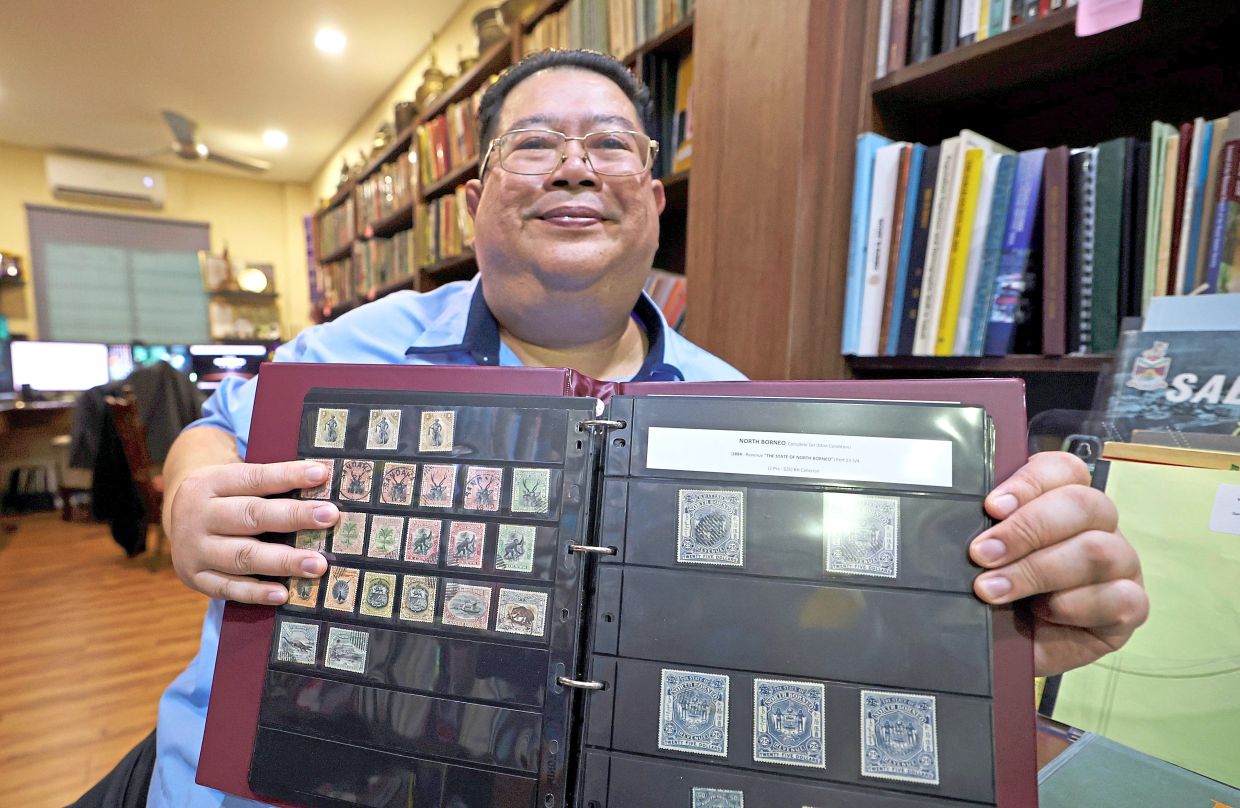
The philatelic treasures of North Borneo are quietly disappearing from public consciousness, threatening to erase a tangible record of Sabah's transformation over more than a century. These postage stamps, issued continuously from 1883 until 1963, represent far more than mere payment for postal services—they constitute what scholars now recognise as a comprehensive visual documentation of the territory's evolution, indigenous culture, and place within the broader British Empire. As markets for these artefacts shrivel and new generations turn away from the hobby that once captivated thousands, preservation efforts have become increasingly urgent.
Dr Shari Jeffri, the 56-year-old founder and president of the Borneo History Association, has emerged as a leading voice in championing the conservation of these stamps. He characterises the North Borneo philatelic collection as a "living archive"—a term that captures the essential paradox facing historians and collectors today. Unlike conventional archives housed in climate-controlled institutions, these stamps exist scattered across private collections, antique shops, and family inheritances, their survival dependent on the whims and longevity of individual custodians. Jeffri's central concern reflects a broader anxiety about cultural preservation in Southeast Asia: younger generations, accustomed to digital communication and instant information access, have shown markedly less enthusiasm for the methodical, contemplative practice of stamp collecting that characterised earlier decades.
The demographic crisis is real and measurable. A systematic survey of antique dealers throughout Kota Kinabalu revealed that North Borneo stamps have become increasingly difficult to locate in the marketplace. When specimens do surface, their prices reflect significant premiums, with valuation determined by a complex interplay of factors including issuance year, physical condition, and rarity status. One notable discovery during this survey involved an album containing stamps from the Queen Elizabeth II series issued between 1954 and 1961—including a striking six-cent denomination featuring the monarch alongside a Dusun woman, and a ten-cent stamp documenting logging operations. These particular pieces underscore how the stamps functioned as instruments of imperial representation and economic messaging.
Jeffri's own relationship with philately originated through familial inheritance rather than childhood passion. His grandfather, employed at the Recreation Club Jesselton during the 1920s, had been exposed to stamp collecting through his interactions with British officers and developed a serious commitment to the hobby. The grandfather's hope—that subsequent generations would inherit both his collection and his enthusiasm—was ultimately realised in Jeffri, though only after an intervening period of disinterest. Introduced to stamps at age seven, Jeffri did not actively pursue collecting until secondary school, at which point his inherited family collection became the catalyst for deeper historical investigation and professional specialisation.
The crown jewels of Jeffri's collection include two two-cent denominations from the inaugural 1883 issue, each featuring a brown sailing boat design and bearing complete postal cancellations. These pieces occupy a unique position within philatelic hierarchies: for serious collectors, a collection lacking representatives from the foundational 1883 series is considered fundamentally incomplete. The philosophical significance extends beyond aesthetic or monetary considerations. As Jeffri explains, every stamp functions simultaneously as historical evidence and narrative document—a physical assertion of territorial identity, economic activity, and cultural priority at a specific moment in time.
The institutional history of North Borneo stamps reflects the territory's complex colonial administration. The British North Borneo Chartered Company, a corporate entity granted sovereign powers by the Crown, initiated postal services and stamp issuance in 1883, maintaining this monopoly for approximately five decades. During this extended period, design evolution tracked broader shifts in how the colonial authorities wished to present North Borneo to international audiences. The earliest series featured heraldic and symbolic imagery—lions, tigers, sailing vessels—paired with the Latin motto "Pergo et Perago" ("I undertake and I achieve"), a deliberate rhetorical assertion of imperial competence and civilisational mission.
From 1894 onwards, the aesthetic vocabulary underwent substantial transformation. Imperial authorities recognised that showcasing North Borneo's distinctive flora, fauna, and environmental riches served multiple propaganda purposes: demonstrating the territory's material wealth, emphasising its ecological difference from European homelands, and justifying the extraction economy that underpinned colonial profitability. The 1935 redesign represented a particularly significant moment in this visual evolution, as it more explicitly centred indigenous Bornean identity within the imperial framework. These denominations, ranging from two cents to one dollar, functioned as miniature primers in imperial geography and resource documentation, circulating globally on international mail and subtly reinforcing claims about colonial legitimacy and developmental progress.
As a philatelist with nearly four decades of active experience, Jeffri possesses detailed knowledge about the technical and material dimensions of stamp authentication and preservation. The paper composition, adhesive chemistry, printing techniques, and postmark characteristics all constitute evidentiary pathways toward establishing authenticity and historical provenance. This technical expertise has become increasingly valuable as the market for rare stamps attracts sophisticated collectors and investors, some motivated more by financial appreciation than historical interest. Stamps bearing complete postal cancellations command particular premiums, as they preserve embedded information—mailing dates, specific post office locations, temporal markers, and routing details—that transforms them from isolated artefacts into components of broader historical documentation systems.
The conservation challenge facing North Borneo's philatelic heritage extends beyond market dynamics or generational disengagement. Physical deterioration presents an ever-present threat, with light exposure, temperature fluctuations, humidity variations, and acid contamination conspiring toward degradation and fading. Jeffri emphasises that preservation requires specialised knowledge: storing stamps in acid-free albums, maintaining consistent environmental conditions, and avoiding contact with materials that might trigger chemical reactions or discolouration. Many collectors, particularly those acquiring stamps casually or inheriting collections without accompanying expertise, unknowingly expose their holdings to preservation hazards.
To develop his substantial expertise, Jeffri studied under recognised authorities within Singapore's philatelic community, specifically Voon Kyam Foh and Tan Chun Lim, while maintaining engagement with specialised reference materials including the Commonwealth & British Empire Stamps catalogue. This educational pathway—acquiring knowledge from experienced practitioners and consulting standardised reference frameworks—represents the institutional scaffolding through which philatelic expertise perpetuates itself. As experienced collectors and scholars age without transmitting their knowledge to younger practitioners, the erosion of institutional memory accelerates.
The apparent obsolescence of postal communication poses perhaps the deepest challenge to philatelic preservation. In an era when digital transmission has displaced physical letters as the dominant form of personal correspondence, stamps have lost their primary functional significance. They no longer materialise on everyday correspondence flowing through postal systems; instead, they survive only as historical curiosities or investment vehicles. This functional displacement creates psychological distance: younger generations lack the intimate, experiential familiarity with stamps that earlier cohorts accumulated through routine encounters with postage. The stamps become foreign objects, disconnected from lived experience.
Yet precisely this historical distance offers preservation advocates a reframing opportunity. North Borneo's stamps function as irreplaceable primary sources documenting Sabah's transition from chartered company territory through late colonialism to independent statehood. They record the economic activities deemed significant enough for visual representation—logging, agriculture, maritime trade. They preserve evidence of indigenous cultural presence within an imperial visual economy. They document changing cartographic and administrative boundaries. No other category of historical material simultaneously offers such comprehensive coverage, such consistent international circulation, and such technical capacity for authentication. The stamps constitute a parallel archive existing outside institutional control, their dispersal across private collections rendering them simultaneously vulnerable and resilient.
The imperative facing contemporary collectors and historians involves transforming passive nostalgia into active preservation strategy. Jeffri's leadership of the Borneo History Association represents one institutional effort toward this goal, though broader systematic approaches—including digital cataloguing initiatives, educational programmes targeting secondary students, and collaborative relationships between private collectors and public institutions—would significantly enhance preservation capacity. The stamps themselves cannot speak or organise their own survival. That responsibility falls to those who recognise that these small paper rectangles, issued more than a century ago by imperial administrators, continue speaking eloquently about Sabah's past and deserve preservation for future generations who may yet develop the curiosity and commitment to listen.

