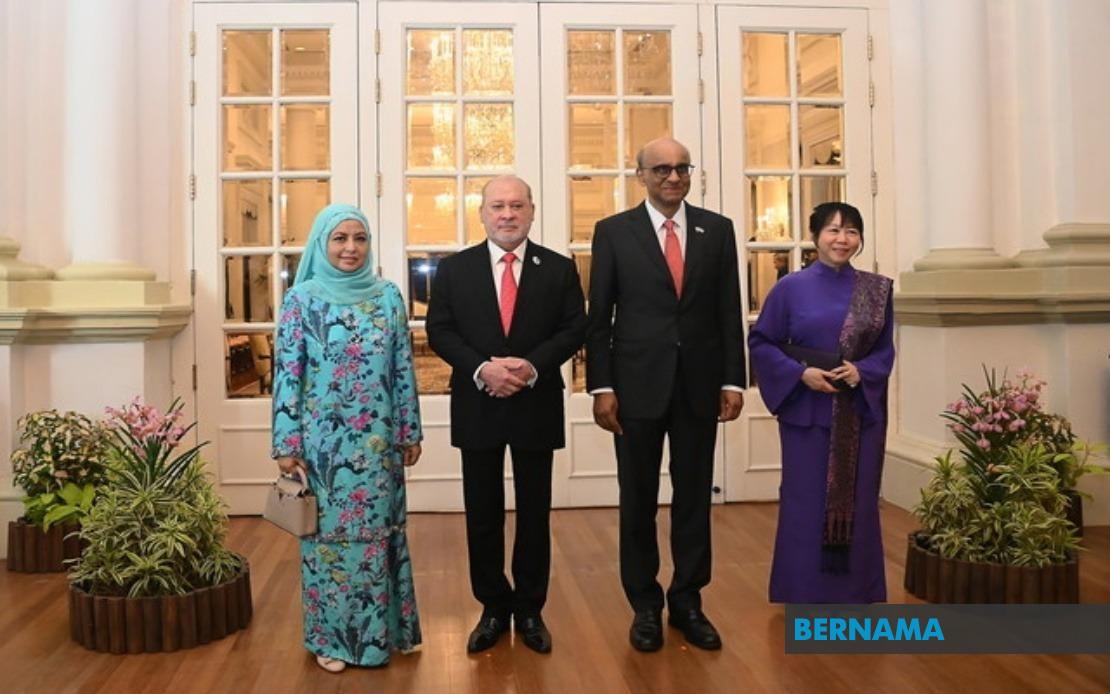
Singapore President Tharman Shanmugaratnam has characterised the Malaysia-Singapore relationship as uniquely enduring, built upon foundations of shared heritage and deep economic interdependence rather than transactional convenience. In remarks preceding his three-day state visit to Malaysia from July 13, 2026—undertaken at the invitation of His Majesty Sultan Ibrahim, King of Malaysia—President Tharman underscored that the two neighbours have developed what he calls a genuine partnership grounded in accumulated trust and mutual respect across six decades of formal relations.
The two countries' historical trajectory reveals connections far deeper than those typical between states. President Tharman noted that Singaporeans and Malaysians are linked through kinship networks and cultural traditions that predate modern nation-states, with these bonds evident in shared customs, languages, and multilayered heritage. The Johor-Singapore Causeway exemplifies this integration, functioning as the world's busiest land border crossing and facilitating hundreds of thousands of daily movements of people and goods. Recent collaborative efforts to preserve this shared culture—including the successful joint UNESCO inscription of the kebaya alongside Brunei, Indonesia, and Thailand—demonstrate how both governments actively work to sustain traditions for future generations. Current initiatives extend to pursuing UNESCO recognition for Chingay, the street procession that visibly celebrates their evolving multicultural identities.
What distinguishes this bilateral relationship from others in the region is an explicit acknowledgement that disagreement is inevitable between close neighbours, yet such disputes need not derail the broader partnership. President Tharman articulated an approach of addressing differences squarely and transparently rather than allowing them to fester or dominate the relationship. This framework—rooted in mutual respect, adherence to international law, and a commitment to dialogue—has enabled both governments and their officials to maintain high levels of familiarity and trust. Rather than viewing occasional tensions as relationship failures, successive governments have consistently chosen to manage sensitive issues through calm negotiation, a discipline that has become increasingly relevant as global conditions deteriorate.
The economic relationship between Singapore and Malaysia extends far beyond symbolic gestures or diplomatic courtesies. Both nations benefit substantially from integrated economies, with trade, investment, and supply chains creating reciprocal advantages. President Tharman emphasised that deepening this economic integration becomes more critical as the global multilateral trading system fragments and great-power competition intensifies. In response, the two countries are pursuing specific high-value projects designed to strengthen regional resilience and attract international investment. The Johor-Singapore Special Economic Zone represents an innovative model of win-win cooperation, combining the respective strengths of each nation while creating new opportunities. Similarly, the Rapid Transit System Link promises to ease daily commuting for hundreds of thousands of workers crossing the land border, potentially reducing congestion while encouraging greater people mobility and labour market integration.
Climate change and energy transition represent areas where tropical neighbours like Singapore and Malaysia share not only common challenges but mutual interests in collaborative solutions. Both countries have announced sustainability and energy transition targets, yet achieving these goals through isolation would prove inefficient. President Tharman highlighted the potential for strengthened collaboration in renewable energy development and carbon credit markets, sectors where regional cooperation could accelerate both nations' progress toward net-zero commitments while creating new economic opportunities. This dimension of cooperation illustrates how global environmental imperatives can drive deeper bilateral integration when states view sustainability as a collaborative endeavour rather than a competitive race.
Digital economy development has emerged as a significant frontier for Malaysia-Singapore cooperation and broader ASEAN advancement. The recently concluded Digital Economy Framework Agreement, scheduled for signature at the 49th ASEAN Summit in Manila in November 2026, promises substantial economic expansion across the region. Current projections suggest ASEAN's digital economy could reach US$1 trillion by 2030 under existing trends, yet implementation of a high-quality DEFA could potentially double this figure to US$2 trillion. For Malaysia and Singapore, as digitally advanced economies within ASEAN, leading this transition offers both commercial advantages and the opportunity to shape regional standards and practices. President Tharman's emphasis on this domain reflects recognition that technological integration may ultimately prove as transformative as trade integration for the region's future prosperity.
Yet President Tharman cautioned that institutional agreements and infrastructure projects, while essential, cannot sustain a partnership without deliberate cultivation of human connections across borders. He identified a generational shift requiring proactive intervention: what came naturally to earlier generations—regular informal exchanges, cultural familiarity, and spontaneous people-to-people contact—now demands formal encouragement and structured programmes. Expanding bilateral exchange initiatives, joint internships, youth leadership forums, and collaborative community projects would help younger Malaysians and Singaporeans develop the same instinctive understanding and mutual regard that characterised previous cohorts. This dimension addresses a genuine vulnerability: as populations turnover and direct personal memories of integration fade, the relationship requires conscious reinforcement through institutional and educational channels.
Within the broader ASEAN context, Singapore and Malaysia occupy distinct but complementary positions as founding members with outsized influence on regional direction. President Tharman explicitly acknowledged Malaysia's successful ASEAN Chairmanship in 2025, which advanced significant initiatives including welcoming Timor-Leste as the 11th member state, upgrading trade agreements, and substantially concluding the digital economy framework. Under Prime Minister Datuk Seri Anwar Ibrahim's leadership, Malaysia demonstrated ASEAN's continued relevance by convening major global powers despite a complicated geopolitical environment. Singapore and Malaysia can leverage this momentum by working closely to maintain open trading systems, deepen ASEAN integration, and expand the grouping's external partnerships. The two countries bear shared responsibility for preserving ASEAN's coherence and trustworthiness as a regional partner, stakes that become higher as great-power rivalry intensifies.
President Tharman's framing of the relationship reflected broader regional anxieties about international stability. He argued that regional peace depends not on the absence of disputes but on the discipline to manage them responsibly through dialogue and restraint. The Singapore-Malaysia example therefore carries pedagogical weight for other regional relationships: it demonstrates that neighbouring states with complex histories and occasional disagreements can maintain stable, productive partnerships by adhering to rules-based approaches and prioritising long-term relationship health over short-term grievance satisfaction. This message resonates beyond bilateral relations into ASEAN dynamics more broadly, where various territorial disputes, competing claims, and historical grievances could easily destabilise the organisation without similar commitment to managed dialogue.
Looking toward Singapore's 2027 ASEAN Chairmanship, President Tharman positioned Singapore-Malaysia cooperation as foundational to regional stability and prosperity. The two countries can jointly work to maintain an open rules-based international order, deepen ASEAN integration, and expand the organisation's partnerships with external actors. Their ability to manage their own relationship responsibly while simultaneously advancing collective ASEAN interests demonstrates that regional cohesion remains achievable even amid global turbulence. This represents both a practical commitment to specific joint projects and a broader assertion that in an era of fragmenting international systems, strong regional integration becomes essential insurance against external disruption.
Beyond formal diplomacy and institutional cooperation, President Tharman's remarks reflected genuine personal appreciation for Malaysia's cultural complexity and hospitality. His references to enjoying Malaysian cuisines and cultural experiences over decades—from his youth through travels with his family—humanised what could otherwise appear as purely transactional state relations. Such personal dimensions matter because they create the affective foundations for political elites to invest in relationship maintenance even when immediate material incentives might not demand it. Leaders who genuinely appreciate neighbouring societies prove more resilient advocates for partnership when domestic political pressures encourage nationalist rhetoric or confrontation. In an era when populist politicians often gain traction by emphasising grievances with neighbours, elite embrace of cross-border appreciation provides important counterweight to divisive impulses.

