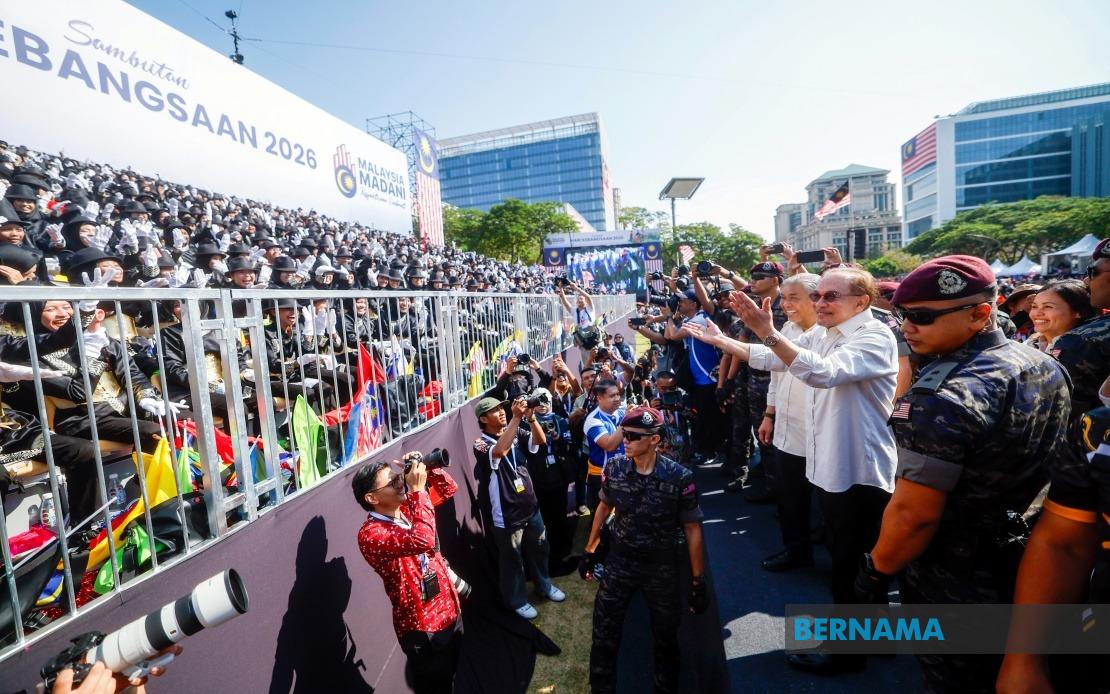
Prime Minister Datuk Seri Anwar Ibrahim expressed his satisfaction with the patriotic fervour demonstrated by Malaysians at the 2026 National Day celebration held at Dataran Putrajaya on August 31. Speaking to reporters after observing the 69th National Day parade, Anwar offered his appreciation to all participants and members of the public who converged on the capital's ceremonial grounds to commemorate the nation's independence. His remarks reflected the visible enthusiasm that characterised the event, which had drawn preparations and expectations across the country in the weeks leading to the celebration.
The festivities commenced at eight o'clock in the morning under the patronage of His Majesty Sultan Ibrahim and Her Majesty Raja Zarith Sofiah, with the King and Queen welcomed by Anwar and his wife, Datuk Seri Dr Wan Azizah Wan Ismail. Also present was Communications Minister Datuk Seri Fahmi Fadzil, who chairs the 2026 National Day and Malaysia Day Main Committee. The attendance of the royal couple underscored the significance of the occasion, which operates as a barometer of national sentiment and civic engagement in Malaysia's political calendar.
Operating under the banner of Malaysia MADANI: Kesejahteraan Dinikmati—roughly translating to Malaysia MADANI: Shared Prosperity Enjoyed—the celebration unfolded through a carefully choreographed sequence of military ceremonial proceedings, artistic performances, and a procession that sought to embody the government's vision of inclusive development. The parade itself represented a substantial logistical undertaking, drawing together 10,819 participants distributed across 76 contingents and 22 marching bands. The spectacle incorporated 11 specially decorated vehicles, 328 assets deployed from land, sea and air domains, 112 service animals, and notably, 22 electric vehicles, signalling the government's commitment to environmental sustainability within its public messaging.
The scale of public participation reflected genuine national engagement with the occasion. More than 100,000 citizens attended the event, with many demonstrating their commitment by camping at Dataran Putrajaya overnight in anticipation. This turnout suggests that despite Malaysia's complex political landscape and the challenges facing the nation, significant sections of the public remain invested in public displays of national identity and unity. The diversity represented across the 76 contingents, drawn from military units, civic organisations, and community groups, visually reinforced the Malaysia MADANI narrative of a nation embracing its multicultural composition.
Anwar's decision to spend considerable time mingling with crowds, traversing more than 500 metres around Dataran Putrajaya and accommodating photograph requests, demonstrated a deliberate strategy of accessibility and direct engagement with ordinary citizens. This style of public interaction, while common in Malaysian political practice, carries particular significance given recent debates about political leadership and public accountability. The Prime Minister's extended presence among attendees signalled an attempt to ground his administration's governance narrative in tangible connection with those whom government policies affect most directly.
The timing of the National Day celebration proved opportune for highlighting welfare announcements made by Anwar in his Prime Minister's Address the previous day. Among these initiatives was the restoration of the monthly basic eligibility quota under the BUDI MADANI RON95 fuel subsidy programme from 200 litres to 300 litres—a decision affecting more than 16 million users of subsidised RON95 petrol. The expansion addresses cost-of-living pressures that have preoccupied Malaysian households, particularly among lower and middle-income groups where fuel expenditure constitutes a substantial budget allocation. The public's immediate and positive response to this announcement, evidenced by a crowd member's spontaneous gratitude expressed directly to Anwar, illustrated how such measures resonate tangibly within communities.
The government simultaneously announced that more than half a million eligible proprietors of diesel-powered pickup trucks and jeeps would receive access to up to 400 litres of BUDI Diesel monthly beginning September 1. This extension to the subsidy programme targets a specific economic segment—commercial vehicle operators and those engaged in agricultural or transport-related activities—whose operational costs directly influence commodity prices and rural livelihoods throughout Malaysia. The announcement thus positioned welfare expansion beyond urban consumer groups toward productive sectors whose prosperity generates broader economic multiplier effects.
These policy announcements during a high-visibility national celebration demonstrate how Malaysia's political leadership integrates fiscal commitments with symbolic national occasions. The juxtaposition of patriotic ceremonial, mass public participation, and welfare expansion messaging creates a comprehensive political narrative connecting governance to national identity. For citizens experiencing economic pressures, the timing and content of such announcements carry weight beyond their technical fiscal implications, signalling government responsiveness to household concerns during periods of national commemoration.
The Malaysia MADANI framework itself, emphasised throughout the celebration's thematic design, represents the Anwar administration's attempt to articulate a coherent governing philosophy emphasising prosperity distribution, multicultural respect, and inclusive development. The parade's visual components—from marching bands to human graphics performances on the terraces—translated this abstract governance concept into memorable imagery accessible to the estimated 100,000 attendees and, through media coverage, to millions nationwide. Such symbolic politics remain central to Southeast Asian political systems, where public ceremonies function as crucial mechanisms for political legitimacy construction.
For Malaysian citizens and observers of regional politics, the 2026 National Day celebration illustrated continuities in how Malaysia's leadership engages with questions of national identity, civic participation, and economic welfare. The integration of expanded subsidy benefits with patriotic commemoration demonstrates how governments employ simultaneous channels—fiscal policy and ceremonial occasion—to reinforce political narratives. The apparent public receptiveness to both the celebration and the announced benefits suggests, at least for this moment, alignment between government initiatives and public expectations around cost-of-living relief.
The scale and enthusiasm of the celebration, coupled with the substance of welfare announcements, positioned August 31's events as more than ceremonial routine. Rather, they functioned as an opportunity for the Anwar administration to demonstrate responsiveness to economic pressures while reinforcing a conception of national unity encompassing Malaysia's religious, ethnic, and cultural diversity. As the nation heads toward continued economic challenges and potential political transitions, such occasions serve as crucial junctures where government legitimacy is either reinforced or questioned through the accumulation of symbolic and material signals perceived by the citizenry.

