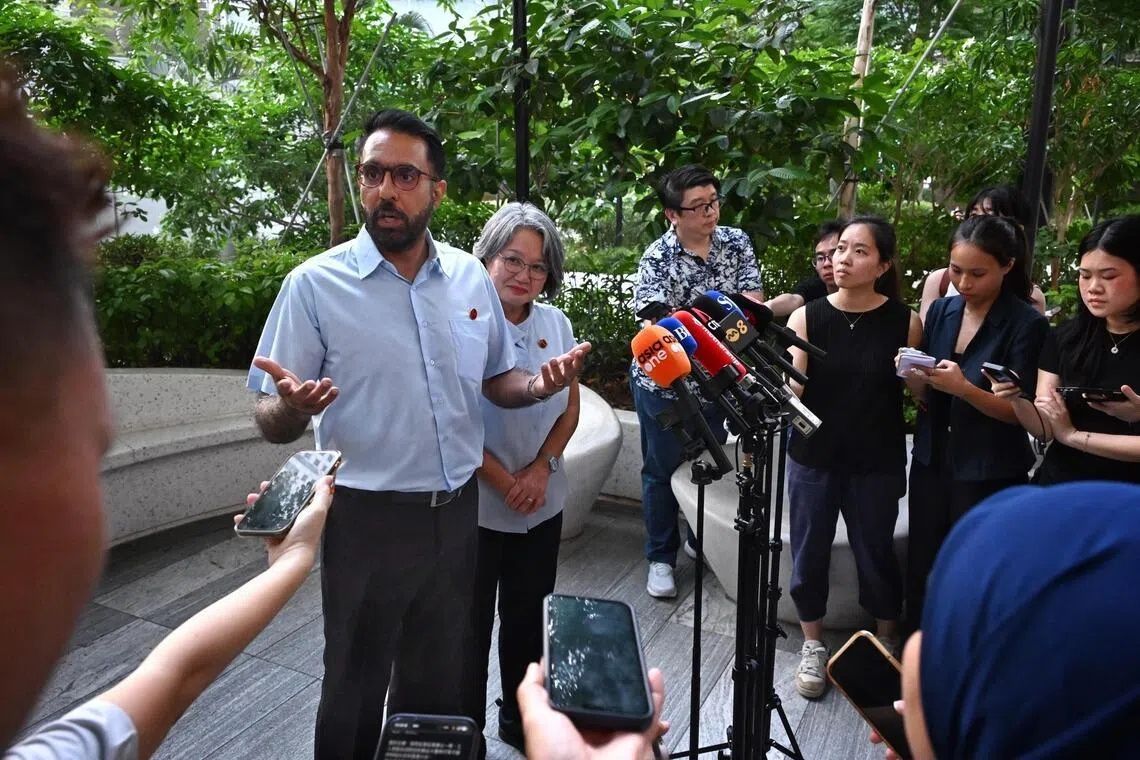
Pritam Singh has cemented his grip on Singapore's largest opposition party after overwhelming support from party cadres rejected calls for his resignation at a special meeting on June 28. The Workers' Party chief faced down an internal revolt triggered by a group of 25 dissidents demanding accountability and a change in leadership, but emerged with his position substantially reinforced. His unopposed re-election as party leader, coupled with a decisive secret ballot that showed roughly four-fifths of the party's inner circle backing his continued leadership, marks a turning point for an organisation that has endured turbulent years marked by scandal and legal controversy.
The challenge to Singh's authority originated from accumulated grievances within the party's base, particularly regarding his handling of former Sengkang GRC MP Raeesah Khan's false statements to Parliament in 2021. Singh faced court conviction for his role in this affair, with legal proceedings establishing that he had guided Khan to maintain her dishonesty over several months. The High Court upheld his conviction in December 2025, and Parliament subsequently declared him unfit for the position of Leader of the Opposition in January 2026. For an opposition party seeking to present itself as an ethical alternative to the ruling administration, these setbacks created genuine vulnerability within organisational ranks.
The formal procedural challenge came through a letter signed by 25 cadres demanding three outcomes: that Singh provide a public accounting of his conduct leading to conviction, that he resign from his position, or that he submit to a membership ballot on his continued fitness to lead. Party chair Sylvia Lim convened a special cadres conference to address these demands, with Aljunied GRC MP Gerald Giam presiding. The atmosphere, according to Giam's account, remained professional and substantive despite the serious nature of the proceedings. Participants were afforded opportunity to articulate their concerns, Singh delivered a comprehensive statement responding to the allegations, and members posed questions directly to him. The process unfolded in a single voting round, avoiding the protracted factional struggle that sometimes characterises opposition party internal contests.
Singh's response emphasised the party's obligation to maintain rational conduct and faithfully represent Singaporean constituents. He framed the internal vote as a test of party unity, noting that the outcome demonstrated cohesion within the membership. While declining to release precise ballot tallies, his characterisation of the result as showing the party was "pretty united" understated the magnitude of his victory. Party insiders subsequently confirmed that Singh captured approximately 80 per cent of the vote among the party's slightly more than 100-strong cadre circle—a proportion exceeding what analysts would typically describe as a supermajority and approaching consensus.
The timing and substance of the intervention by former Workers' Party chief Low Thia Khiang proved crucial to the outcome. As the meeting commenced at midday on June 28, Low made a public statement affirming his continued backing for Singh, effectively neutralising speculation that had circulated among dissidents about whether the previous party leader might support alternative candidates. This gesture from a revered party elder—someone whose credibility remained intact despite no longer holding formal position—provided crucial political cover for wavering cadres. Low's endorsement signalled that the party establishment largely viewed the internal challenge as manageable rather than as evidence of fundamental organisational dysfunction.
The apparent search by dissident cadres for a credible challenger to Singh highlighted the structural constraints facing opposition movements in Singapore's political context. For a challenge to succeed, dissidents required not merely numerical support among the membership but also an alternative figure with sufficient stature to plausibly assume leadership. The absence of such a candidate, combined with Low's reaffirmation of support for Singh, left the internal opposition politically isolated. The Workers' Party's biennial electoral process proceeded immediately after the challenge vote, with Singh proceeding to unopposed re-election as party chief. Party chair Sylvia Lim, a fixture since 2003, likewise faced no opposition for her continued tenure.
The party's central executive committee—the body responsible for operational decision-making between annual conferences—underwent renewal with most incumbents retaining their positions. Four of the twelve elected members do not sit in Parliament, including Low, former Aljunied GRC MP Faisal Manap, and long-serving member Tan Kong Soon. Notably, the committee added senior counsel Harpreet Singh as a new addition, drawing from the party's Punggol GRC team fielded during the May 2025 general election. The CEC retains authority to co-opt an additional seven members, a mechanism typically activated approximately one month following elections.
Harpreet Singh's statement following the vote provided insight into how party members themselves rationalised their backing for Singh despite his legal troubles. He rejected the notion that cadres had voted according to "blind loyalty," instead characterising the decision as reflecting careful assessment of Singh's historical performance and personal qualities. Singh pointed to his "tireless service," demonstrated capacity to maintain "calm under sustained political pressure," and ability to guide the party through "significant milestones in Singapore's parliamentary history." This framing attempted to separate judgement about Singh's legal violation from broader evaluation of his leadership capabilities. Harpreet Singh explicitly acknowledged that the High Court conviction stood and merited respect, yet argued that a complete evaluation of character necessarily encompassed broader dimensions of personal conduct and historical contribution.
The context for the internal party meeting included a formal disciplinary response that Singh had received two months earlier from the Workers' Party's own CEC. That body had issued a letter of reprimand following investigations by an internal disciplinary panel comprising Sengkang GRC MPs Jamus Lim and He Ting Ru and former Hougang MP Png Eng Huat. The panel determined that Singh had contravened two articles of the party's constitution through actions related to Khan's false parliamentary statements. This internal party discipline indicated that the organisation's formal structures possessed mechanisms for addressing misconduct by senior figures without removing them from leadership—a middle path between complete exoneration and forcing resignation.
Singh's legal trajectory had been severe by opposition party standards. Beyond the conviction itself, Parliament's Committee of Privileges and subsequent court proceedings had established his role in Khan's dishonesty. His appeal of the conviction was rejected when the High Court upheld the verdict in December 2025. Prime Minister Lawrence Wong subsequently removed him from the parliamentary position of Leader of the Opposition in January 2026, a formal pronouncement of unsuitability that carried significant symbolic weight. Wong then invited the Workers' Party to nominate another MP for the LO position, an invitation the party declined. Instead, the Workers' Party maintained that the role should naturally reside with the leader of the largest opposition party, a position that implicitly rejected the premise that Singh's legal troubles rendered him unsuitable for the formal status that typically accompanies such leadership.
For Malaysian observers and other Southeast Asian watchers of Singapore politics, the incident reveals both constraints and resilience in the city-state's opposition structures. The Workers' Party's capacity to manage internal dissent through formal procedures and to retain unity around a leader despite serious legal vulnerabilities demonstrates organisational coherence. Yet the party's inability or unwillingness to distance itself from a leader facing court conviction also illustrates the limited political space available to opposition movements operating under significant state pressure. The outcome suggests that Singapore's largest opposition party has concluded that its interests are better served by maintaining leadership continuity and party cohesion than by attempting the high-risk strategy of leadership transition. Singh's overwhelming endorsement by party cadres effectively closes this chapter of the Workers' Party's recent turbulent history, at least temporarily.

