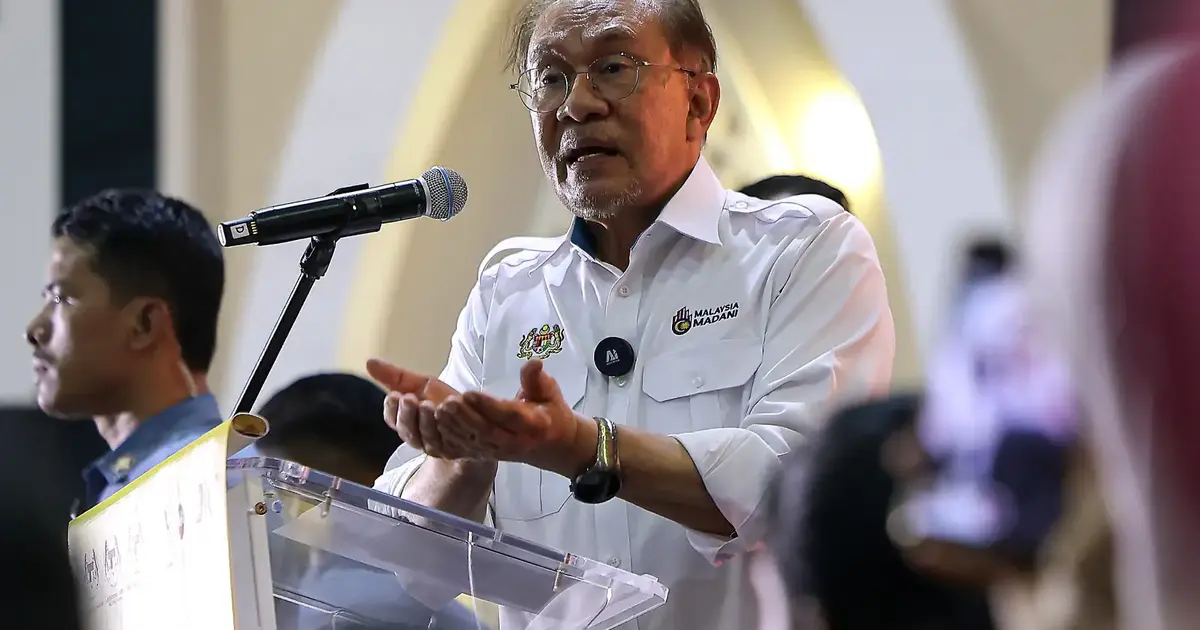
Prime Minister Anwar Ibrahim has moved to clarify a persistent tension in Malaysian public discourse, asserting that the defence of minority community interests represents no threat to the constitutionally enshrined position of Islam and Malay-Muslim Malaysians. The statement addresses longstanding anxieties within certain segments of the Malay-Muslim majority who view enhanced protection for non-Muslim and non-Malay communities as an implicit erosion of Article 153 privileges and Islamic prerogatives established at the nation's founding.
Anwar's position reflects a carefully calibrated approach to Malaysia's foundational social contract, which historically balanced exclusive Malay-Muslim constitutional protections against the grant of citizenship rights to the Chinese and Indian immigrant communities during the transition to independence. This arrangement has remained fundamentally intact for over seven decades, yet continues to generate interpretive disputes about the precise scope and application of Article 153, which grants the Yang di-Pertuan Agong custodianship over Malay rights, Islam's constitutional position, and the operational framework for Bumiputera privileges.
The prime minister's intervention appears designed to counter narratives circulating within certain conservative and nationalist quarters that frame efforts to strengthen enforcement of constitutional protections for minority groups—whether through enhanced grievance mechanisms, anti-discrimination legislation, or expanded civic participation—as a form of constitutional revisionism. These narratives have gained traction intermittently during political cycles when competitive appeals to identity-based constituencies become especially pronounced, occasionally creating rhetorical space for zero-sum framings of communal rights.
At the substantive level, Anwar's argument rests on a distinction between quantitative zero-sum competition and complementary constitutional implementation. The thrust of his reasoning suggests that Malaysia's founding constitutional architecture was never conceived as a single-axis spectrum wherein gains for minorities necessarily translate into losses for Malays and Muslims. Rather, the constitutional settlement contemplated dual systems of protections operating simultaneously: specific privileges for Bumiputeras and Islam anchored in Article 153, coupled with equal citizenship and protection under law for all Malaysians regardless of ethnic or religious origin under other constitutional provisions.
This interpretive framework becomes particularly important in the Malaysian context given the country's experience with episodic communal tensions and the government's ongoing responsibility to maintain social cohesion across deeply diverse populations. The experience of neighbouring regional states with unresolved minority grievances underscores the potential costs of allowing systematic disparities in legal protection or civic standing to accumulate unchecked. Conversely, attempts to dismantle established majority community protections have historically triggered defensive mobilisations and political instability.
Anwar's reassurance carries heightened salience given Malaysia's demographic composition and the political economy of Malaysian federalism, wherein electoral competition increasingly hinges on the ability of political coalitions to mobilise identity-based voting blocs. Statements clarifying that minority protection and majority constitutional standing are not inherently incompatible serve a crucial function in constraining political incentives toward inflammatory identity appeals that might otherwise dominate discourse during competitive electoral periods.
The practical implications of the prime minister's position extend to questions of institutional implementation and legislative agenda-setting. If minority protections are viewed as fully compatible with, rather than antagonistic to, Malay-Muslim constitutional standing, then Malaysian policymakers potentially face fewer political constraints in strengthening enforcement mechanisms for anti-discrimination law, expanding avenues for minority grievance redressal, and pursuing measures designed to enhance equal treatment before the law. Conversely, opponents of such measures can no longer rely exclusively on constitutional anxiety narratives; they must advance competing substantive arguments about effectiveness or unintended consequences.
The statement also reflects positioning within broader intra-government and coalition dynamics. Malaysia's ruling coalition encompasses parties representing Malay-Muslim, Chinese, and Indian constituencies, creating persistent pressures to demonstrate commitment to each group's interests. Anwar's emphasis on constitutional compatibility rather than trade-off dynamics allows the government to claim simultaneous commitment to both traditional Bumiputera frameworks and enhanced minority protections—though the actual allocation of resources, legislative priorities, and enforcement efforts will ultimately determine credibility of such claims.
Historically, similar clarificatory statements have emerged during periods when minority communities have mobilised around specific grievances—whether concerning education policy, religious conversion procedures, land rights, or economic opportunity structures—and when majority-community political actors have responded with defensive mobilisations. The effectiveness of such statements in actually reshaping underlying political incentives or public attitudes remains contested and context-dependent.
Moving forward, the durability of Anwar's framing will depend substantially on concrete governmental action demonstrating that minority protection initiatives proceed in tandem with respect for established constitutional frameworks rather than in opposition to them. Explicit acknowledgment of constitutional boundaries, careful legislative drafting that preserves existing Bumiputera structures whilst expanding non-discriminatory protections, and visible consultation with majority-community stakeholders can strengthen credibility. Conversely, policy choices perceived as unilateral or dismissive of majority-community concerns risk reinvigorating the very political dynamics the prime minister's statement seeks to transcend.
Ultimately, Anwar's assertion that minority defence does not entail abandonment of constitutional provisions favouring Malays and Islam reflects recognition that Malaysia's long-term stability rests on the mutually reinforcing nature of inclusive governance and constitutionally anchored protections. This framework acknowledges that both systems derive legitimacy from a founding constitutional settlement that contemplated plurality management through differentiated but complementary structures of rights and safeguards rather than through winner-take-all approaches to power distribution.

