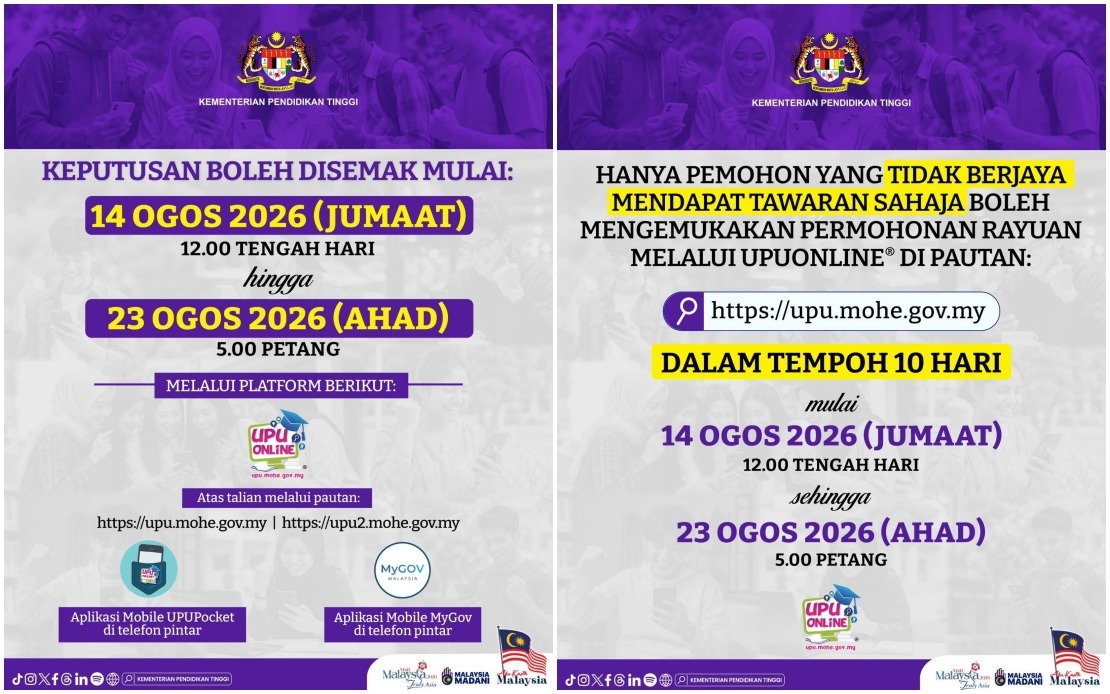
The Ministry of Higher Education has confirmed that admission decisions for STPM and equivalent qualification holders seeking entry to Malaysia's public universities will be released on August 14. This marks a crucial milestone for thousands of secondary school graduates awaiting confirmation of their university placements for the 2026/2027 academic session. The announcement comes as part of the standardised timeline administered through the UPUOnline system, which centralises applications across the nation's public higher education institutions.
Prospective students can access their results from noon on August 14 through multiple digital platforms, reflecting the government's push toward comprehensive e-government services. The official UPU portals at https://upu.mohe.gov.my and https://upu2.mohe.gov.my will display individual outcomes, while smartphone users can utilise the UPUPocket mobile application or the MyGov portal for real-time notifications. This accessibility window extends until 5 pm on August 23, providing a ten-day period for applicants to review their results without time pressure.
Once results are published, the responsibility shifts to candidates to formally respond to their offers. The confirmation process runs from August 15 through August 23, with successful applicants required to accept or reject their placements through individual university websites during this critical window. This stage is essential because failing to confirm acceptance within the specified timeframe may result in forfeiture of the offer, which could then be redistributed to other applicants. The Ministry emphasises that this confirmation process is binding, creating a direct link between student decision-making and institutional capacity planning.
Following student confirmations, public universities will begin issuing official offer letters on August 15 to those candidates who have accepted their places. These formal documents serve as the legal basis for enrolment and are typically required during registration for academic facilities and student services. The staggered timeline between result release and letter issuance allows universities to process confirmations systematically and prepare administrative documentation efficiently, reducing the risk of errors that could complicate the registration period.
For applicants who do not receive offers in the initial allocation, the Ministry has established an appeal mechanism within the same timeframe. Unsuccessful candidates may submit formal appeals through UPUOnline between August 14 and 23, a ten-day window that provides a structured pathway for those hoping to secure alternative placements. This appeals process acknowledges that initial allocations may not capture all deserving applicants and creates a second opportunity for marginal cases or those affected by minor scoring differences.
Crucially, the Ministry has stipulated that appeal selection depends entirely on available vacancies following the registration of newly admitted students. This means that spaces offered through appeals must emerge from the existing pool rather than through expanded intake, preventing institutions from exceeding their planned student numbers. This approach maintains institutional capacity management while still offering flexibility to accommodate additional candidates where genuine places become available, particularly when initially successful applicants decline their offers.
The Ministry's statement makes explicit that the placement offer for this academic session is final and immutable in most circumstances. Applicants cannot request programme changes or transfers between universities after receiving their initial offers, a restriction designed to prevent last-minute administrative chaos and ensure that universities can plan their cohorts with certainty. This firmness contrasts with some international systems that allow post-offer modifications and reflects the Malaysian system's focus on orderly, predictable transitions from secondary to tertiary education.
The timing of this announcement represents the culmination of months of application processing. STPM candidates typically submit their applications in the preceding academic session, and universities evaluate applications using standardised criteria including examination results, co-curricular achievements, and special considerations such as socioeconomic background or representation from underserved regions. The August 14 release therefore marks a transition point where institutional decisions become visible to individual applicants, triggering a cascade of personal decision-making across the country.
For Malaysian students, this timeline carries significant implications. The combination of early August announcement and late August confirmation deadlines effectively compresses the decision-making period during the school holidays, when many students are away from school counsellors and institutional resources. Students in rural areas or those from lower-income backgrounds may face particular challenges in accessing online platforms or obtaining guidance during this window, an equity consideration that the government could address through enhanced community awareness campaigns during July.
The broader context involves transforming Malaysia's university admissions toward greater transparency and accessibility. The transition to fully digital application and result dissemination through UPUOnline represents a modernisation effort that theoretically removes geographical and socioeconomic barriers to information access, though implementation challenges remain. For regional comparisons, Malaysia's centralised, government-coordinated system contrasts with more decentralised approaches in neighbouring countries, offering administrative efficiency at the potential cost of institutional autonomy.
Looking forward, the August 14 release initiates a rapid sequence of administrative actions through August and into September when registration typically begins. Successful applicants will use this period to secure accommodation, arrange funding, and prepare for orientation programmes scheduled before classes commence. Universities simultaneously must finalise class rosters, allocate teaching resources, and ensure that infrastructure accommodates enrolled cohorts. The compressed timeline thus represents a test of institutional efficiency across the public university system, with any delays potentially cascading into disruptions for the broader academic calendar.

