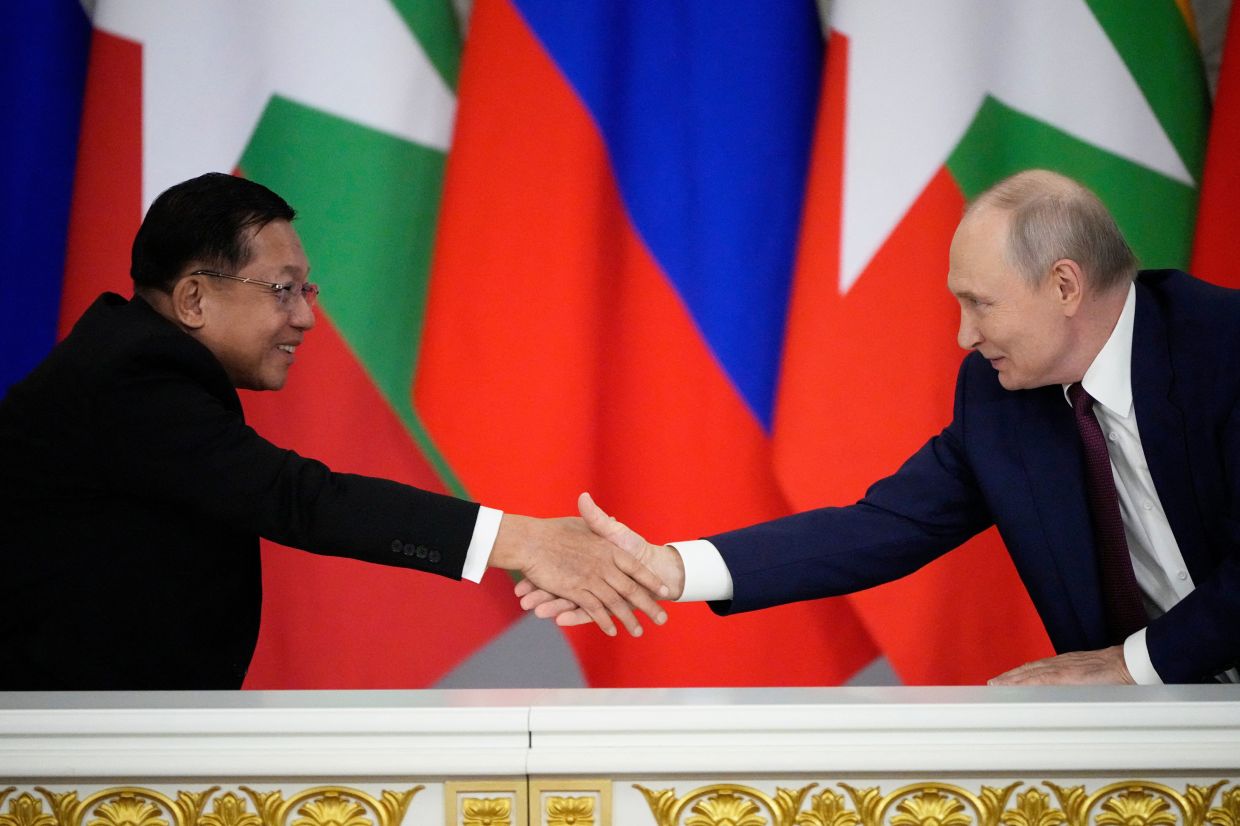
Russian President Vladimir Putin has reaffirmed Moscow's commitment to strengthening bilateral relations with Myanmar during a landmark meeting with the country's leader Min Aung Hlaing in the Kremlin. The encounter marked the first official visit to Russia by Min Aung Hlaing since his formal assumption of the presidency following contested elections earlier this year, signalling the continuing strategic importance of Myanmar to Russian interests in Southeast Asia during a period of international isolation.
Putin characterised the relationship between Moscow and Naypyidaw as increasingly characterised by mutual trust, describing ties as "especially trusting" in recent years. The framing reflects Russia's broader pivot towards Asia as Western sanctions and diplomatic pressure mount in the wake of the Ukraine invasion. Myanmar, by contrast, has remained one of the few significant nations maintaining robust engagement with the Kremlin, effectively offering diplomatic cover and economic partnership opportunities unavailable elsewhere.
The substance of the Moscow discussions centred on ambitious economic ventures that would deepen Russia's energy footprint in Myanmar's strategically located southern regions. Putin outlined plans for the construction of a thermal power plant and a modern oil refinery, alongside Russian involvement in geological surveys and hydrocarbon extraction. These infrastructure projects represent not merely commercial transactions but strategic anchors that would bind Myanmar's development trajectory to Russian technological expertise and capital investment for decades to come.
Energia cooperation extends beyond oil and gas. Putin emphasised "good prospects" for collaboration on liquefied natural gas exports, opening pathways for Myanmar to access international markets while remaining dependent on Russian technical partnerships. Such arrangements insulate both nations from Western pressure while creating mutual economic incentives that transcend normal commercial relationships. For Myanmar, access to Russian expertise in energy infrastructure offers a counterweight to potential Western sanctions or isolation.
Defence and military-technical cooperation forms the bedrock of the bilateral relationship, with Putin explicitly highlighting the "close" military ties developed since Myanmar's 2021 coup. Russia has supplied the Myanmar military with advanced weaponry exceeding US$400 million in value since the junta's takeover, according to United Nations assessments from May 2023. This arsenal includes sophisticated systems that enable Myanmar's armed forces to maintain regional military advantage whilst remaining insulated from Western arms embargoes. The military dimension explains why defence and security officials featured prominently in the Kremlin delegation.
Nuclear technology partnerships underscore the depth of Moscow-Naypyidaw strategic alignment. Myanmar is collaborating with Russia's Rosatom State Corporation on constructing a small-scale nuclear power plant, representing the initial phase of incorporating atomic energy into Myanmar's healthcare, agricultural, and industrial sectors. Such partnerships typically involve long-term technology transfer, training arrangements, and ongoing technical dependencies that institutionalise close ties between nations across multiple governmental layers and institutions.
The Moscow summit occurs within a broader pattern of diplomatic activity by Min Aung Hlaing's administration seeking international legitimisation following a disputed election process that attracted significant international censure. The military leader has embarked on an extensive regional diplomatic tour, visiting China, India, Laos and Thailand in recent months whilst simultaneously attempting rapprochement with the United States and the Association of Southeast Asian Nations. This balancing act reflects Myanmar's complex position as a nation seeking international acceptance whilst rejecting external pressure to release ousted civilian leader Aung San Suu Kyi.
Russia's role in this equation carries particular significance for regional stability calculations. Unlike Western nations and many traditional partners, Moscow has consistently supported Myanmar's military administration without imposing human rights conditions or political demands. This approach contrasts sharply with Asean diplomacy, which has attempted calibrated pressure on the Myanmar junta whilst maintaining engagement. Russian backing provides the Myanmar leadership with an alternative diplomatic anchor and economic lifeline independent of Western-aligned institutions.
The frequency of high-level exchanges between Moscow and Naypyidaw underscores their deepening coordination. This represents at least the fourth Putin-Min Aung Hlaing encounter since the 2022 Ukraine invasion, with intervening visits from Russia's security establishment. When Putin's top security aide Sergei Shoigu visited Myanmar in February following the disputed election, he became the first foreign official to travel there, a symbolic gesture of Russian support precisely when international criticism mounted.
For Malaysia and other Southeast Asian nations, the Russia-Myanmar partnership trajectory carries important implications. It demonstrates how geopolitical isolation can drive nations toward alternative power centres, particularly those willing to offer partnership without political conditionality. It also illustrates how energy-rich Southeast Asian nations can leverage their resources to attract great power investment and support, potentially altering regional balance-of-power calculations. As Myanmar becomes increasingly integrated into Russia's strategic architecture through energy partnerships and military dependencies, its foreign policy autonomy may gradually contract, with consequences for regional security dynamics that extend well beyond bilateral relations.

