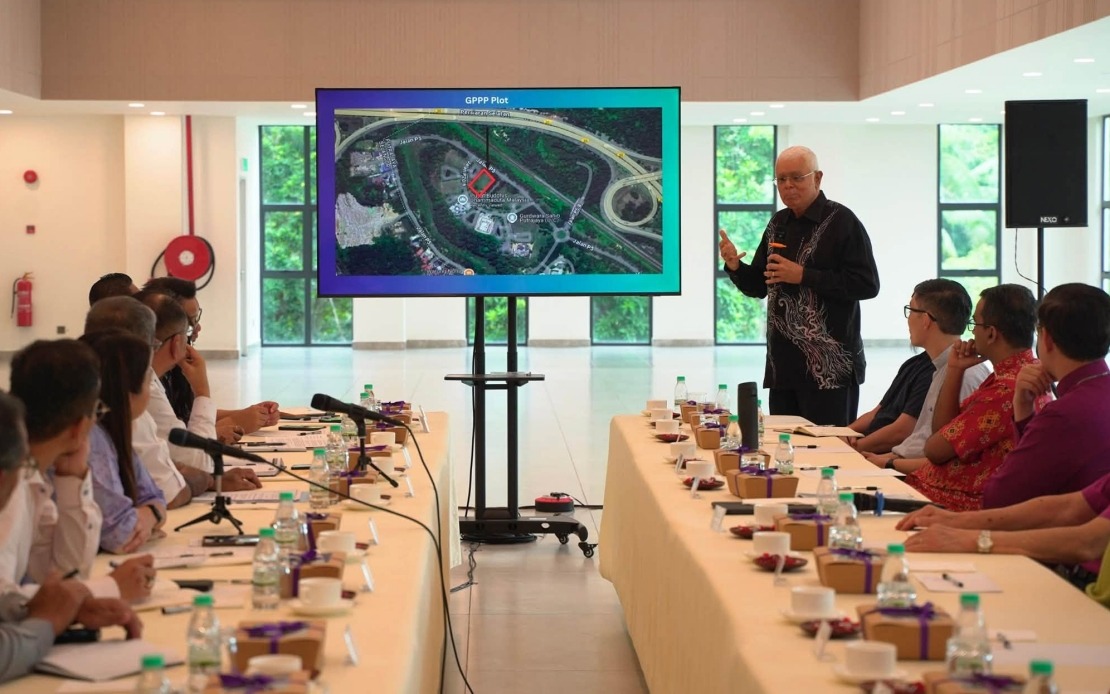
The federal government has designated sites within Putrajaya's Precinct 20 for non-Muslim places of worship as part of a longstanding commitment to inclusive urban development, according to National Unity Minister Datuk Aaron Ago Dagang. The planning initiative, conceived over a decade ago in 2013, reflects a deliberate approach to accommodating religious diversity within the federal capital's structured expansion, signalling that faith-based infrastructure has been woven into Putrajaya's master planning rather than treated as an afterthought to development.
Aaron emphasised that the provision of designated religious spaces demonstrates more than mere logistical accommodation. The strategy represents a philosophical commitment to creating urban environments where multiple faith communities can observe their beliefs within purpose-built facilities whilst maintaining proximity and dialogue with one another. This approach aligns with broader goals of fostering neighbourhoods that function as cohesive social units despite their religious heterogeneity, a principle increasingly vital in Malaysia's multicultural context where religious tensions occasionally surface in less well-planned settings.
The National Unity Ministry's policy framework explicitly references Policy 17 under the Putrajaya Structure Plan 2050, formally titled "Putrajaya Towards an Inclusive Compassionate Community." This policy document establishes that inclusive community-building and mutual respect form constitutional pillars of the capital's long-term vision. By anchoring the Precinct 20 initiative within this broader strategic framework, government officials position religious plurality not as a tolerated deviation from urban planning but as a central objective guiding infrastructure decisions and spatial allocation.
The Harmoni MADANI initiative, launched by the National Unity Ministry in 2024, provides contemporary momentum to these longstanding plans. The programme operationalises the concept of "Understand, Respect, Accept and Celebrate" across Malaysia's diverse religious landscape, translating abstract principles of harmony into concrete community engagement initiatives. Precinct 20's development therefore serves as a practical demonstration of how MADANI principles translate into tangible urban outcomes, offering a model potentially applicable to other Malaysian cities grappling with religious coexistence.
Precinct 20 already hosts several functioning religious institutions that collectively illustrate the precinct's emerging interfaith character. The Prince of Peace Church, a recently established congregation, now operates within the designated area, whilst the Dhammaduta Malaysia Buddhist Centre has maintained operations since 2023. These facilities demonstrate that the planning framework has transitioned from theoretical designation into functional reality, with genuine communities establishing worship centres and creating regular religious activity within the precinct.
Multiple additional faith communities are developing facilities within Precinct 20, indicating sustained momentum in the interfaith infrastructure project. The Gurdwara Sahib Putrajaya, which will serve the Sikh community, remains under construction, as do the Dewi Sri Lalithaambigai Alayam temple for Hindu worshippers and the San Qing Taoist Temple serving the Taoist community. These concurrent development projects suggest coordinated planning rather than piecemeal accommodation, with multiple religious communities simultaneously establishing institutional presence within the designated precinct.
A specifically allocated site has been reserved for the construction of a Roman Catholic church, indicating that Christian denominations beyond the Protestant Prince of Peace congregation will have representation within Precinct 20. This deliberate multi-denominational approach prevents any single faith tradition from monopolising Christian space whilst ensuring that diverse theological perspectives within Christianity receive institutional recognition and dedicated worship facilities.
The concentration of multiple religious facilities within a single precinct creates conditions favourable to sustained interfaith dialogue and mutual understanding. Unlike dispersed religious institutions scattered across a city, clustered worship spaces naturally generate opportunities for community interaction, shared civic responsibilities, common facility challenges, and organic relationship-building among clergy and congregants of different faiths. Precinct 20 thus functions as an intentional interfaith hub rather than simply accommodating religious plurality through spatial separation.
The significance of this model extends beyond Putrajaya itself. As Malaysia's federal capital and administrative centre, Putrajaya's urban planning decisions carry symbolic weight and often influence approaches adopted by state governments and municipal authorities nationwide. The successful establishment of a functioning interfaith neighbourhood within Putrajaya potentially demonstrates to other Malaysian cities that religious diversity can be accommodated through thoughtful urban design rather than generating conflict or requiring restrictive regulations.
For Southeast Asian observers, Putrajaya's Precinct 20 illustrates how countries with religiously plural populations can embed inclusivity within foundational urban planning rather than addressing religious accommodation reactively. The initiative predates contemporary interfaith movement surge by several years, suggesting that Malaysia's government recognised demographic and social realities requiring structural rather than programmatic responses to religious coexistence challenges.
The practical implications for Malaysian religious communities remain significant. The designation of specific precinct sites removes uncertainty surrounding religious building approvals and provides institutional certainty for faith communities planning long-term facility development. Communities pursuing worship space establishment can reference existing planning frameworks rather than navigating political obstacles or community opposition that sometimes emerges when religious buildings are proposed in areas lacking explicit official designation for that purpose.
Minister in the Prime Minister's Department (Federal Territories) Hannah Yeoh's participation in precinct visits alongside Aaron underscores cross-ministerial coordination on religious affairs, suggesting that federal, state, and portfolio-specific governance channels work collaboratively on these initiatives. This administrative alignment presumably reduces bureaucratic friction and accelerates facility development timelines compared to situations where different government entities maintain conflicting priorities regarding religious infrastructure.

