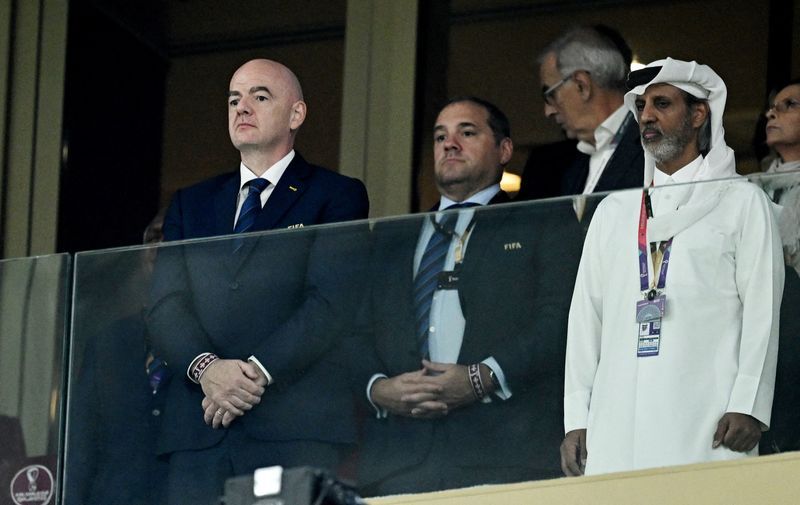
The Qatar Football Association has deepened its confrontation with the Asian Football Confederation over the governing body's failure to seek consent from member nations before endorsing a joint statement that attacks FIFA President Gianni Infantino's leadership and conduct. In correspondence that marks an unusually public spat for an organization that traditionally conducts its affairs behind closed doors, QFA President Hamad bin Khalifa Al-Thani has now issued his third letter in the escalating exchange, contending that the AFC's explanations have only generated further questions without resolving the core issue of procedural legitimacy.
The dispute centres on whether AFC President Sheikh Salman bin Ebrahim Al-Khalifa possessed the authority to commit the confederation's name to an open letter, signed alongside UEFA and CONCACAF, that raised serious concerns about Infantino's conduct regarding a controversial privatization proposal for the World Cup tournament. The controversy erupted after FIFA floated the FIFA Forward Enterprise initiative, which would have introduced private investment into the World Cup structure—a proposal developed without prior consultation with continental confederations, instead being pitched directly to FIFA's 211 member nations.
Infantino's attempt to advance this initiative has triggered unprecedented internal resistance within football's governance structure, particularly as he prepares his campaign for reelection next year. The joint letter from three continental confederations represented a significant challenge to his authority and has emboldened critics questioning his leadership direction. Yet Qatar's response to this criticism has focused not on defending Infantino's position directly, but rather on attacking the procedural mechanisms through which the AFC lodged its complaint.
Al-Thani's latest correspondence emphasizes that the AFC's written response to his initial objections essentially acknowledges that no meaningful consultation occurred prior to the statement's release. Whether the consultation was intended to involve the AFC's executive committee, individual member associations, or some broader membership process remains unclear, according to the Qatari official. This absence of prior deliberation, Al-Thani argues, constitutes a fundamental breach of institutional governance, regardless of how comprehensively the AFC's explanation addresses the substantive issues surrounding FIFA's conduct or the merits of the privatization proposal itself.
The significance of this row extends beyond mere procedural disputes between bureaucratic entities. Qatar, as one of only six AFC member nations to have declared support for Infantino during the initial crisis, occupies a strategically delicate position within Asian football's hierarchy. Al-Thani himself serves on the FIFA Council and sits on the AFC's executive committee, giving him insider status in multiple layers of football governance. His decision to escalate this confrontation publicly—breaking with the AFC's preference for private negotiations—suggests growing frustration among Infantino's supporters with how the confederation's leadership has responded to the privatization controversy.
Sheilh Salman has defended his authority to act unilaterally, asserting in his Tuesday letter that he possessed both the institutional power and the responsibility to safeguard Asian football's interests through decisive action. He highlighted that the AFC has precedent for making significant public statements without comprehensive member consultation, pointing to previous occasions when the confederation's leadership rallied behind Qatar's selection as the 2022 World Cup host despite substantial international opposition and controversy. Yet this historical parallel cuts both ways in the present dispute.
Al-Thani's rebuttal attempts to distinguish between those prior statements and the Infantino letter. When the AFC backed Qatar's World Cup hosting rights, he contends, it did so as an expression of the confederation's institutional interest in the successful staging of an Asian World Cup—a matter directly affecting the confederation's own standing and prestige. By contrast, the letter criticizing Infantino represents commentary on FIFA governance that extends beyond the AFC's narrow institutional interests and touches on matters affecting global football governance structures where member associations themselves hold stakes and viewpoints that may diverge.
The dispute also reflects deeper tensions within the AFC regarding how much authority its president can exercise unilaterally versus how much deference must be paid to the confederation's membership. Al-Thani emphasizes that any powers Sheikh Salman possesses derive from and are circumscribed by the executive committee—a body on which Al-Thani himself sits. This invocation of executive committee constraints is noteworthy because it frames the disagreement not as a conflict between Qatar and the broader AFC membership, but as a question of proper governance hierarchy within the confederation's own institutional structure.
The public nature of this exchange represents a remarkable departure from AFC convention. Typically, disputes between confederation leadership and member associations are resolved through confidential negotiations and private correspondence. The fact that Qatar has chosen to escalate through increasingly detailed written rebuttals, all of which have been circulated to international media outlets, suggests that ordinary channels for resolution have been exhausted or are perceived as inadequate. This transparency, while unusual, serves Qatar's strategic interests by placing Sheikh Salman's decision-making authority under public scrutiny.
For Malaysian observers and Southeast Asian readers more broadly, this governance dispute carries significance beyond football administration. The clash between confederation presidents and member associations over consultation procedures mirrors broader questions about accountability and democratic governance in regional and international organizations. Moreover, the AFC's internal discord weakens the confederation's collective negotiating position relative to FIFA on matters affecting Asian football's interests and allocation of resources. When continental confederations cannot maintain unified positions on fundamental governance questions, their members lose leverage in demanding equitable treatment from FIFA's central authority.
The AFC has not yet responded to Al-Thani's latest letter, leaving the next move uncertain. Whether Sheikh Salman will stand firm on his assertion of presidential authority, seek to reconcile with Qatar through compromise, or attempt to gather broader AFC support for his position remains to be seen. What is clear is that the Infantino reelection battle has fractured what previously appeared to be a cohesive AFC position, and the confederation may struggle to rebuild institutional unity before crucial FIFA votes occur.
The immediate stalemate reveals how Infantino's privatization proposal has rippled through football's governance structures, creating unexpected alliances and conflicts that transcend traditional geographic or political divisions. Qatar's governance-focused critique of the AFC's procedures may prove more consequential for establishing precedents about confederation authority than the underlying disputes about FIFA's conduct and privatization schemes. As this dispute continues to unfold, it demonstrates how procedural questions about institutional authority can become just as divisive as substantive policy disagreements in football's complex political landscape.

