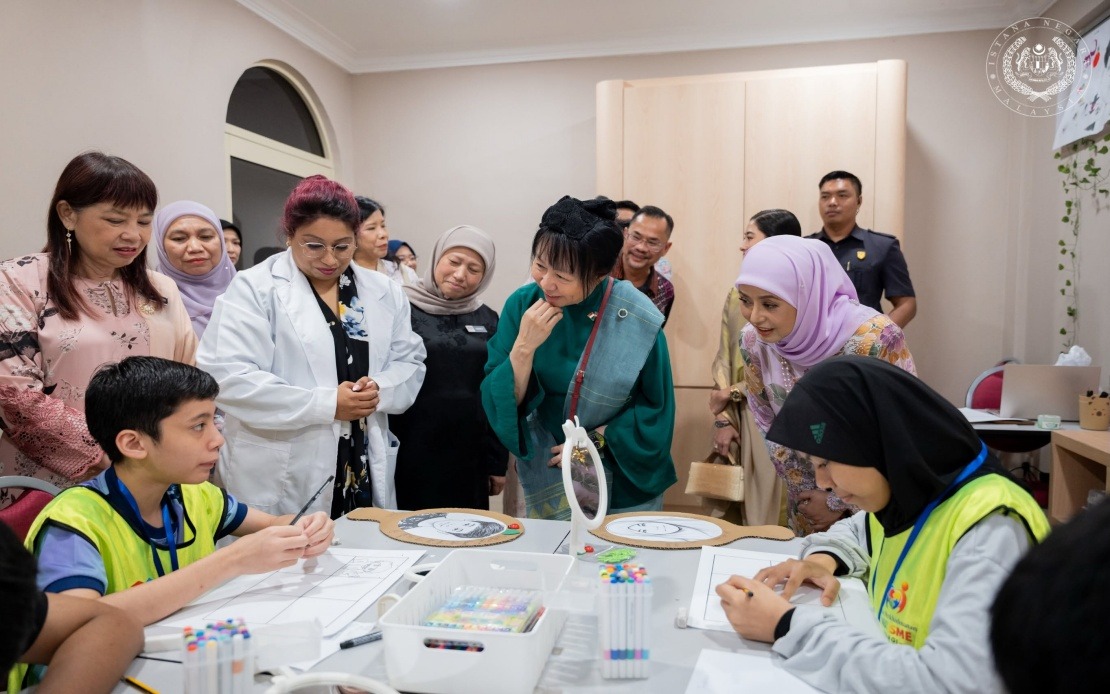
Her Majesty Raja Zarith Sofiah, Queen of Malaysia, welcomed Singapore First Lady Jane Ittogi Shanmugaratnam to the Bangi Autism Service Centre in a carefully orchestrated diplomatic visit that underscored growing cooperation between Malaysia and Singapore on social welfare matters. The engagement, which took place on July 14, formed part of the broader state visit by Singapore President Tharman Shanmugaratnam to Malaysia, marking an opportunity for both nations to strengthen bilateral relations through cultural and institutional exchanges.
The reception of the distinguished visitor reflected the formal nature of the occasion, with Tunku Tun Aminah Sultan Ibrahim joining Her Majesty to greet Jane Ittogi upon arrival. The composition of attendees demonstrated the significance placed on the visit by Malaysian authorities, with Prime Minister's wife Datuk Seri Dr Wan Azizah Wan Ismail present alongside Women, Family and Community Development Minister Datuk Seri Nancy Shukri and other senior government officials. This high-level participation signalled Malaysia's commitment to showcasing its autism support infrastructure to regional partners.
The tour itself proved substantive rather than merely ceremonial, with both leaders engaging directly with the centre's operational facilities. Their inspection encompassed the Activities of Daily Living Room, where individuals with autism develop practical life competencies, as well as the Occupational Therapy Room and gymnasium facilities. By observing these spaces firsthand, Jane Ittogi and Her Majesty gained insight into Malaysia's hands-on methodology for autism intervention, which emphasises functional skill development and holistic therapeutic support rather than purely clinical approaches.
During her remarks at the centre, Minister Nancy Shukri articulated the scope of autism support across Malaysia, noting that the Social Welfare Department had registered 93,199 individuals with autism as of June. She projected further growth in these figures, attributing the anticipated increase to improved public consciousness regarding autism spectrum conditions and expanded access to early screening and diagnostic pathways. This disclosure places Malaysia's registered autism population in context for regional comparison and reflects ongoing efforts to establish comprehensive prevalence data.
The Bangi Autism Service Centre itself represents an important institutional model within Malaysia's social welfare framework. Rather than functioning as a purely government operation, the facility exemplifies a public-private partnership approach, with operational responsibility shared between the National Autism Society of Malaysia and the Damansara Damai Community-Based Rehabilitation Centre. This collaborative structure allows the centre to blend government resources with NGO expertise and community engagement, creating a hybrid approach that has gained favour among Southeast Asian health and social services jurisdictions.
For Singapore, the visit offered an opportunity to examine how a neighbouring nation structures its autism support systems at a time when prevalence awareness has increased substantially across Southeast Asia. Singapore itself has invested considerably in autism services, and the exposure to Malaysia's institutional approaches may inform future policy refinements or best practice exchanges. Such bilateral engagement on social services remains relatively uncommon at the vice-regal level, suggesting both nations view autism support as a legitimate priority within diplomatic dialogue.
The visit's timing within President Tharman Shanmugaratnam's broader state itinerary demonstrates how modern state visits frequently incorporate social policy dimension alongside traditional political and economic discussions. By selecting an autism centre rather than, for example, a manufacturing facility or financial institution, both governments signalled alignment on the importance of disability inclusion and social welfare as markers of national development and regional standing.
The Australian-trained approach that influenced much of Malaysia's autism service development reflects the region's broader engagement with international best practices. The Activities of Daily Living model, which the visitors observed, derives from decades of research on skill generalisation and community integration for individuals with autism. By hosting Singapore's First Lady, Malaysia effectively demonstrated that such sophisticated therapeutic infrastructure exists within the region rather than requiring overseas referrals or expertise.
Looking forward, the visit may catalyse further collaboration between Malaysia and Singapore on autism prevalence research, service standardisation, and professional training. Both nations face comparable challenges in meeting rising demand for assessments and interventions, particularly as diagnostic awareness spreads through urban middle-class populations. A coordinated regional approach to workforce development and resource sharing could substantially improve service capacity across both countries.
The approximately 11:30 am conclusion of the visit represented a carefully calibrated duration that balanced substantive engagement with the demanding schedules typical of state visitors. Rather than a perfunctory walkthrough, the tour allowed genuine observation of therapeutic activities and provided context for ongoing discussion between Malaysian and Singaporean officials regarding social welfare innovation. Such exchanges, often overlooked in media coverage focused on trade or security matters, often prove influential in shaping policy direction within individual governments.

