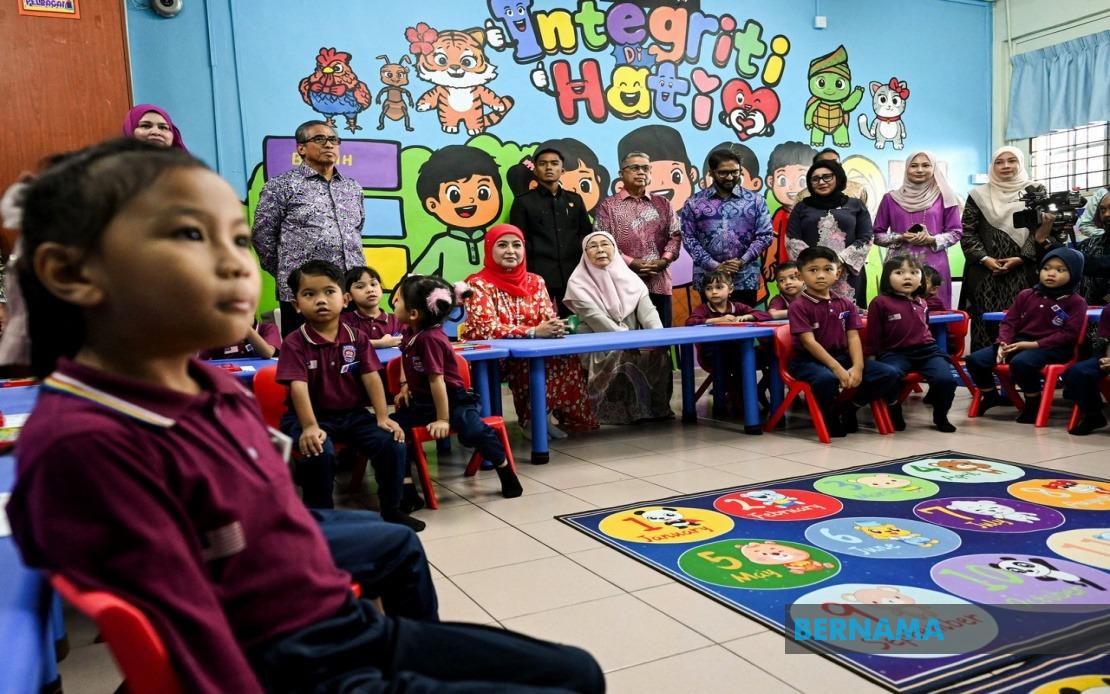
Queen Raja Zarith Sofiah formally opened the Children's Integrity Module (MIKa) on Wednesday at Tabika Perpaduan Taman Bukit Cheras in Kuala Lumpur, underscoring the government's commitment to nurturing integrity as a foundational value from the earliest stages of childhood development. The royal patronage of this educational initiative signals the significance placed by the nation's leadership on character building and ethical development during formative years when habits and principles are most readily absorbed.
The Queen arrived at the venue at 9:45 am and was received by National Unity Minister Datuk Aaron Ago Dagang, Chief Secretary to the Government Tan Sri Shamsul Azri Abu Bakar who also chairs the Malaysian Institute of Integrity (IIM), and Bandar Tun Razak Member of Parliament Datuk Seri Dr Wan Azizah Wan Ismail. After formally launching the MIKa initiative, Her Majesty visited classrooms to observe practical learning sessions and engaged directly with pupils, offering hands-on perspective into how integrity concepts are being transmitted to young learners through interactive educational methods.
The MIKa programme represents a deliberate pedagogical shift in Malaysian education policy, targeting the critical 2-6 age bracket when cognitive and moral development occurs most rapidly. By introducing structured integrity-building curricula at this stage, the government seeks to establish ethical frameworks before children develop entrenched behaviours or attitudes. This preventative approach contrasts with reactive strategies that typically address integrity concerns among older students or adults already shaped by less scrupulous habits.
Tan Sri Shamsul Azri articulated the driving philosophy behind MIKa during his address, emphasizing that integrity cannot be imposed solely through legal mechanisms or regulatory enforcement. Instead, ethical conduct must be cultivated organically through early exposure, making righteous behaviour intuitive rather than obligatory. The Chief Secretary suggested that when children internalize integrity principles during their most formative period, trustworthiness becomes intrinsic to their character rather than external compliance imposed by authority figures. This developmental psychology perspective aligns with contemporary educational research demonstrating that values absorbed in early childhood prove far more durable than those encountered later in life.
Development of the MIKa curriculum commenced in 2024 and involved collaboration among 35 specialists in early childhood education, reflecting substantial investment in pedagogical rigour. Beyond academic experts, the project drew support from multiple government ministries, public agencies, tertiary institutions, and private organizations operating within the early childhood education sector. This multi-stakeholder approach suggests recognition that integrity development requires coordination across institutional boundaries rather than isolated efforts by any single government agency.
The government has established an ambitious implementation timeline, projecting that by 2030 the MIKa framework will permeate Malaysia's entire early childhood education ecosystem. This encompasses expansion to more than 31,000 childcare centres, kindergartens, and preschools nationwide—a massive scale suggesting the initiative represents flagship policy rather than experimental pilot programme. Achieving such comprehensive coverage across diverse private and public institutions poses significant logistical and training challenges, particularly ensuring consistency in pedagogical delivery across socioeconomically varied communities.
The philosophical underpinning of MIKa reflects broader concerns about institutional integrity and public trust in Malaysia. Corruption and malpractice scandals have periodically undermined confidence in government agencies and major private corporations, creating perception that ethical deficiencies are systemic rather than anomalous. By investing in character formation during childhood, policymakers implicitly acknowledge that adult integrity problems originate from inadequate early ethical foundation, making prevention through education more cost-effective than remediation through enforcement.
Importantly, the initiative does not position schools and childcare facilities as sole responsibility-bearers for integrity development. Tan Sri Shamsul Azri explicitly highlighted the irreplaceable role of parents as primary moral exemplars and behaviour models for children. This recognition that institutional education complements rather than substitutes for family influence reflects understanding that children internalize parental conduct more powerfully than formal curriculum instruction. The module's success ultimately depends on alignment between institutional teaching and home environment values.
For Malaysian parents and educators, MIKa introduces structured framework for discussing ethical concepts with young children in age-appropriate language. Traditional approaches often assumed integrity would be absorbed through osmosis or indirect modeling, whereas MIKa provides explicit curriculum scaffolding that makes abstract principles concrete and discussable. Teachers receive guidance in translating integrity concepts into classroom activities, games, and narratives that resonate with developing minds, transforming what might otherwise remain parental platitudes into embodied learning.
The programme also positions Malaysia within Southeast Asian and global conversations about character education. Nations including Singapore, Indonesia, and Thailand have similarly invested in ethics and values curricula, recognizing that economic competitiveness increasingly depends on workforce integrity and institutional trustworthiness. MIKa represents Malaysia's contribution to this regional movement while distinctly addressing local priorities and cultural contexts regarding civic values and national identity.
Success metrics for MIKa will likely emerge over the coming years as trained educators implement the curriculum and researchers assess its impact on childhood behaviour, academic performance, and prosocial attitudes. The five-to-six-year window until 2030 provides sufficient timeframe to measure programme effectiveness while allowing refinement based on preliminary findings. Long-term evaluation would require tracking cohorts through adolescence and adulthood to determine whether childhood MIKa exposure correlates with reduced corruption, enhanced civic engagement, and institutional trust in subsequent decades.
For the broader Malaysian public, MIKa represents tangible policy response to concerns about ethical decline and institutional integrity. By embedding integrity training within early childhood curricula, the government signals that character development merits the same systematic attention and resource allocation as literacy, numeracy, and language instruction. Whether widespread adoption proves transformative or merely incremental depends substantially on implementation consistency, educator commitment, and reinforcement through family and community engagement beyond classroom walls.

