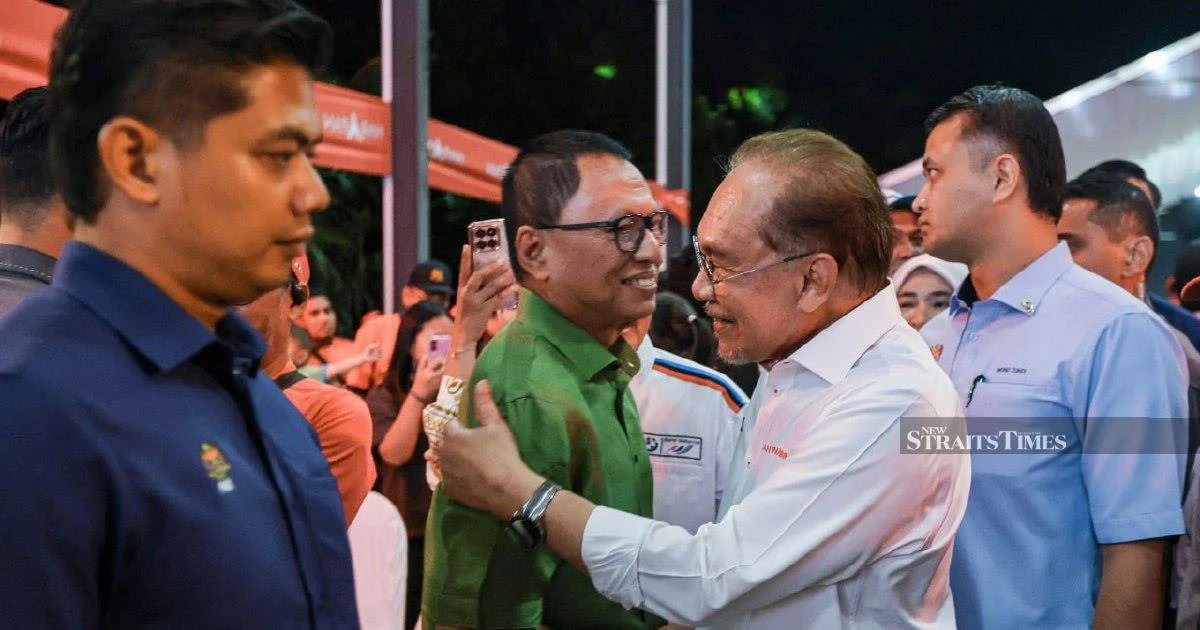
Political banter reached new heights in Johor Baru when Bersama leader Datuk Seri Rafizi Ramli seized upon a candid moment between Datuk Dr Mohd Puad Zarkashi and Prime Minister Anwar Ibrahim to deliver a pointed quip about shifting political loyalties. The jibe, offered in the characteristic style of Malaysian political commentary, reflects the complex web of party allegiances and personal relationships that characterise the current political landscape in the country.
The exchange emerged following a weekend encounter in which Puad was seen in a warm public embrace with Anwar, an image that did not escape the notice of observers tracking the movement of key political figures and their positioning within Malaysia's competitive coalition landscape. Such visual moments carry outsized significance in Malaysian politics, where public displays of camaraderie often signal shifting political calculations or strengthened personal bonds between influential personalities.
Rafizi's comment, employing the imagery of portfolio switches—a term familiar to those tracking ministerial appointments and political reassignments—carries multiple layers of meaning. The wordplay simultaneously alludes to the notion of political defection or realignment while maintaining the veneer of humorous observation, a diplomatic device frequently deployed by Malaysian politicians seeking to make pointed observations without crossing into outright accusation.
The context surrounding this exchange reveals deeper currents within Malaysia's political ecosystem. Puad, a long-standing figure within Umno's ranks, has maintained a complex relationship with various political formations and has previously served in multiple capacities across different administrations. His public appearances and interactions with senior government figures are frequently scrutinised by political analysts seeking to discern patterns in coalition-building or hints of behind-the-scenes negotiations.
Anwar's position as Prime Minister since late 2022 has reshaped the political terrain considerably. The administration represents a coalition spanning multiple parties with historically divergent interests, including PKR, DAP, Amanah, and various components within the Umno-led coalition. This delicate balance requires careful navigation of relationships and occasional strategic realignments, particularly as the government faces ongoing challenges related to governance, economic policy, and internal coalition management.
Rafizi's observation touches upon a persistent feature of Malaysian political culture: the fluid movement of prominent figures between political formations and the carefully calibrated dance of coalition politics. While such repositioning occasionally reflects genuine ideological shifts, more commonly it represents pragmatic calculations regarding influence, access to power, and control of party machinery. The Bersama leader's comment implicitly acknowledges this reality whilst simultaneously deploying humour as a deflection mechanism.
The significance of such public interactions cannot be understated in Malaysian political discourse. A single photograph or moment of apparent warmth between two figures can generate extensive speculation regarding coalitional stability, ministerial reshuffles, or emerging power blocs. Media outlets and political observers invest considerable effort in parsing such images for hidden meanings, whilst politicians themselves carefully manage their public appearances to signal alignment or distance as political circumstances dictate.
Puad's background in Umno, combined with any closer association with Anwar's administration, raises questions about the evolving nature of cross-party collaboration at senior levels. The Umno party structure has long maintained complex relationships with PKR and other Pakatan Rakyat component parties, particularly following the 2022 election outcome that proved inconclusive and necessitated creative coalition engineering. The resulting government, whilst functional, remains inherently unstable given the competing interests of its constituent parties.
Rafizi's quip also reflects the broader dynamics within Bersama, a political entity that has sought to position itself as a reform-oriented alternative within Malaysia's political spectrum. Comments directed at other figures serve simultaneously to reinforce Bersama's distinct positioning whilst engaging in the rhetorical exchanges that characterise Malaysian political competition. The tone of humorous observation allows for political point-scoring whilst avoiding the formal accusations or confrontations that might escalate political tensions.
Looking forward, such interactions and the commentary they generate provide valuable windows into the state of coalition dynamics and personal relationships among Malaysia's political elite. As the government continues to navigate legislative challenges and prepare for eventual electoral contests, the positioning of figures like Puad and their apparent relationships with senior leadership figures such as Anwar will remain subjects of intense scrutiny. The public embrace that prompted Rafizi's comment may prove significant only in retrospect, or it may signal the beginning of more substantial political realignments that could reshape the composition or priorities of Malaysia's government.

