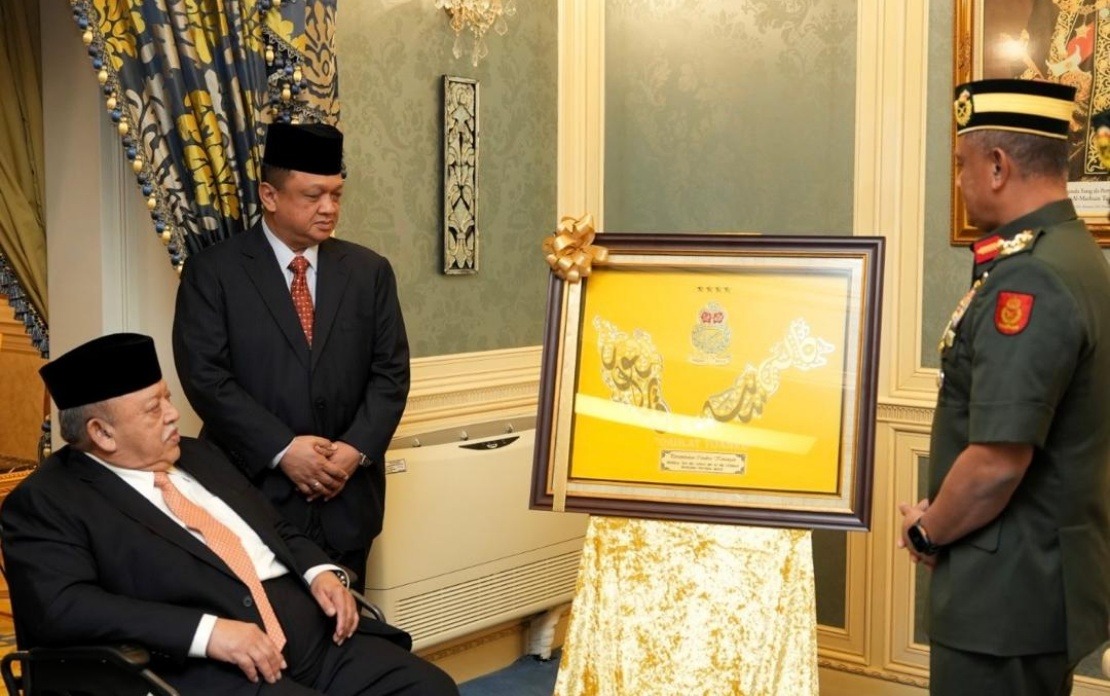
Tuanku Syed Sirajuddin Jamalullail, the Raja of Perlis, received General Tan Sri Azhan Md Othman, the country's army chief, in a ceremonial audience held at the Balai Menghadap Biru in Istana Arau on July 29. The formal meeting highlighted the collaborative relationship between Perlis's royal household and the armed forces, with the palace statement emphasising the significance of such engagements in reinforcing institutional bonds.
The Raja Muda of Perlis, Brigadier General Tuanku Syed Faizuddin Putra Jamalullail, was present alongside his father during the proceedings. The Raja Muda, who simultaneously holds the position of Commander of the 504th Territorial Army Regiment stationed at Kem Bukit Keteri near Padang Besar, embodied the close operational relationship between the Perlis state administration and military structures. His dual role as both a member of the royal household and an active military commander underscores how Malaysia's institutional framework integrates royal authority with defence command structures at the state level.
According to Istana Arau's official statement, the audience served multiple strategic purposes beyond ceremonial courtesy. The meeting functioned as a deliberate platform to deepen institutional cooperation between the Perlis Royal Institution and the armed forces, reinforcing established protocols that link state-level governance with national defence structures. Such audiences reflect Malaysia's constitutional framework, wherein the sultans and rajas maintain formal roles within military hierarchies and security governance.
The Raja of Perlis holds significant ceremonial military appointments that extend his influence beyond purely symbolic functions. As Colonel-in-Chief of both the Royal Ranger Regiment and the Royal Military Police Corps, Tuanku Syed Sirajuddin maintains direct institutional links to these military units. These positions vest him with genuine authority within military command structures and allow him to influence policy discussions affecting personnel, operational readiness, and institutional development within these organisations.
The palace statement emphasised that the meeting underscored mutual appreciation for the armed forces' role in safeguarding national sovereignty and protecting civilian populations. This framing is significant in the Malaysian context, where the military's contribution to internal security, border defence, and disaster response operations receives regular public acknowledgment from civilian leadership. The acknowledgment serves both to validate the armed forces' institutional standing and to reinforce civilian-military relations at a time when such partnerships require consistent cultivation.
These ceremonial exchanges between royalty and military brass reflect deeper structural realities in Malaysian governance. The constitution positions state rulers and rajas as supreme commanders of military forces within their respective territories, creating formal channels through which royal authority interfaces with professional military command. Audiences of this nature allow for informal discussion of security challenges, military development priorities, and state-level defence concerns that might otherwise proceed through purely administrative channels.
The explicit mention of national development and people's welfare in the palace statement suggests that discussions extended beyond narrow military concerns. In Perlis's context, such forums provide opportunity to address cross-cutting issues including border security challenges in the north, developmental priorities affecting state stability, and coordination between civilian administrations and military installations. The state's proximity to the Thai border and its significant military presence make such high-level consultations particularly valuable for addressing regional security dynamics.
The emphasis on preserving peace, stability, and prosperity through defence-royal institution cooperation reflects broader Malaysian governance philosophy. Malaysia has historically navigated security challenges through integrated approaches combining military capability, royal institutional authority, and civilian administration. Public acknowledgment of these partnerships, through formal audiences and official statements, reinforces public confidence in institutional coordination during periods of security concern or rapid change.
From a broader regional perspective, Malaysia's visible integration of military and royal structures provides institutional stability that many Southeast Asian nations find challenging to maintain. The regular interaction between top military command and state-level royalty demonstrates functional channels for addressing security concerns without resorting to extra-constitutional mechanisms. For Malaysian readers and regional observers, such engagement illustrates how institutional maturity and established protocols enable militaries and traditional authority to coexist productively within constitutional frameworks.
The audience between Tuanku Syed Sirajuddin and General Tan Sri Azhan thus represents more than ceremonial courtesy. It embodies Malaysia's distinctive approach to integrating defence structures with constitutional monarchy, ensuring that military modernisation and strategic planning occur within frameworks that preserve both professional autonomy and royal authority. For Perlis specifically, such engagement ensures the state's security concerns receive attention at the highest military levels and that regional defence capabilities align with state development objectives.

