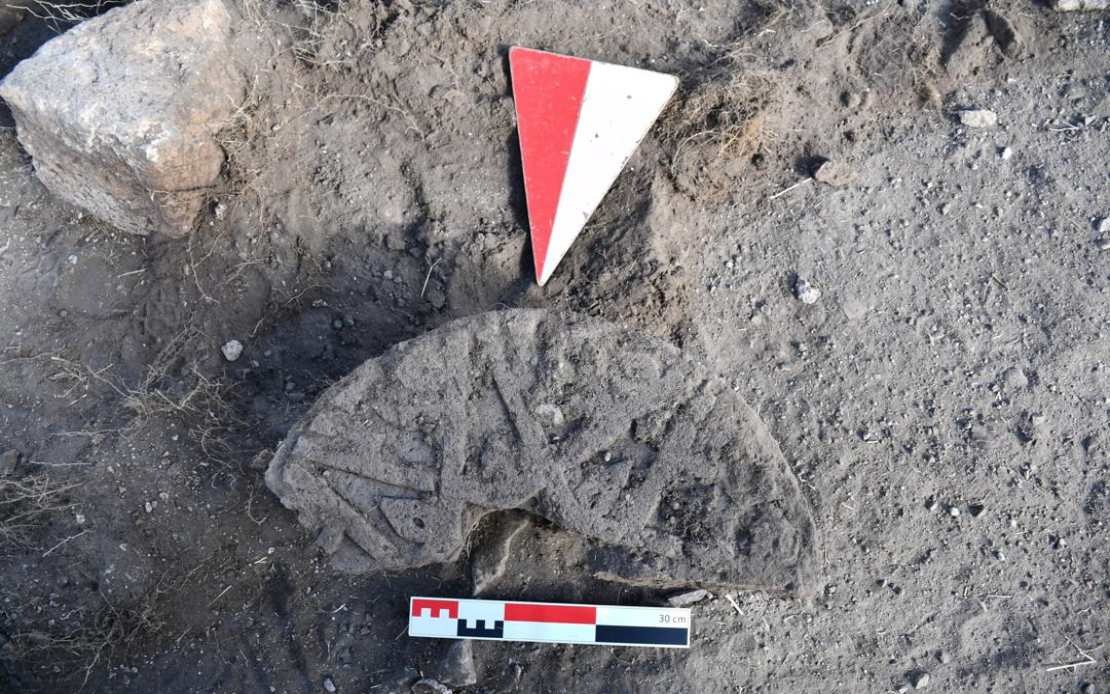
A significant archaeological discovery has emerged from the ancient ruins of Ani in eastern Türkiye, where excavators have unearthed a stone bearing multiple inscriptions of Prophet Muhammad's name. The artefact, announced by Turkish Culture and Tourism Minister Mehmet Nuri Ersoy, represents an important addition to understanding the site's complex religious and cultural layers spanning centuries.
The stone displays the name of Prophet Muhammad repeated six times in Kufic script, a classical Arabic calligraphic style that flourished during the medieval Islamic period. According to Ersoy's account, three of these inscriptions are particularly ornate, being carved into a decorative band that encircles an eight-pointed star, suggesting the stone served a ceremonial or commemorative function rather than being a utilitarian object. The craftsmanship evident in the design indicates it was produced by skilled artisans working within a sophisticated cultural milieu.
Archaeologists believe the stone originated from a Seljuk tomb tower, linking the artefact to the period when Turkic dynasties ruled over Anatolia and the broader region. The discovery emerged during ongoing excavations at a Seljuk cemetery that has been systematically studied since 2021, reflecting the methodical approach modern archaeologists employ to extract maximum historical information from such sites. The cemetery itself represents multiple generations of burials, offering insights into community structure, religious practices, and material culture across generations.
The location of Ani itself carries profound historical significance for understanding the medieval Eastern Mediterranean and Central Asian worlds. Situated in Kars province on the Turkish-Armenian border, Ani occupied a crucial position on the ancient Silk Road trade networks that connected East Asia with the Mediterranean world. This geographic positioning meant the city functioned as a cosmopolitan crossroads where merchants, ideas, religions, and cultures intersected and mingled, creating a uniquely pluralistic urban environment.
During the tenth and eleventh centuries, Ani served as the capital of the Bagratid Armenian kingdom, representing a zenith of Armenian power and cultural achievement. The city's prominence during this period left behind monumental architecture and artistic traditions that still captivate visitors. However, the site's subsequent history reflects the broader geopolitical transformations that reshaped the region, as Ani fell under the successive control of Byzantine, Seljuk, and Ottoman empires, each leaving cultural and religious imprints on the urban landscape.
The presence of Seljuk tombs and this newly discovered Islamic inscribed stone demonstrates the layering of different civilizations within Ani. Rather than representing a clean succession of cultures, the archaeological record suggests cultural continuity and syncretism, with later inhabitants building upon, incorporating, and sometimes reusing elements from earlier periods. The Islamic inscriptions indicate that after the Seljuk conquest, Islamic religious expression became central to how inhabitants marked significant spaces and commemorated their dead.
Ani's designation as a UNESCO World Heritage Site in 2016 recognized the exceptional universal value of its ruins and their importance to human heritage. This status provides international recognition and protection, attracting scholarly attention and fostering conservation efforts. For Malaysian and Southeast Asian readers, Ani exemplifies how ancient sites far from home can reveal universal patterns about human civilization, religious expression, and the enduring impact of trade networks that, while focused on Asia and the Mediterranean, ultimately connected distant regions through commerce and cultural exchange.
The discovery of this inscribed stone arrives at a moment when understanding medieval Islamic civilization has become increasingly important for contemporary geopolitics and cultural identity. The artefact contributes tangible evidence to debates about Islamic heritage in Anatolia, a region where Turkish Muslim identity now predominates but which once hosted diverse religious and ethnic communities. Such discoveries help establish that this diversity was neither incidental nor degrading but rather an integral part of the region's historical identity.
For archaeologists and historians, inscribed stones like this provide direct textual evidence of religious devotion and commemorative practices among Seljuk populations. The repetition of Prophet Muhammad's name suggests it may have served as a talisman, a prayer aid, or a statement of faith. The careful artistic execution indicates that inscribing these names was considered a worthy investment of resources, demonstrating the religious and cultural priorities of Seljuk-era inhabitants at Ani.
The ongoing excavations at the Seljuk cemetery promise further discoveries that will progressively illuminate daily life, burial practices, and material culture during this transformative period. Each artefact recovered provides another data point for reconstructing how different populations coexisted and interacted across Anatolia and the broader Eastern Mediterranean during the medieval period. The stone bearing Prophet Muhammad's name stands as a eloquent testament to the depth and sophistication of Islamic religious life in medieval Ani.

