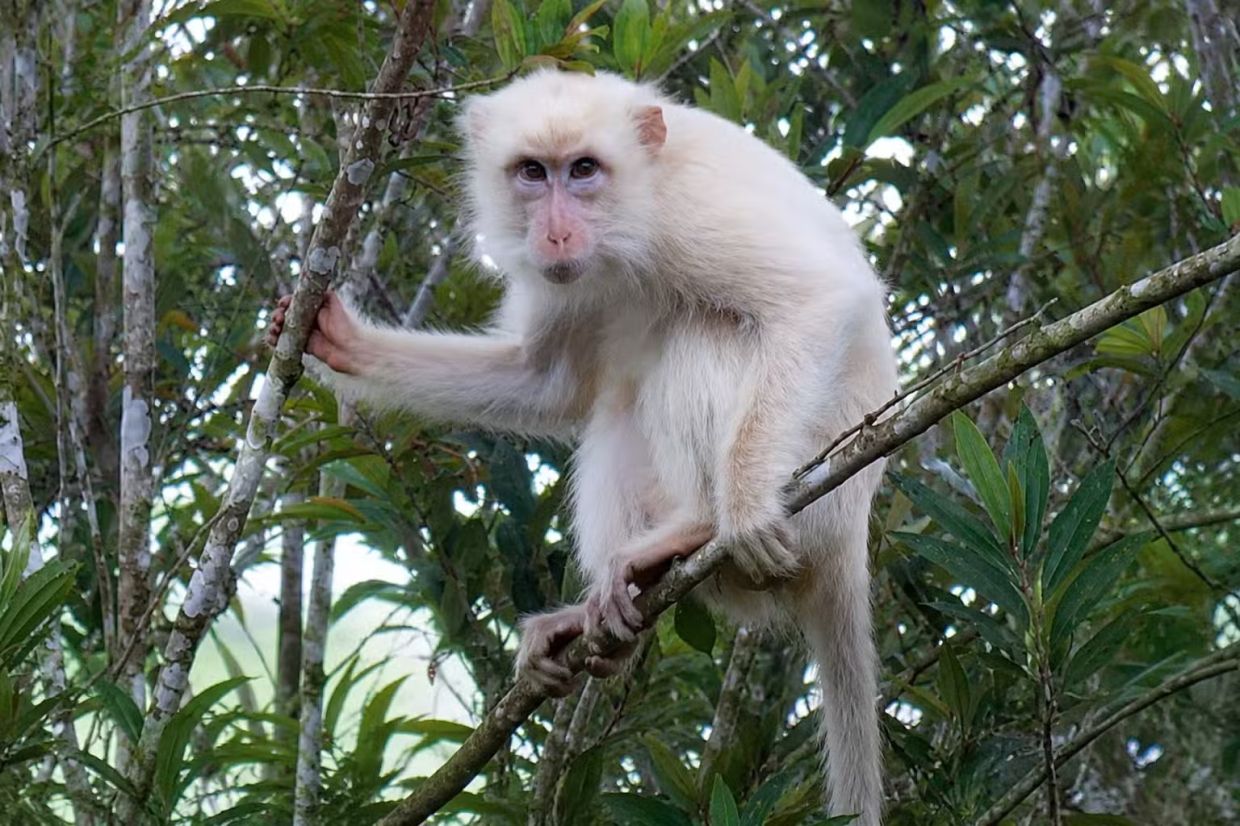
A distinctive white macaque dwelling in the forests of Sultan Kudarat has become the focus of an intensive conservation campaign following increased public attention, prompting Philippine environmental authorities to establish protective measures around the animal and its habitat. The Department of Environment and Natural Resources (DENR) Region XII, working alongside the municipal government of Senator Ninoy Aquino town, has implemented restrictions on area access in response to growing concerns that viral social media exposure could jeopardise the creature's wellbeing.
Local residents report sightings of the unusual primate dating back to 2016, when the animal first began appearing regularly in the forested localities near the community. For years, the macaque remained largely a local curiosity, familiar to those living in proximity to its roaming grounds. The situation changed dramatically once photographs and videos began circulating across social media platforms, transforming what had been a quiet regional phenomenon into a matter of national interest and, consequently, conservation concern.
Scientific assessment of the animal's condition reveals complexity that extends beyond initial assumptions. Early observations suggested the macaque suffered from albinism, a total absence of pigmentation. However, a field validation team from DENR XII discovered that the animal possessed brown to dark brown eyes, an indicator inconsistent with true albinism. Experts now suspect the condition may involve leucism, a distinct genetic phenomenon characterised by reduced pigmentation rather than its complete absence, or potentially another related pigmentation anomaly altogether. The Philippine long-tailed macaque (Macaca fascicularis philippensis) will require formal scientific verification before researchers can definitively classify its condition.
The emergence of the macaque into public consciousness through digital media channels has created an unexpected vulnerability for the species. Wildlife protection officials explicitly cautioned that heightened visibility substantially increases the risk of disturbance, illegal hunting, and capture. The macaque now faces tangible threats from poaching activities and organised wildlife trafficking networks that exploit rare or unusual animals for black market trade. This concern reflects broader challenges across Southeast Asia, where digital connectivity has paradoxically endangered rare species by exposing their locations to criminal networks and unscrupulous collectors.
Responding to these threats, Senator Ninoy Aquino's municipal government moved swiftly to establish temporary protective zones. Access restrictions now apply to areas where the macaque is routinely observed, creating a buffer against unauthorised human interference. These measures simultaneously serve to prevent illegal wildlife collection attempts and mitigate other potential harms. The intervention reflects growing recognition among local administrators that proactive habitat protection represents an essential strategy for species conservation in the modern era, particularly when species gain sudden prominence through social media exposure.
Barangay Bugso, the specific locality most affected, has embarked upon a formal legislative process to institutionalise protections for the white macaque, its immediate habitat, and the surrounding forest ecosystem. The proposed ordinance will establish permanent legal frameworks for species protection once formally enacted, moving beyond temporary restrictions to create enduring safeguards. Until enactment, the barangay maintains strict entry prohibitions for the macaque's immediate vicinity, a measure that balances conservation imperatives against community access rights.
Beyond mere restrictions, local authorities recognise the importance of positive ecological investment. Barangay Bugso plans extensive tree-planting initiatives and habitat restoration programmes designed to strengthen overall biodiversity within the region. These efforts aim simultaneously to support the resident macaque population and promote what officials term responsible ecotourism—a model that allows communities to benefit economically from natural resources while maintaining ecological integrity. This approach acknowledges that sustainable conservation requires local stakeholder engagement and tangible economic incentives for communities living alongside protected wildlife.
Field assessments conducted by DENR monitoring teams found that the macaque's immediate environment continues to support the species effectively. Secondary forest vegetation persists throughout the area, and natural food sources remain adequate for sustaining the resident monkey population. These findings suggest that habitat degradation does not currently pose the primary threat; rather, human interference and deliberate exploitation represent the immediate danger requiring management intervention.
Philippine environmental law provides comprehensive legal protection for the macaque and all native wildlife species. Republic Act No. 9147, formally titled the Wildlife Resources Conservation and Protection Act, explicitly prohibits hunting, capturing, collecting, possessing, transporting, trading or disturbing any protected wildlife without appropriate governmental permits. This legislation establishes clear legal consequences for violations, though enforcement effectiveness often depends upon adequate resources and community cooperation. DENR has invoked these provisions to reinforce the legitimacy of access restrictions and to underscore the legal dimension of wildlife protection.
Recognising the particular role that digital content creators play in either endangering or protecting wildlife, DENR has issued direct appeals to vloggers, photographers, journalists, social media users and residents. The agency specifically requests that individuals refrain from disclosing precise locations of wildlife sightings and avoid posting geotagged content that could enable bad actors to locate protected species. This guidance reflects hard-won lessons from conservation failures elsewhere, where enthusiastic documentation inadvertently facilitated poaching and trafficking operations.
At the national level, DENR XII will submit comprehensive documentation regarding the white macaque to the Biodiversity Management Bureau, enabling technical specialists to conduct formal evaluation and classification. Ongoing monitoring protocols will track the animal's health and population dynamics, while strengthened coordination with municipal stakeholders ensures that conservation efforts remain aligned and effective. Information campaigns targeting wildlife protection awareness will attempt to shift public behaviour toward responsible observation practices.
The white macaque of Sultan Kudarat exemplifies contemporary conservation challenges that blend ecological science, community engagement, legal frameworks, and digital communication dynamics. Its story suggests that protecting rare species in the twenty-first century requires sophisticated approaches extending far beyond simple habitat preservation—encompassing media literacy, community incentivisation, and careful management of the relationship between scientific interest and conservation security. For now, the unusual primate continues inhabiting its forest home, no longer merely an intriguing local sighting but a focal point for discussing how Philippine society balances curiosity, documentation, and environmental stewardship.

