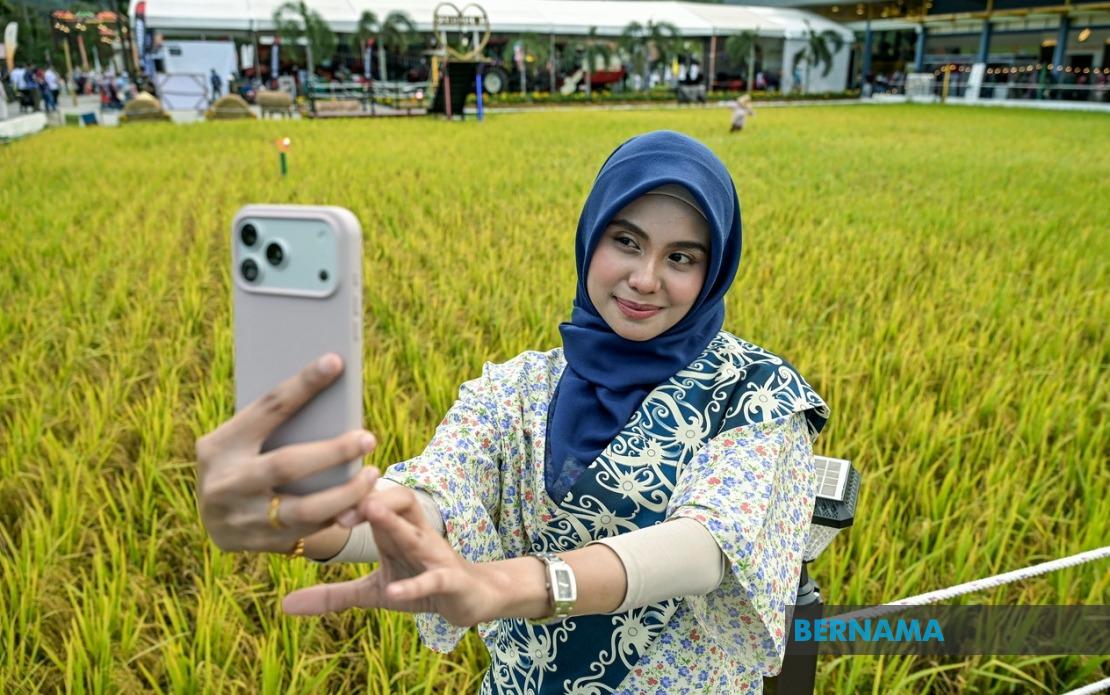
The inaugural Paddy Art exhibition at Laman Padi, launched as part of the Malaysia Agriculture, Horticulture and Agrotourism Exhibition (MAHA) 2026 held at Malaysia Agro Exposition Park Serdang (MAEPS), has secured a coveted position in the Malaysia Book of Records as the nation's largest paddy art formation. The landmark artwork features the Jalur Gemilang alongside symbolic heart and hand motifs together with the word "Jati", all meticulously arranged using sophisticated agricultural techniques that harness the natural colour variations inherent in different maturity stages of the MR284 paddy variety.
The achievement represents far more than a visual spectacle. Minister of Agriculture and Food Security Datuk Seri Mohamad Sabu emphasised that the record-setting formation exemplifies how Malaysia's agricultural sector can transcend traditional commodity production to generate innovative cultural and economic value. The collaborative effort between government agencies and private-sector partners demonstrates a strategic approach to repositioning paddy cultivation within the broader context of experiential tourism and creative industries. This shift acknowledges the evolving expectations of visitors and stakeholders who increasingly view agricultural landscapes as platforms for storytelling and engagement rather than purely functional production zones.
The concept of agrotourism has gained substantial momentum across Southeast Asia, particularly among urban populations and younger demographics whose daily lives often disconnect them from farming realities. Mohamad articulated a vision wherein paddy fields serve multiple economic and social functions simultaneously—functioning as educational centres, employment generators, technology showcases, and destinations for leisure activities. This multifaceted approach creates additional income streams for farming communities and stimulates local economies, particularly beneficial for regions where agricultural returns have faced pressure from global commodity price fluctuations and climate variability.
Laman Padi itself spans seven acres across the MAEPS site, comprising seven distinct paddy plots alongside two dedicated information centres and galleries. Each component offers visitors a differentiated narrative that charts the historical evolution and contemporary innovations within Malaysia's rice and paddy industries. The infrastructure deliberately integrates heritage elements with cutting-edge agricultural technology, thereby bridging generational knowledge gaps and demonstrating pathways toward sustainable intensification. This curatorial approach transforms the exhibition from a passive display into an interactive learning environment where visitors engage with both tangible and conceptual dimensions of paddy cultivation.
Educational programming constitutes a central pillar of the Laman Padi initiative, with approximately ten schools participating in hands-on paddy-related activities. Young participants gain direct experience in planting techniques, crop management, and post-harvest processes—knowledge increasingly rare among urban-dwelling Malaysian youth. Such engagement fosters agricultural literacy and potentially cultivates renewed interest in farming careers at a moment when the sector faces persistent labour shortages and generational transitions. The infotainment framework employed at Laman Padi strategically balances information dissemination with entertainment value, acknowledging that contemporary audiences expect educational experiences to be engaging and immersive rather than purely didactic.
The commercial dimension extends significantly beyond paddy cultivation showcases. Participating companies across the broader rice and paddy value chain—including BERNAS and numerous allied enterprises—utilise Laman Padi as a strategic platform for direct consumer engagement, product demonstration, and brand positioning. This concentration of industry players within a single venue facilitates networking, knowledge exchange, and collaborative innovation while simultaneously providing visitors with comprehensive insights into supply chain complexity and industry diversity. The exhibition thus functions as a microcosm of Malaysia's agricultural economy, illustrating interconnections between production, processing, distribution, and consumption.
Culinary programming further amplifies the exhibition's appeal and economic impact. Laman Padi features diverse food concepts and regional dishes sourced from across Malaysia, leveraging paddy products as primary ingredients. This gastronomic dimension transforms agricultural commodities into memorable sensory experiences, deepening visitor engagement and extending dwell times within the venue. The culinary integration also highlights opportunities for value-added processing and product differentiation, demonstrating how farmers and small enterprises can capture increased margins through innovation and creative marketing.
Initial visitor metrics provide encouraging indicators of public interest and engagement. Paddy Industry Development Division (PIP) secretary Shamsul Akbar Sulaiman reported that Laman Padi recorded approximately 4,000 visitors during its initial day, with organisers projecting daily attendance of roughly 10,000 visitors throughout the ten-day MAHA 2026 exhibition. These figures suggest substantial community interest in agricultural tourism experiences and validate the strategic positioning of agrotourism as a growth sector within Malaysia's broader tourism economy. Sustained visitation would generate substantial multiplier effects across accommodation, food service, transportation, and ancillary retail sectors.
The Malaysia Book of Records recognition carries symbolic significance extending beyond the paddies themselves. The designation formally acknowledges Malaysia's capacity for agricultural innovation and creative expression, countering persistent international perceptions of the nation as primarily a commodity exporter. The record serves as a soft-power asset, positioning Malaysia within global discourses regarding sustainable agriculture, cultural heritage, and rural development. As agritourism gains prominence among Southeast Asian destination marketing organisations, Malaysia's achievement provides a differentiation point within increasingly competitive regional tourism markets.
For policymakers and industry stakeholders, Laman Padi represents a tangible demonstration of agricultural diversification strategies beyond yield maximisation and cost reduction. The model suggests that farming communities can achieve economic sustainability through integrated approaches combining primary production with tourism services, educational programming, and experiential marketing. This diversification proves particularly relevant for smallholder farmers and cooperative enterprises seeking resilience against commodity price volatility and climate shocks. The exhibition framework provides a replicable model potentially adaptable to other agricultural regions and product categories throughout Malaysia and the broader Southeast Asian region.
The agrotourism paradigm also addresses growing rural-urban divides and environmental consciousness among Malaysian consumers. Urban visitors increasingly seek authentic connections with food sources and cultivation practices, creating market opportunities for farmers willing to invest in visitor infrastructure and educational programming. This demand reflects global trends toward transparency, sustainability credentials, and provenance narratives. Farmers positioned to articulate their stewardship practices and product quality stories gain competitive advantages in premium market segments, potentially improving farm-gate returns and incentivising continued agricultural engagement among younger generations.
Moving forward, the success metrics for Laman Padi extend beyond attendance statistics to encompass measurable income generation for participating farmers, employment creation within agritourism services, and quantifiable enhancement in agricultural sector perceptions among younger demographics. The initiative represents a meaningful pivot within agricultural policy frameworks, signalling that governments and industry bodies increasingly recognise the multifunctional potential of farmed landscapes. As climate change pressures intensify across Southeast Asia, such integrated approaches combining food security objectives with ecosystem services and experiential value may provide pathways toward more resilient and economically viable agricultural futures.

