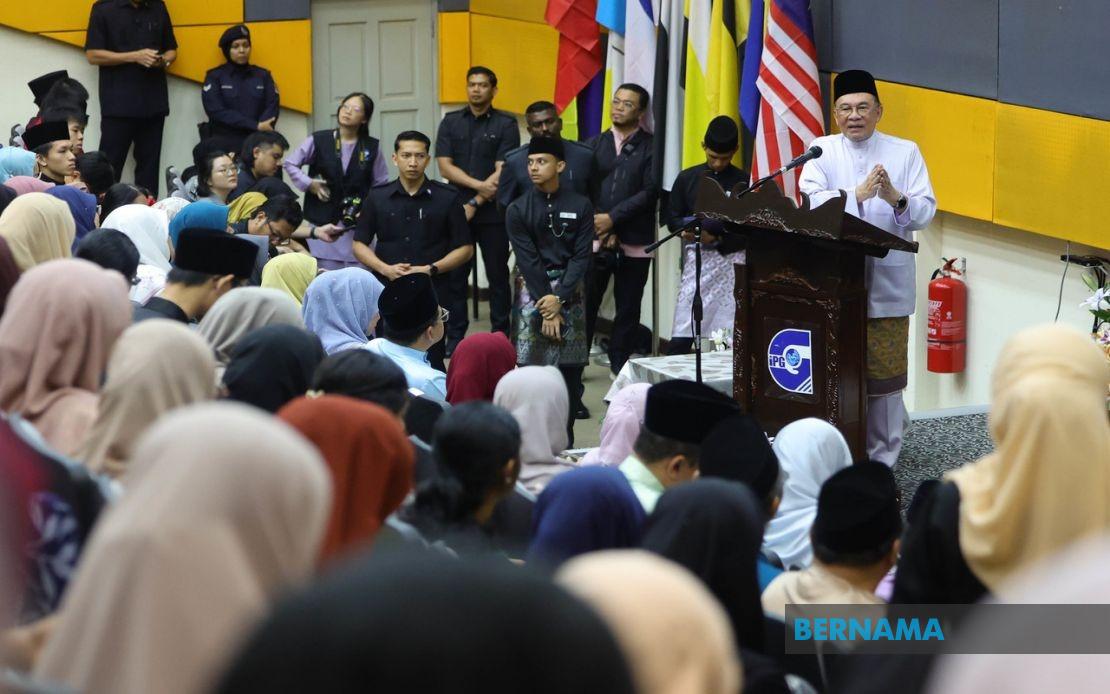
Prime Minister Datuk Seri Anwar Ibrahim has pinpointed an unexpected source of obstruction to Malaysia's reform initiatives: not the absence of technological capability or professional expertise, but rather the unwillingness of certain segments of society—particularly among the country's elite—to abandon entrenched practices and challenge a culture that has normalized corruption. Speaking at the Technical Education Campus of the Institute of Teacher Education in Bandar Enstek, Anwar articulated the fundamental challenge his administration has grappled with throughout its tenure: transforming institutional culture when those invested in the status quo actively resist change.
Drawing on his experience managing the government for more than three years, the Prime Minister revealed that anti-corruption campaigns and systemic governance improvements consistently encounter significant pushback from quarters comfortable with longstanding arrangements. This resistance, he emphasized, stems not from ignorance or incapacity but from a calculated defence of privilege and position. The observation cuts to the heart of Malaysia's reform predicament, suggesting that technical solutions and policy announcements alone cannot overcome the human dimension of institutional transformation, where vested interests actively oppose measures that threaten their influence or require behavioural modification.
Anwar acknowledged that his government's reform agenda remains deeply unpopular in certain circles, yet he articulated an unwavering commitment to pursuing these changes regardless of public disapproval among affected parties. The government recognizes that strengthening governance mechanisms and dismantling corruption networks will generate friction and controversy, but views these efforts as non-negotiable investments in the nation's administrative future. This stance reflects a broader understanding that genuine systemic change necessarily disrupts existing power structures and comfort zones, producing inevitable opposition from beneficiaries of the old arrangement.
The Prime Minister's characterization of reform resistance as stemming from those who have become normalized to improper practices offers insight into the psychological and institutional barriers hindering change. He noted that individuals may present themselves as modern in appearance and worldview, yet cling to resistance when facing actual implementation of reforms that challenge their established positions. This observation highlights a fundamental disconnect between cosmetic modernization and substantive institutional evolution—a distinction particularly relevant in societies where external appearances of progress mask deeper structural continuities.
Anwar framed Malaysia's reform imperative within philosophical and civilizational contexts beyond mere administrative efficiency. He positioned the drive for systematic improvement as a moral and cultural obligation, rooted in religious principles and civilizational standards that demand continuous advancement rather than acceptance of imperfect existing systems. This framing elevates reform beyond technical governance matters into questions of national character and ethical orientation, suggesting that Malaysia's ability to modernize hinges partly on whether society embraces continuous improvement as a fundamental value rather than viewing stability as preferable to disruptive change.
The Prime Minister's remarks carry particular resonance for Malaysian education stakeholders, given that his comments targeted educators and students at the Institute of Teacher Education. Teachers occupy crucial positions as both implementers of policy and cultural ambassadors, tasked with instilling in students the values of integrity, accountability, and institutional trust that underpin functional democracies. Anwar's emphasis on overcoming resistance to change speaks directly to the need for educational institutions to cultivate generational capacity for navigating and supporting systemic reform.
Malaysia's reform trajectory reveals tensions inherent in managing change within hierarchical systems where senior personnel may resist measures threatening their authority or requiring public accountability. Anti-corruption initiatives, rationalization of bureaucratic processes, and transparency requirements fundamentally alter power dynamics and require elites to accept new constraints on discretionary authority. Anwar's framing suggests that much resistance stems not from principled disagreement with reform objectives but from concrete threats to individual and institutional prerogatives accumulated over decades.
The Prime Minister's characterization of reform resistance as cultural and psychological rather than technical or resource-based has implications for how policymakers approach change management. Rather than focusing primarily on creating better systems and processes, governments may need to invest simultaneously in cultural transformation, leadership realignment, and institutional incentive restructuring that makes compliance with reform more attractive than resistance. This might involve transparent communication about reform benefits, accountability mechanisms for obstructionist behaviour, and celebration of early adopters who model the desired cultural shift.
For regional observers, Anwar's analysis illuminates challenges common across Southeast Asia, where many nations wrestle with entrenched bureaucracies, weak institutional accountability, and vested interests defending corrupt arrangements. Malaysia's explicit acknowledgment of these obstacles and commitment to persisting despite resistance provides a case study in the difficulties of governance modernization across the region. The question remains whether persistent political will and gradual institutional change can overcome decades of normalized malpractice and cultural acceptance of informal systems operating alongside official frameworks.
The sustainability of Malaysia's reform agenda depends partly on whether the government can demonstrate tangible improvements in service delivery and governance quality that convince broader populations of reform benefits. When elites obstruct change, the performance legitimacy of new systems becomes crucial to maintaining political support for continued reforms. Anwar's comments suggest a government cognizant of these stakes, committed to pressing forward despite institutional friction, and recognizing that meaningful transformation requires navigating not just technical challenges but deeply embedded human and organizational resistance.

