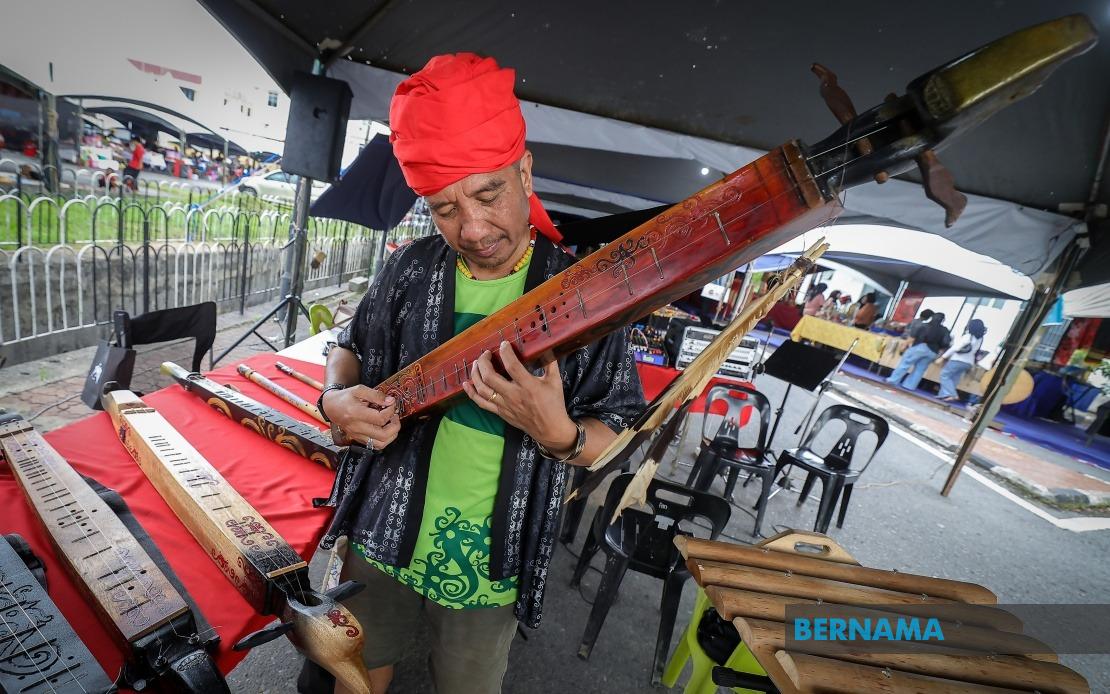
Sarawakian musician Rining Peter Paris has unveiled his latest musical endeavour, 'Sigar Suba', a carefully crafted composition that represents a deliberate shift in his artistic focus. Officially launched on July 1, this world music fusion single marks a significant moment in the ongoing cultural preservation efforts of the 53-year-old performer and his ensemble, Bata' Uduh. Rather than treading familiar ground, the release deliberately spotlights the cultural identity of Lun Bawang men—a demographic that has historically received less artistic attention compared to feminine-centred themes in traditional music.
The instrumentation of 'Sigar Suba' demonstrates Paris' commitment to authenticity whilst embracing contemporary production sensibilities. The composition prominently features the Tapi', a traditional two-string plucked instrument that occupies a place of considerable significance within Lun Bawang cultural expression. Complementing this centrepiece are other time-honoured instruments including the Pek Bu, Ruding, and xylophone, creating a sonic landscape that bridges generations. This instrumental diversity reflects a broader philosophy within the band about honouring ancestral sounds while remaining relevant to modern listeners.
Paris articulated a clear creative intention behind this departure from his earlier works. His previous recordings, including 'Busak Baku' and 'Busak Elai', had predominantly explored themes rooted in feminine aesthetics and natural imagery—compositions that celebrated ornamental beauty and environmental connection. However, Paris recognised a conspicuous gap in the musical landscape: the absence of meaningful artistic representation celebrating Lun Bawang male identity and masculine cultural expression. This observation prompted him to channel his songwriting towards rectifying what he perceived as an imbalance in cultural documentation through music.
The title itself carries embedded cultural meaning that functions as both artistic expression and educational statement. 'Sigar' references a traditional head covering worn during celebrations, whilst 'suba' denotes the colour red, combining to describe the distinctive crimson headpiece that Lun Bawang men proudly display during festive occasions such as the Irau Aco festival. By selecting this evocative title, Paris anchored his composition within tangible cultural symbols that younger audiences could readily identify and understand, transforming abstract concepts of heritage into concrete, visible markers of identity.
The lyrical content demonstrates meticulous attention to cultural detail and educational purpose. Composed entirely in the Lun Bawang language, 'Sigar Suba' functions simultaneously as artistic expression and ethnographic documentation. The verses systematically catalogue elements of traditional male attire and regalia: the kuyu talun—a garment fashioned from bark—the pelepet, a traditional machete integral to hunting and agricultural practices, and distinctive tusk ornaments that denote status and cultural affiliation. This granular approach transforms the song into a living repository of material culture, encoding practical knowledge within an artistic framework that ensures cultural transmission across generational lines.
Paris emphasises that the underlying motivation driving this project extends beyond mere artistic innovation. He conceptualises 'Sigar Suba' as a deliberately targeted message directed towards younger members of the Lun Bawang community, particularly young men who navigate increasingly globalised cultural environments. The song functions as a gentle but persistent reminder of ancestral identity, encouraging listeners to maintain connections with their heritage whilst navigating contemporary existence. This pedagogical dimension reflects a sophisticated understanding of how music can serve as a vehicle for cultural consciousness-raising, particularly within communities experiencing gradual cultural erosion.
Paris' broader mission transcends this single release, rooted instead in nearly a decade-long dedication to preserving the Tapi' instrument specifically. His personal investment extends beyond performance into actual instrument craftsmanship; functioning as both musician and luthier, Paris has handcrafted 66 Tapi' instruments that have found their way into homes across Malaysia, Australia, the United States, and Canada. This international distribution network demonstrates growing international interest in Southeast Asian indigenous instruments, though Paris remains primarily focused on domestic cultural preservation. Notably, prominent Malaysian experimental musician Belle Sisoski has also expressed interest in incorporating the Tapi' into contemporary musical explorations, suggesting the instrument's capacity to bridge traditional and avant-garde musical contexts.
Paris' approach to preserving traditional sound whilst ensuring contemporary relevance reveals sophisticated thinking about cultural sustainability. Rather than presenting Lun Bawang musical traditions as museum artefacts frozen in time, he actively integrates modern genres including reggae and fusion elements into Bata' Uduh's creative output. This deliberate hybridisation strategy acknowledges the reality that young audiences gravitate towards contemporary musical idioms, whilst the incorporation of traditional instruments ensures that ancestral sonic signatures remain audible within modern arrangements. The methodology sidesteps the false dichotomy between tradition and innovation, instead positioning them as complementary forces.
'Sigar Suba' now occupies prominent positions on major digital music streaming platforms, ensuring accessibility for the global Lun Bawang diaspora alongside curious listeners encountering the community's artistic expressions for the first time. This digital distribution represents a significant departure from historical patterns where such music existed primarily within community contexts, transmitted orally and experientially rather than through technological mediation. The democratisation of access through streaming platforms fundamentally expands the potential audience whilst simultaneously raising questions about cultural appropriation and respectful consumption.
Paris articulates ambitious long-term aspirations that extend beyond his current part-time engagement with music and instrument-making. He has established 2028 as a target date for transitioning towards full-time pursuit of Tapi' instrument construction and musical composition, suggesting confidence in the sustainable commercial viability of these traditionally-rooted practices. This timeline reflects realistic assessment of resource requirements and market development necessary to establish viable livelihoods centred on indigenous cultural production. Should Paris successfully achieve this transition, his example could provide an instructive model for other Southeast Asian cultural practitioners seeking to generate sustainable income from heritage-based artistic work.
The broader significance of 'Sigar Suba' extends beyond individual artistic achievement, touching upon contemporary discussions about indigenous cultural preservation across Southeast Asia. At a moment when globalisation pressures threaten linguistic and cultural continuity within minority communities, Paris' deliberate artistic choices—composing entirely in Lun Bawang language, foregrounding traditional instruments, documenting material cultural practices—constitute forms of cultural resistance and renewal. His work suggests that heritage preservation need not operate exclusively through academic or governmental frameworks; grassroots artistic innovation rooted in community identity can simultaneously serve aesthetic, educational, and preservation functions.

