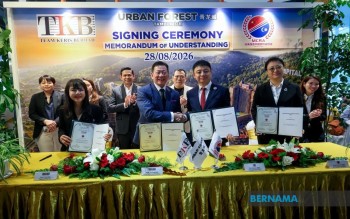
A transformative RM1 billion urban forest development in Tambun is positioned to reshape Perak's tourism landscape and establish the state as a competitive international destination rather than a domestic-focused region. The 84-acre project, spearheaded by Team Keris Bhd in partnership with RJJ Hotels and the Malaysian Chinese Restaurant Association, seeks completion within three years and promises to generate substantial economic momentum through complementary investments across tourism, hospitality, food and beverage, retail and commercial sectors.
The initiative addresses a fundamental gap in Perak's tourism infrastructure. Currently, the state has relied predominantly on domestic visitors and adjacent tourist attractions like the Lost World of Tambun. By introducing international-standard hotel services, curated dining experiences, and coordinated hospitality frameworks, the Tambun urban forest aims to position Ipoh and wider Perak as a destination worthy of extended stays by overseas travellers, rather than brief stopovers for visitors en route to other Malaysian destinations. This strategic pivot reflects recognition that sustainable tourism growth requires integrated experiences spanning accommodation, dining, transport, and cultural discovery rather than isolated attractions.
The food and beverage component represents a particularly innovative dimension. The development will dedicate 40 percent of F&B operators to Malaysian Chinese Restaurant Association members, with the remaining 60 percent comprising other Malaysian operators, creating a deliberately curated culinary landscape. This structure ensures visitors encounter authentic Malaysian dining rather than homogenised international chain offerings, a positioning that differentiates Perak from competitors across Southeast Asia. The emphasis on Malaysian food operators also directly supports local entrepreneurs and regional culinary traditions, anchoring the development to genuine community benefit beyond property development metrics.
Muslim-friendly dining provisions underscore sophisticated market positioning. By ensuring 30 percent of F&B offerings accommodate halal standards—including innovative menu items such as halal dim sum—the urban forest addresses diverse dietary requirements and expands addressable markets. This approach recognises that contemporary international tourism spans visitors from varied religious and cultural backgrounds, requiring hospitality infrastructure that respects these preferences without treating them as afterthoughts. The collaboration between RJJ Hotels and the Malaysian Chinese Restaurant Association on halal menu development demonstrates how traditional cuisines can adapt to broader accessibility requirements.
The hospitality infrastructure benefits substantially from RJJ Hotels' alignment with Jin Jiang Hotels, a global platform encompassing over 50 countries, more than 40 hotel brands, and 200 million members. This international distribution network transforms Tambun's appeal from a regional consideration into a globally marketed destination. Travellers booking through Jin Jiang's ecosystem encounter Ipoh and Perak as viable alternatives to more established Malaysian tourism corridors, addressing a persistent connectivity challenge where international visitors arriving in Kuala Lumpur or Penang frequently bypass Perak due to perceived inconvenience. By packaging comprehensive travel experiences—flights, accommodation, meals, and activities—as integrated offerings, RJJ Hotels removes the friction that historically deterred extended stays.
The extended-stay model carries particular significance for regional economics. Individual tourists spending one or two nights generate limited local expenditure compared to visitors remaining four or five days. Through coordinated accommodation, dining, and entertainment offerings, the urban forest encourages longer engagement with Perak's economy, multiplying spending across multiple F&B outlets, retail establishments, and service providers. This aligns visitor duration with economic benefit extraction, creating sustainable revenue streams for multiple stakeholders rather than concentrating returns among large hotel operators alone.
Supply chain development represents an often-overlooked but crucial dimension of the initiative. The Malaysian Chinese Restaurant Association's commitment to encouraging food ingredient manufacturers—particularly sauce and spice producers—to establish facilities in Perak creates backward-linkage employment and value addition. Rather than importing finished products, Perak could develop manufacturing capabilities for ingredients subsequently exported throughout Southeast Asia and beyond. This vertical integration positions the state not merely as a tourism consumption site but as a production centre for regional food commerce, generating employment across multiple skill levels from manufacturing through hospitality service delivery.
Malaysia's halal certification framework emerges as a strategic commercial asset. Products and restaurant concepts developed within Perak's urban forest ecosystem potentially scale across domestic and Southeast Asian markets capitalising on halal accreditation. This is particularly significant given halal markets spanning Muslim-majority nations, diaspora communities in Western markets, and increasingly health-conscious consumers globally prioritising halal standards. By developing brands and products in Perak that leverage halal certification as a competitive advantage, the state positions itself as a Southeast Asian hub for halal food innovation and production, with implications extending far beyond tourism into export-oriented manufacturing.
The training and skills development commitment articulated by the Malaysian Chinese Restaurant Association addresses workforce capacity constraints. International-standard hospitality requires service personnel trained to specific professionalism benchmarks, kitchen staff capable of executing contemporary culinary techniques, and management expertise in yield management and customer experience optimisation. By embedding skills development into the urban forest's operational framework, the initiative builds Perak's hospitality labour capacity, creating transferable expertise applicable across future tourism and hospitality projects throughout the state.
The development's positioning within Perak's existing tourism infrastructure demonstrates strategic complementarity. Rather than competing with the Lost World of Tambun and other established attractions, the urban forest functions as a supporting ecosystem that enhances their appeal by providing quality accommodation and dining options previously unavailable. Visitors attracted to Lost World facilities gain integrated hospitality alternatives, extending their stays and increasing aggregate spending. This multiplier effect benefits all tourism stakeholders, creating positive-sum outcomes rather than zero-sum competition.
Pearak's transformation from domestic-focused tourism destination to international competitor reflects broader Southeast Asian trends. Thailand, Vietnam, and Indonesia have successfully repositioned regional centres—not merely capitals—as destination-worthy locations through integrated tourism development combining cultural authenticity, culinary excellence, and international hospitality standards. Perak's urban forest initiative positions the state similarly, recognising that competitiveness increasingly depends on experiential quality, cultural distinctiveness, and seamless visitor journeys rather than proximity to major metropolitan centres.
The three-year development timeline positions completion around 2027, aligning with anticipated post-pandemic stabilisation of international tourism flows and potential cyclical demand increases. Successfully executing the project within this window could establish Perak as a preferred regional destination ahead of competitor states developing similar capabilities, capturing market share before saturation. The initiative's success metrics will extend beyond visitor numbers to encompass employment creation, small and medium enterprise development, skills advancement, and sustainable local economic value capture—outcomes determining whether transformational potential translates into tangible community benefit.

