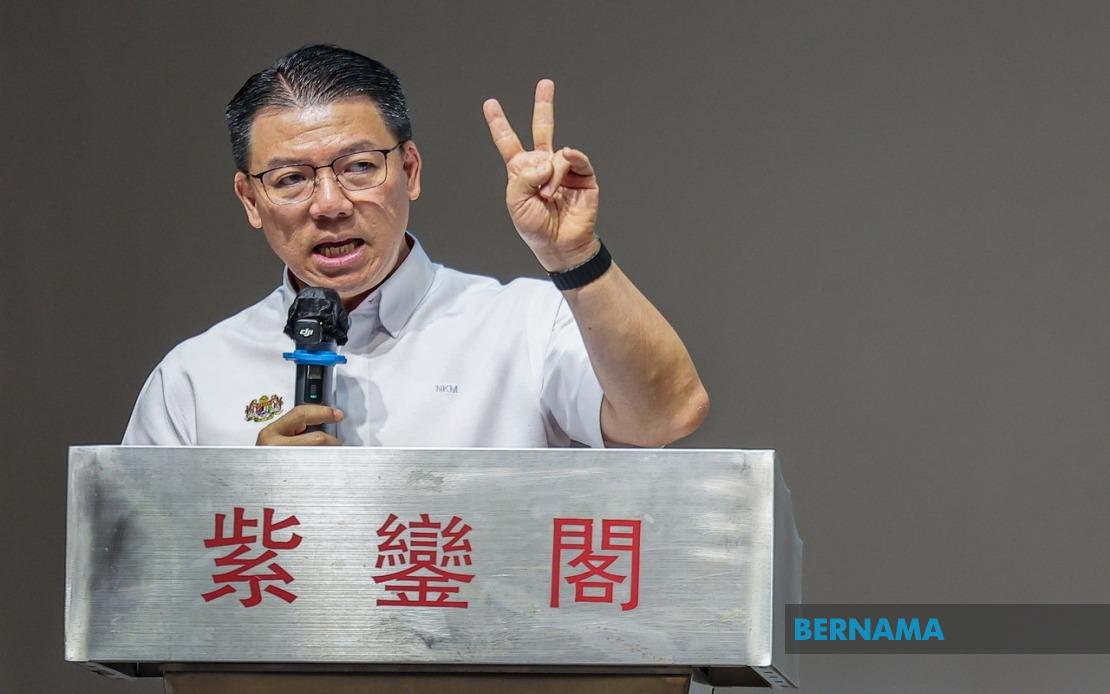
The Ministry of Housing and Local Government has committed RM200 million over four years beginning in 2023 to support the maintenance of non-Muslim houses of worship across Malaysia, according to an announcement by Minister Nga Kor Ming at an event in Kluang, Johor. The Non-Muslim Houses of Worship (RIBI) Maintenance Initiative represents what the government characterises as a tangible demonstration of its MADANI administration's pledge to treat all communities with equal consideration and respect, encompassing repair and upkeep work for churches, gurdwaras, Hindu temples, Buddhist temples, and other religious associations throughout the country.
The scale of community demand for such support appears to significantly exceed initial budget expectations. Since the programme's inception, the e-RIBI System has received 1,478 applications with a combined value exceeding RM279 million, suggesting that maintenance backlogs and upgrade requirements across Malaysia's diverse religious infrastructure remain substantial. This gap between available funds and requested assistance points to an ongoing infrastructure challenge affecting minority faith communities, where deferred maintenance and necessary improvements continue to accumulate faster than current resource allocation can address.
In Johor specifically, the state has received RM18.75 million in cumulative allocations between 2023 and May 2026, enabling support for 154 different institutions. During the ceremony in Kluang, Minister Nga announced an additional RM3.14 million specifically designated for 27 Johor RIBIs in the current year, with these funds directed toward renovation projects, structural maintenance, new construction initiatives, and emergency repairs designed to preserve the functionality and safety of these community spaces.
The minister framed the initiative within a broader political narrative about national cohesion and inclusive development. His statement emphasised that the MADANI government approaches nation-building without limiting consideration to ethnic or religious categories, instead seeking equitable benefit distribution across all communities to reinforce social unity. This messaging reflects a particular political positioning—one that highlights interfaith accommodation as a governmental responsibility and a foundation for economic and social stability.
Nga articulated a specific philosophical approach to governance, contrasting the building of bridges with the construction of walls, and promoting unity against division. He connected this abstract commitment to concrete economic outcomes, arguing that religious harmony creates conditions for currency strength, foreign investment attraction, and employment generation. This framing suggests the government views religious accommodation not merely as a moral imperative but as an economic and developmental necessity, a perspective that may resonate differently across Malaysia's various communities and political constituencies.
The diversity characterisation of Malaysia emerges as central to the minister's justification for the programme. Rather than diversity being presented as something to be managed or contained, it is positioned as an intrinsic national strength requiring active preservation and celebration. This rhetorical approach may be intended to counter domestic narratives that frame religious or ethnic pluralism as a problem requiring limitation rather than a feature warranting investment and support.
Transparency and accountability mechanisms are built into the programme's administration. The Ministry of Housing and Local Government has committed to continuous professional monitoring of approved projects, emphasising efficient and transparent resource deployment to ensure government allocations reach genuinely deserving organisations. This emphasis on oversight and verification may be responsive to historical concerns about fund allocation equity or implementation efficacy across religious communities.
For the Southeast Asian region more broadly, Malaysia's approach to institutionalising minority religious infrastructure maintenance offers a comparative case study in managing religious pluralism through government allocation mechanisms. While many regional nations navigate religious diversity through legal frameworks emphasising majority traditions, Malaysia's RIBI initiative represents a more explicitly accommodationist approach, allocating direct public resources to minority faith infrastructure. The programme's existence and scale thus reflect particular choices about how a Muslim-majority nation with constitutionally protected religious minorities structures its relationship to those communities.
The initiative also illustrates contemporary approaches to competitive politics in Malaysia. By visibly directing government resources toward minority religious communities, the MADANI administration signals responsiveness to non-Bumiputera populations and minority faith constituencies, potentially attempting to build or consolidate political support among these groups. The public ceremony in Kluang and the accompanying media attention amplify this signal, extending its reach beyond the immediate beneficiaries.
Implementation challenges remain implicit in the programme's structure. The significant gap between allocated funds and requested assistance suggests future political pressure to expand the budget. Additionally, ensuring that allocation decisions avoid perceptions of favouritism or political calculation—particularly in a context where religious matters attract considerable scrutiny—requires sustained administrative discipline and transparent decision-making processes.
Looking forward, the RIBI initiative's continuation and expansion may depend partly on broader political stability and continued government commitment to the MADANI framework. Should political priorities shift or administrative capacity for oversight prove inadequate, implementation could falter. The programme thus represents not merely a technical allocation of funds but a political investment in a particular vision of Malaysian multiculturalism.
For religious minority communities, the initiative provides concrete material support for infrastructure challenges that have accumulated over decades of limited government investment. The current four-year commitment, however, runs only until approximately 2027, leaving uncertainty about funding sustainability beyond that horizon. Religious organisations receiving support would likely benefit from advocacy for long-term programme guarantees, ensuring that infrastructure improvements do not depend on annual political negotiations or shifting administrative priorities.
The e-RIBI System's establishment as the application mechanism represents an effort to standardise and depoliticise allocation decisions through digital administration. Whether this system actually reduces discretionary decision-making or merely relocates it to the approval stage remains an empirical question requiring assessment of actual allocation patterns and community perceptions of fairness in the process.

