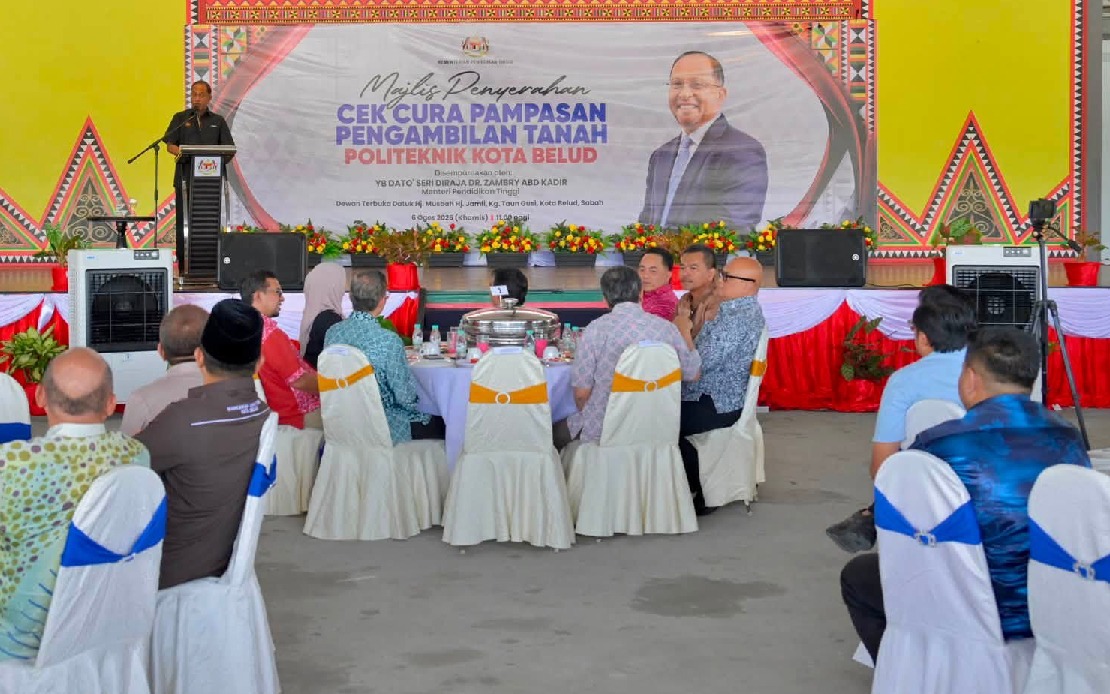
Malaysia's ambitious RM250 million polytechnic in Kota Belud has moved into active development following the formal completion of land acquisition, positioning the institution to welcome its first cohort of students by 2030. Higher Education Minister Datuk Seri Zambry Abd Kadir marked the milestone by overseeing a mock cheque presentation to affected landowners on Wednesday, effectively unlocking the construction phase of what officials describe as a transformative educational facility for East Malaysia's technical workforce pipeline. The timeline extends across the remainder of this decade, allowing adequate space for comprehensive design work, regulatory approvals, and phased construction before the doors open to learners seeking qualification in high-demand fields.
The institutional foundations for this polytechnic stretch back nearly a decade, originating from advocacy work initiated in 2017 when then-Kota Belud Member of Parliament Datuk Seri Abdul Rahman Dahlan first proposed the concept. That extended gestation period reflects the complexity of identifying suitable land, negotiating acquisition, securing budget allocation within federal development frameworks, and aligning the institution's academic direction with long-term economic priorities. The transition from abstract proposal to tangible ground-breaking represents a significant vindication of patient institutional planning, particularly for constituencies in the interior regions where access to quality technical education remains uneven.
Zambry emphasised that the polytechnic will embed itself within Sabah's emerging industrial landscape, deliberately structuring its curriculum around sectors shaping the state's economic future. The institution will prioritise four interconnected domains: renewable energy systems, artificial intelligence applications, computer science fundamentals, and technology-driven agricultural methodologies. This curriculum architecture reflects a strategic calculation that Sabah's competitive advantage increasingly depends on workers who can bridge traditional primary industries with contemporary technological frameworks. Rather than importing generic vocational training from peninsular templates, the polytechnic will calibrate its offerings to local contexts—whether that means agronomy students learning precision farming through sensors and data analytics, or energy technicians qualified to maintain and optimise solar installations and geothermal systems.
The institutional trajectory contemplates evolutionary growth in student numbers, beginning modestly and expanding systematically. Officials project an initial intake of approximately 500 students, a figure that acknowledges both the limited initial infrastructure and realistic demand assessment for the opening year. Over subsequent years, capacity will scale incrementally toward a target band of between 1,000 and 1,500 enrolments. This graduated expansion strategy allows the polytechnic to establish quality standards and faculty expertise before rapid scaling, avoiding the pitfalls of institutions that have grown too swiftly and compromised educational quality in the process. For Malaysian higher education policy, this measured approach reflects accumulated lessons about sustainable institutional development.
The broader policy context illuminates why this Sabah investment carries national significance. Malaysia's overarching development blueprint, the 13th Malaysia Plan, emphasises technical and vocational education as essential infrastructure for inclusive growth and productivity enhancement. The polytechnic system, distinct from university pathways, traditionally serves learners pursuing practical qualifications that feed directly into mid-level technical employment. By distributing polytechnic capacity more equitably across the federation, particularly in states where such facilities remain scarce, policymakers aim to reduce regional disparities in educational access and opportunity. Kota Belud's location in a predominantly agricultural district suggests the facility will particularly benefit students from rural backgrounds who might otherwise need to relocate to urban centres for comparable training.
The project's RM250 million investment underscores the substantial resource commitment that contemporary polytechnic infrastructure demands. The figure encompasses not merely classroom buildings but laboratories equipped for practical hands-on training in emerging technologies, computing facilities supporting AI and software development instruction, renewable energy demonstration systems allowing students to learn through experimentation with actual equipment, and agricultural research infrastructure supporting smart farming curricula. For Malaysian readers monitoring public expenditure, this investment merits examination as a test case for how effectively substantial capital allocation translates into institution-building that generates measurable economic returns through graduate employment and innovation contribution.
The implementation sequencing outlined by Zambry suggests the project will navigate through recognised development phases beginning immediately with detailed design work. The transition into what Malaysia's planning apparatus terms the Third Rolling Plan within the 13th Malaysia Plan framework indicates coordination with broader federal resource allocation cycles. This administrative alignment matters practically—it establishes budget certainty across multiple fiscal years and positions the polytechnic within established procurement and oversight mechanisms. For construction projects of this scale, such integration reduces the risk of funding disruptions or scope creep that have delayed other public infrastructure initiatives.
Sabah's positioning within Malaysia's educational geography makes this polytechnic development particularly consequential. The state has historically experienced constraints in accessing quality technical training relative to Peninsular Malaysia, partly reflecting infrastructure concentration in more densely populated regions. Establishing a well-resourced polytechnic in Kota Belud redistributes educational capacity in ways that should benefit not only that district but surrounding communities. The facility will likely attract students from across Sabah's interior regions where transportation constraints currently limit polytechnic access, potentially catalysing broader human capital development across the state.
The technological emphasis in the polytechnic's planned curriculum signals recognition that Sabah's economic future increasingly depends on knowledge-intensive sectors rather than resource extraction alone. Green energy development is accelerating across Southeast Asia as regional nations respond to climate imperatives and energy security considerations. Malaysia, possessing substantial solar and biomass potential, requires technicians capable of installing, maintaining, and optimising renewable systems. Similarly, artificial intelligence and computer science expertise has become strategically critical across all economic sectors—agricultural enterprises need data scientists to analyse farm productivity patterns, energy companies require software engineers to manage smart grid systems, and manufacturers increasingly depend on automation specialists. By training students in these integrated domains, the polytechnic positions Sabah's workforce to participate in these higher-value economic activities.
The mock cheque ceremony, while ceremonial in appearance, functionally represents the resolution of a critical administrative hurdle that frequently stalls public infrastructure projects in Malaysia. Land acquisition disputes, compensation negotiations, and title transfer complexities have historically delayed major facilities across the country. That Kota Belud cleared this stage suggests effective coordination between state authorities, federal agencies, and affected communities. For other proposed facilities facing similar challenges, the Kota Belud experience potentially demonstrates workable administrative pathways for expediting land issues without protracted litigation or political controversy.
Looking forward across the remainder of this decade, the Kota Belud polytechnic represents both immediate educational infrastructure expansion and longer-term institutional capacity-building for Malaysia's technical education system. The 2030 completion target aligns with broader national aspirations to enhance workforce readiness for economic transitions accelerating through digitalisation and green energy transitions. Success in establishing this facility and recruiting capable faculty will influence policymakers' confidence in extending similar polytechnic infrastructure to other underserved regions, potentially reshaping how Malaysia distributes technical education opportunities across its diverse geography.

