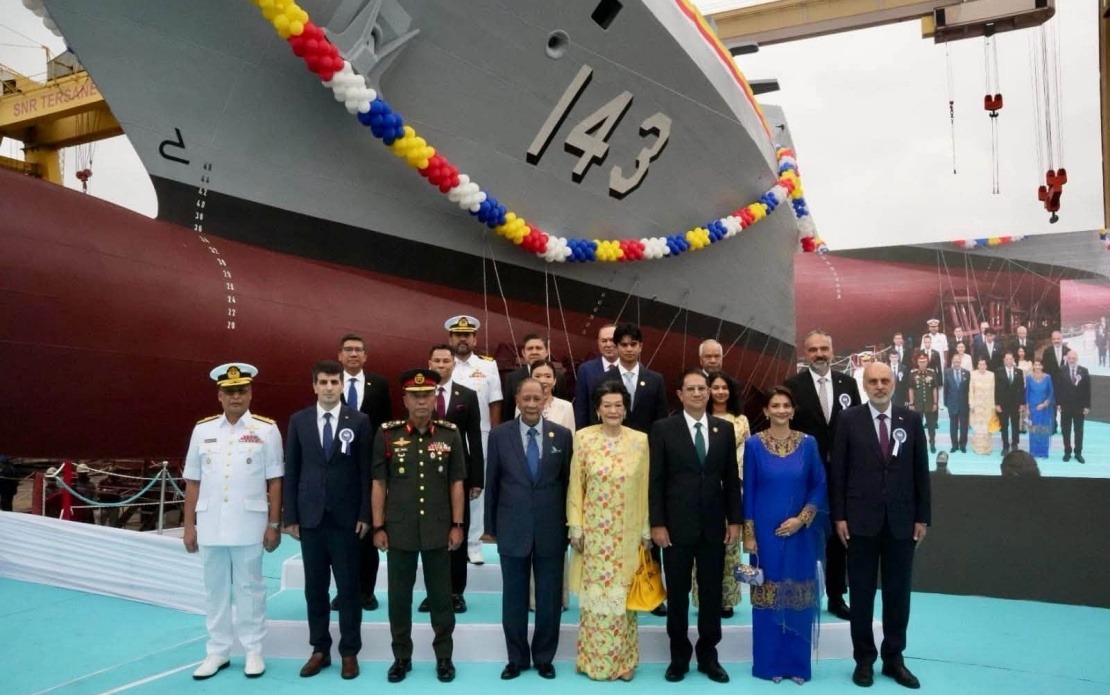
The government has reiterated its commitment to strengthening the Royal Malaysian Navy's operational capabilities through sustained investment in modern warships and advanced defence systems. Defence Minister Datuk Seri Mohamed Khaled Nordin made this statement during the ceremonial launch of the Tunku Osman Jewa, the third vessel in the Littoral Mission Ship Batch 2 programme, underscoring the strategic importance of maintaining a well-equipped maritime force in an increasingly contested regional environment.
The evolving nature of maritime security across Southeast Asia—encompassing territorial disputes, transnational piracy, human trafficking, and illegal fishing—demands that naval forces possess contemporary platforms and integrated capabilities. Malaysia's maritime domain extends across critical shipping lanes and economic zones, making naval modernisation not merely a defence procurement issue but an economic and national security imperative. The ongoing tensions in contested waters, combined with sophisticated maritime threats, have prompted regional navies to reassess their force structures and acquisition priorities.
The Littoral Mission Ship Batch 2 acquisition represents a watershed moment in Malaysia's defence partnerships, marking the first Government-to-Government collaboration between Kuala Lumpur and Ankara for the procurement of naval vessels. This partnership carries broader implications for Malaysia's strategic positioning in the region and its approach to defence diversification. Rather than relying exclusively on traditional defence suppliers from Western nations or the Asia-Pacific, the agreement signals Malaysia's willingness to deepen security ties with Turkey, a NATO member with substantial naval engineering capabilities and a growing defence export industry.
The three LMSB2 vessels, upon completion, will significantly enhance the RMN's capacity to conduct extended operations in Malaysia's Exclusive Economic Zone and beyond. These ships are specifically designed for littoral—or near-shore—operations, addressing the unique geographical and operational demands of Southeast Asian waters. Their modular design allows for various mission configurations, from anti-piracy and counter-trafficking operations to humanitarian assistance and disaster relief missions, providing the RMN with operational flexibility that older vessels cannot match.
The naming of the lead ship, Tunku Osman Jewa, honours the legacy of a distinguished military figure and member of the Kedah royal family, underscoring the deep connections between Malaysia's armed forces and the institution of constitutional monarchy. The presence of the Sultan of Kedah, Al Aminul Karim Sultan Sallehuddin Sultan Badlishah, and the Sultanah of Kedah, Sultanah Maliha Tengku Ariff, at the launching ceremony elevated the occasion beyond a routine military procurement event, reflecting its national significance and the symbolic importance attached to naval modernisation within Malaysia's defence framework.
The delivery schedule, with all three vessels expected to join the fleet by the end of 2027, aligns with the broader 15-to-5 Transformation Plan—an ambitious modernisation initiative designed to restructure the RMN into a leaner but significantly more capable force. This programme extends beyond mere ship acquisition; it encompasses integrated upgrades to command-and-control systems, personnel training, logistics infrastructure, and operational doctrine. The transformation represents a calculated shift from maintaining a large number of ageing vessels toward operating a smaller fleet of technologically advanced warships capable of sustained operations in contested maritime environments.
From a regional perspective, Malaysia's investment in naval modernisation carries implications for the balance of power in Southeast Asia. As Vietnam, the Philippines, Indonesia, and Singapore pursue comparable upgrade programmes, the collective enhancement of regional naval capabilities is reshaping the military balance. This modernisation trend reflects broader anxieties about freedom of navigation, resource security, and the maintenance of a rules-based maritime order in an era of great power competition between the United States and China.
The Turkish partnership also illustrates evolving defence industry dynamics. Turkish shipbuilders have emerged as competitive alternatives to traditional European and American suppliers, offering cost-effectiveness without apparent strings attached regarding operational autonomy. For Malaysia, this arrangement avoids some of the political sensitivities associated with defence procurement from Western nations, while simultaneously accessing modern military technology. The arrangement demonstrates how middle-power nations can leverage multiple security partnerships to advance national interests without excessive dependence on any single external actor.
The financial dimensions of the LMSB2 programme remain significant. Defence budgets across Southeast Asia have faced pressure from competing development priorities and the economic impacts of regional uncertainties. Malaysia's commitment to completing this acquisition, despite budgetary constraints, reflects a strategic determination to maintain credible naval deterrence and operational capacity. The staggered delivery schedule through 2027 provides some budgetary flexibility, allowing the government to distribute acquisition costs across multiple fiscal years while progressively retiring older vessels from service.
Looking forward, the successful integration of these Turkish-built vessels into the RMN will generate important lessons for future defence partnerships and procurement strategies. The experience will inform decisions regarding subsequent phases of fleet modernisation and the broader restructuring contemplated under the 15-to-5 Transformation Plan. Additionally, the operational experience gained from crewing and maintaining vessels of this particular design will contribute to the RMN's technical expertise and institutional capacity for managing advanced maritime platforms.
The Defence Minister's emphasis on sustained investment in modern capabilities reflects recognition that maritime security challenges in Southeast Asia are neither temporary nor susceptible to quick fixes. Maintaining naval relevance in an era of rapid technological change, evolving threat profiles, and resource constraints demands consistent long-term commitment. The LMSB2 acquisition, though substantial, represents only one component of a comprehensive defence modernisation strategy that must address doctrine, training, infrastructure, and personnel development alongside hardware procurement.

