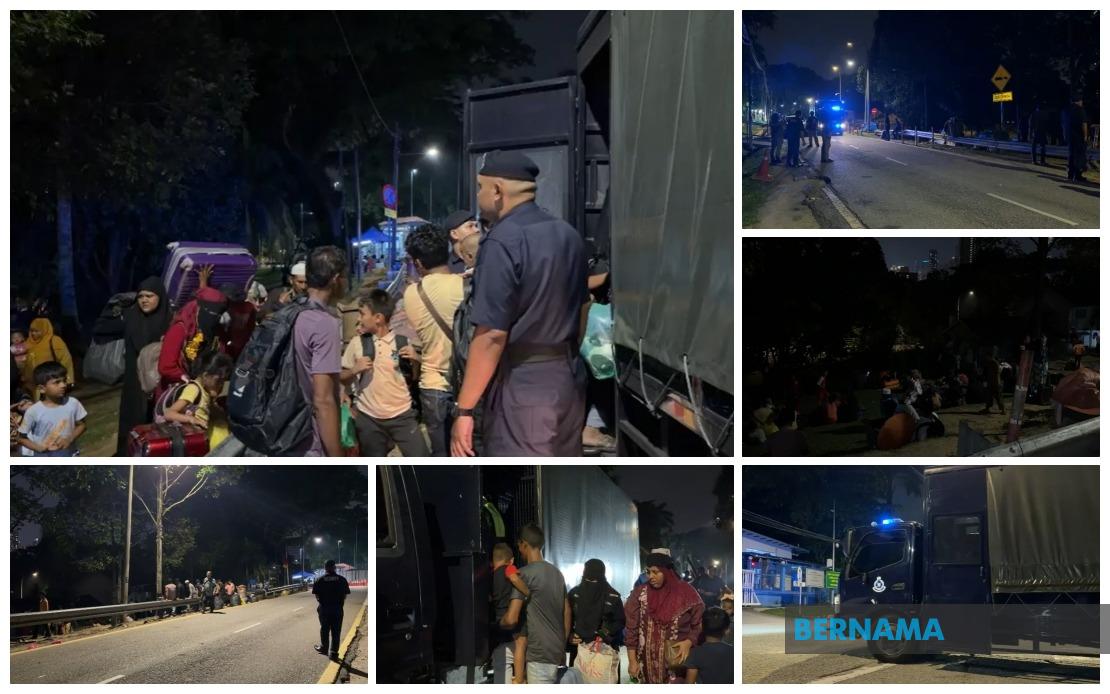
Authorities in Kuala Lumpur relocated several hundred Rohingya refugees from outside the United Nations High Commissioner for Refugees (UNHCR) office on Jalan Bukit Petaling to the Kuala Lumpur Police Contingent Headquarters on July 27 for systematic documentation and identity verification. Kuala Lumpur police chief Datuk Fadil Marsus confirmed the transfer took place in the evening, with operations commencing at 8.20 pm when the initial deployment of two police vehicles proved inadequate given the volume of refugees and their accompanying luggage.
The operation required four police trucks to accommodate all the individuals being relocated. According to field observations, many of the refugees carried substantial personal belongings, necessitating additional transport capacity. The systematic nature of the transfer suggested coordination between multiple government agencies preparing for the next phases of processing.
The refugees are understood to have arrived in Kuala Lumpur earlier that day on three buses after relocating from an established settlement in Penang. The concentration of so many individuals at the UNHCR office prompted swift government response, reflecting concerns about public order and the need to verify their legal status in Malaysia. The timing of their arrival and the subsequent gathering suggested coordinated movement, though circumstances surrounding their initial relocation from Penang remained unclear from official statements.
Once at police headquarters, the refugees underwent initial identity checks to establish their documentation status and refugee classification. The National Security Council (MKN) was expected to coordinate proceedings the following day to differentiate between individuals holding valid UNHCR documentation and those without recognized refugee credentials. This multi-stage verification process reflects Malaysia's approach to managing refugee populations and ensuring proper categorization of foreign nationals within its borders.
Government sources indicated that individuals carrying valid UNHCR cards would be assessed for suitable placement options, potentially within existing refugee support frameworks or resettlement pathways. Conversely, those unable to produce UNHCR documentation or who could not substantiate their legitimate refugee status faced different procedures. Such individuals would be transferred to the custody of the Immigration Department (JIM) and processed through the standard immigration system, eventually being sent to immigration detention facilities pending arrangements for repatriation to their countries of origin.
The situation prompted a firm policy statement from Prime Minister Datuk Seri Anwar Ibrahim, who declared that the government would not tolerate any refugee group that disturbed public order or attempted to claim control over areas within Malaysian territory. His remarks underscored the government's commitment to maintaining social stability while managing humanitarian concerns. The statement appeared designed to signal both resolve to the public and clarity to international observers regarding Malaysia's stance on refugee management.
The Prime Minister instructed enforcement agencies, including the Royal Malaysia Police, JIM, and local authorities, to apply rigorous enforcement measures against anyone breaching relevant laws. This directive expanded enforcement responsibility beyond immigration personnel to encompass broader law enforcement and municipal authorities, reflecting the multi-departmental nature of refugee and public order management in Malaysia. The emphasis on law enforcement suggested the government viewed the UNHCR office gathering as potentially crossing regulatory boundaries.
Malaysia's handling of refugee populations occurs within a complex regional and international context. As a non-signatory to the 1951 Refugee Convention, Malaysia operates outside the formal international refugee framework, instead treating most asylum seekers and refugees as illegal migrants subject to immigration law. This legal distinction shapes how authorities process individuals like the Rohingya, who despite their humanitarian status face potential deportation under Malaysian immigration procedures.
The Rohingya population in Malaysia has grown significantly over recent years, with many fleeing persecution in Myanmar and seeking sanctuary across Southeast Asia. Rohingya communities in Malaysian cities, particularly Kuala Lumpur, have become increasingly visible, creating tensions around resource allocation, employment competition, and social integration. The concentration of Rohingyas at the UNHCR office suggests frustration within the refugee community regarding their protracted situation and limited prospects for permanent resettlement or integration.
The incident also highlights the precarious nature of UNHCR operations in Malaysia, where the organization's limited mandate and lack of formal government partnership constrains its ability to provide comprehensive refugee protection and services. Gatherings at UNHCR offices often reflect broader community anxieties about documentation, resettlement prospects, and access to humanitarian assistance. The quick government response to disperse the gathering demonstrates official sensitivity to such concentrations of foreign nationals and concerns about unauthorized assemblies.
For Malaysian policymakers, the incident underscores ongoing tensions between humanitarian concerns and domestic security and stability considerations. The government's preference for processing refugees through police custody rather than direct UNHCR coordination reflects institutional approaches that prioritize law enforcement frameworks over humanitarian pathways. Moving forward, the outcome of the National Security Council's coordination effort will likely influence both refugee community confidence in official processes and broader regional perceptions of Malaysia's refugee management practices.
The situation carries implications for Southeast Asian approaches to refugee challenges more broadly, particularly regarding the Rohingya crisis. As one of the region's more developed economies with established refugee communities, Malaysia's policy responses are observed by other nations grappling with similar population movements. The emphasis on documentation verification and the distinction between recognized and unrecognized refugee status reflects broader regional trends toward stricter immigration controls and security-focused approaches to refugee management.

