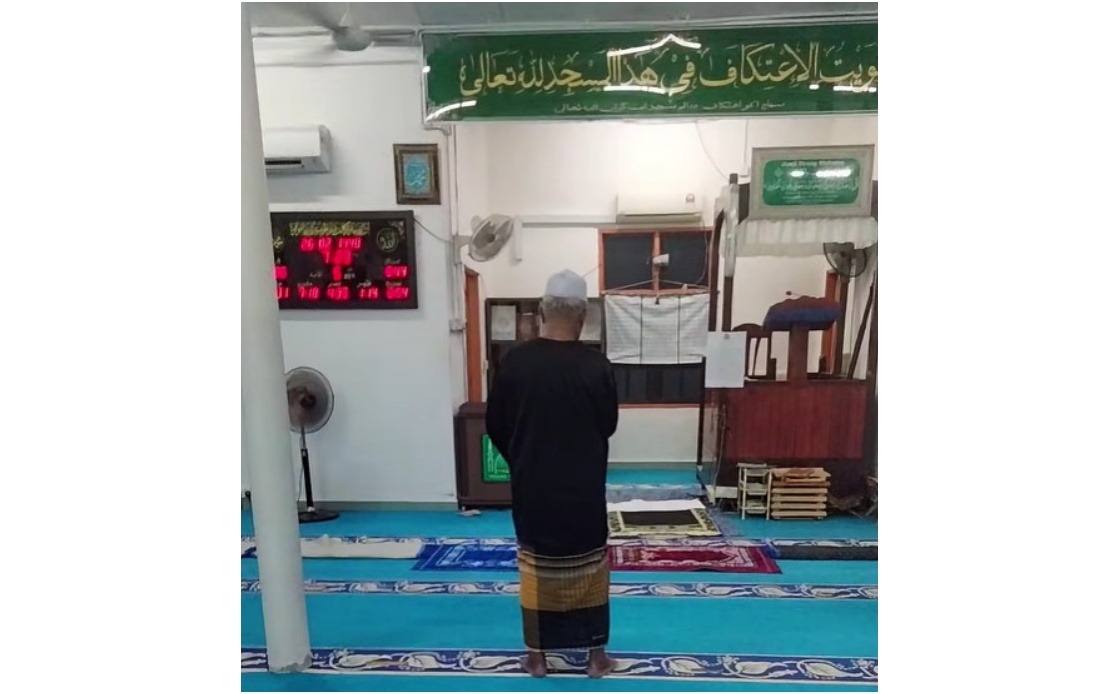
A brief video that surfaced on social media platforms in recent weeks has put a rural mosque in Mersing's spotlight, capturing a single worshipper conducting prayers and simultaneously fulfilling the roles of imam and bilal—the person who leads congregational calls to prayer. The 15-second clip, which spread across Facebook and WhatsApp, prompted questions about the viability and management of Masjid Tanjung Resang, a facility that serves a dispersed and declining local population. Yet the controversy has revealed deeper questions about how rural religious institutions adapt to demographic shifts and what constitutes meaningful community engagement in less densely populated areas.
Mersing Member of Parliament Muhammad Islahuddin Abas, who himself resides in the village, acknowledged the factors underlying the viral moment while defending the mosque's operational standing. The crux of the challenge, he explained, lies in the village's demographic composition: although physical houses dot the landscape, many residents have relocated for employment elsewhere, leaving behind a skeleton population. This pattern mirrors broader rural-to-urban migration trends across Malaysia, where young people and working-age adults increasingly move to cities and industrial hubs, hollowing out traditional communities. The resulting low density of residents means that the congregation naturally contracts, particularly during times when individuals are away for work or have permanently left the area for economic opportunities.
Despite these headwinds, Muhammad Islahuddin emphasised that the mosque maintains its weekly programming and religious activities without interruption. The institution continues to host religious lectures, recitations of the Quran's Yasin chapter, and other devotional gatherings that anchor the community's spiritual life. The mosque's management has demonstrated commitment to sustaining these functions even as the congregation fluctuates. When the local MP received screenshots of the viral video through a WhatsApp conversation with a friend based in Kuala Lumpur, he expressed surprise at the attention the brief clip had generated, yet recognised that the controversy carried an unexpected positive dimension.
Muhammad Islahuddin reframed the viral moment as a form of inadvertent marketing for Masjid Tanjung Resang. The mosque's physical setting—positioned off the main road and somewhat removed from easy visibility—had previously rendered it obscure even to residents of the surrounding district. Many people, he noted, were simply unaware the facility existed. The viral video, in unintentionally raising awareness, introduced the mosque to an audience far beyond Mersing, generating precisely the kind of public recognition the institution might have otherwise struggled to achieve through conventional means. This observation points to a paradox of social media: negative attention can sometimes produce beneficial outcomes through expanded visibility.
Beyond its primary religious function, the mosque serves a broader community purpose within the local landscape. Muhammad Islahuddin highlighted its role as a visitor-friendly facility that welcomes individuals from all backgrounds, including non-Muslims. The location's proximity to Gunung Arong, a hiking destination that attracts outdoor enthusiasts from across the region, positions the mosque as a natural checkpoint and rest facility for trekkers. The institution provides amenities and hospitality to these visitors, effectively functioning as part of the area's broader infrastructure for tourism and recreation. This multipurpose dimension adds layers of significance beyond traditional congregational worship, anchoring the mosque within a network of community services that extend to outsiders and transient populations.
Abdul Syamil Abdul Fadzil, the mosque's chairman, moved swiftly to address the controversy when representatives from the Johor Islamic Religious Affairs Department (JAINJ) made enquiries following the video's circulation. He clarified that the footage captured a noja—an assistant—performing voluntary prayers in solitude, a misrepresentation of the mosque's actual operational state. The video's snapshot, he insisted, bore little resemblance to the mosque's regular functioning, which encompasses diverse religious activities held consistently throughout the week. His intervention underscores the importance of institutional response and clarification in the age of viral content, where brief, decontextualised clips can rapidly shape public perception regardless of their representativeness.
The incident illuminates the particular challenges facing rural religious institutions in Malaysia's contemporary demographic landscape. As rural populations shrink and age, mosques designed to serve larger congregations must adapt their operational models and self-narratives. The sparse congregation at Masjid Tanjung Resang reflects not mismanagement or religious decline but rather the inexorable demographic pressures reshaping Malaysia's countryside. Religious authorities, village leaders, and congregational representatives must navigate the tension between maintaining traditions built around larger communities and acknowledging present realities. The mosque's ability to pivot toward serving non-congregational functions—hosting hikers, welcoming visitors, and remaining spiritually active through alternative programming—suggests strategies for sustaining rural religious infrastructure despite population challenges.
The controversy also speaks to the role of social media in amplifying and potentially distorting perceptions of rural Malaysia. A single frame of video, divorced from context, can generate widespread misinterpretation about the state of community institutions. Muhammad Islahuddin and Abdul Syamil's responses reflect an emerging necessity for religious and civil leaders to engage proactively with online discourse, countering misleading narratives with explanatory context. The willingness of the Johor Islamic Religious Affairs Department to investigate and ultimately accept the mosque chairman's explanation demonstrates how institutional mechanisms can verify ground realities and protect vulnerable institutions from reputational harm based on incomplete information.
Looking forward, Masjid Tanjung Resang exemplifies how rural mosques must innovate within constraints. The facility's openness to visitors, its integration with local tourism infrastructure, and its commitment to sustained religious programming despite population pressures represent adaptive strategies. The viral episode, rather than exposing fundamental failure, has inadvertently showcased the institution's resilience and multifaceted role within the community. For Southeast Asian readers observing similar demographic transitions in their own regions, the Mersing mosque offers a case study in how traditional institutions navigate change while maintaining spiritual and social relevance in evolving contexts.

