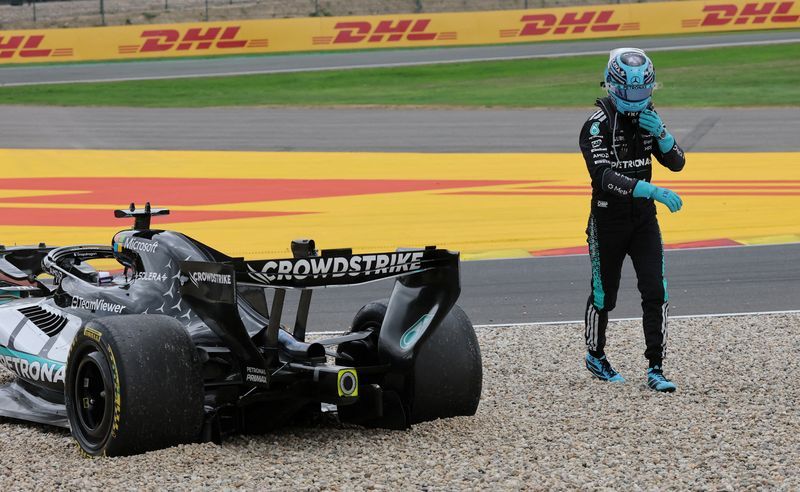
George Russell's title challenge suffered another setback at the Belgian Grand Prix on Sunday when the Mercedes driver crashed out during the opening lap at Spa-Francorchamps, colliding with Ferrari's Lewis Hamilton in a costly encounter that left him frustrated with both technical failures and racing circumstances. The incident, which unfolded on a track known for dramatic overtaking moments, marked yet another frustrating result for Russell as he attempts to mount a serious challenge in the championship standings against his Mercedes teammate.
Russell had qualified well, securing third position on the grid heading into the race, but his afternoon unravelled almost immediately once the lights went out. After making a strong start to the first corner, the British driver found himself in the unfortunate position of having his race compromised by a cascade of technical failures that undermined his competitive position. The battery system that powers the hybrid element of the modern Formula One power unit refused to recharge properly exiting Turn One, a critical moment that set off a chain reaction of problems.
The technical malfunction left Russell severely compromised through the high-speed sections of the circuit. He exited the opening corner with only 35 per cent battery remaining when he should have had full charge, and the system refused to recover as he progressed through the lap. The turbo element of the power unit failed to respond correctly, compounding the electrical issue and depriving him of the power delivery expected from a competitive Mercedes engine. By the time he reached the notorious Eau Rouge corner complex, Russell was running on empty battery reserves—a zero per cent reading that he later described as genuinely dangerous given the speeds involved at that portion of the track.
This sudden loss of performance advantage meant Russell was quickly surrounded and overtaken by faster cars around him. The driver who had shown competitive pace throughout qualifying suddenly found himself swallowed up by three competitors, a situation that would have tested any driver's composure. Rather than maintaining his third-place position, he found himself pushed back down the order and struggling to control his machinery. The frustration for Russell clearly stemmed not from the inevitable consequences of mechanical failure, but from the position that failure placed him in, vulnerable and exposed in the middle of the pack when he should have remained competitive.
Contending with his car's deteriorating condition, Russell attempted to recover lost ground by making an aggressive move alongside Hamilton, the Ferrari driver and his former Mercedes teammate. The two collided as they battled for position, with Russell's car spinning off into the gravel trap and beaching itself in the process. Hamilton continued in the race under the safety car that was deployed in response to Russell's stranded vehicle. Though stewards investigated the incident and assessed blame through a five-second penalty for Hamilton, Russell's view of the episode was more nuanced. He acknowledged that Hamilton bore greater responsibility for the collision but stressed that the Ferrari driver had not acted recklessly, characterizing the contact as a racing incident born from the proximity and intensity of their battle.
Russell's resignation to his fate reflected the mounting toll of a difficult season in terms of results and points finishes. The British driver has now gone three consecutive races without scoring championship points, a statistic that places him increasingly in arrears as he chases down the championship leader. His response to yet another failure—expressed as being "numb to the disappointment"—suggests a driver psychologically bracing himself against repeated setbacks. When asked about the outcome, he noted with a weary tone that when misfortune strikes with such regularity, the sting eventually dulls into something more manageable.
The championship battle itself has taken on a particular complexion with Kimi Antonelli emerging as the dominant force. The Mercedes driver who started from pole position at Spa has built a commanding lead, now sitting 25 points clear of Russell in the standings after nine rounds of the 22-race campaign. Antonelli has secured six victories this season, establishing himself as the clear favourite for the championship, while Russell struggles to maintain relevance in the title conversation. The contrast is particularly stark given that both drivers represent the same team, yet their fortunes have diverged sharply.
Russell's technical complaints about power delivery on the straights had been flagged since Saturday's qualifying session, indicating that these issues were not sudden failures but rather persistent problems that the team has struggled to resolve. The fact that such fundamental reliability concerns were not addressed overnight raises questions about Mercedes' technical direction and their ability to fix issues between sessions. In a sport where marginal gains determine outcomes, a malfunctioning battery system that drains at crucial moments is a significant disadvantage that no amount of driver skill can overcome.
The incident at Spa serves as a microcosm of Russell's season so far—a combination of mechanical unreliability and racing circumstances conspiring to keep him off the podium. While he demonstrated the speed and racecraft to compete on the opening lap, he lacked the reliable machinery to deliver a result. The collision with Hamilton, while frustrating, pales in comparison to the underlying mechanical problems that placed him in that vulnerable position in the first place. For Malaysian and Southeast Asian Formula One enthusiasts following Russell's campaign, the message is clear: without resolution of these persistent technical issues, his championship aspirations will continue to slip away regardless of qualifying performance or racing ability.
Mercedes faces an urgent engineering challenge to restore reliability and performance parity with competitors before the championship deficit becomes insurmountable. Russell's stoicism in the face of repeated disappointments suggests patience wearing thin, and the team must act decisively to prevent further deterioration in their competitive position during the middle stages of the season.

